Solar Quotes in Baulkham Hills
Comparing solar quotes in Baulkham Hills NSW 2153? Check equipment, installation extras, installer credentials, warranties and aftercare before you sign.
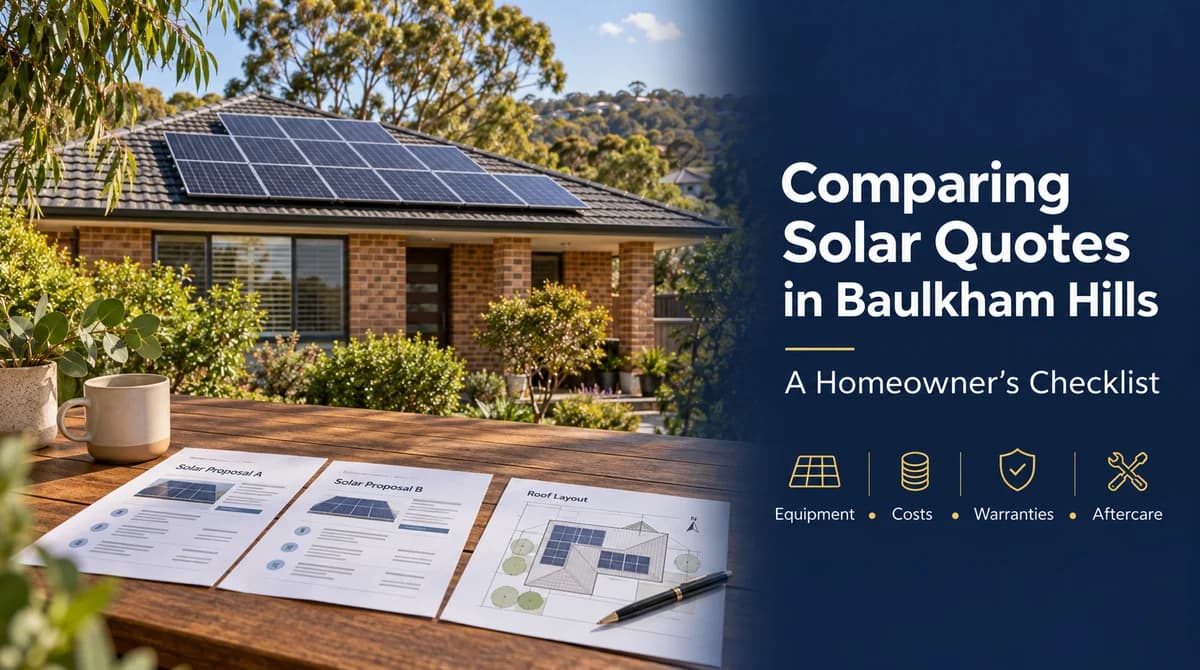
Comparing Solar Quotes in Baulkham Hills: A Homeowner’s Checklist
Comparing solar quotes for your home in Baulkham Hills NSW 2153? Start with the exact equipment, proposed roof layout, total installed cost and support included. Two offers advertised as the same system size can deliver different outcomes.
The most useful question is: What will I receive for this price, and how well does it suit my property?
This checklist helps you compare proposals, identify missing costs and ask better questions before choosing an installer. If you are still exploring system options, start with Kratos Energy’s residential solar solutions.
Solar quote comparison: what to check first
Put each proposal beside the others and complete these checks. Mark anything missing as “confirmation required” rather than assuming it is included.
Item | What your quote should identify |
|---|---|
Panels | Manufacturer, exact model, quantity and total capacity |
Inverter | Model, rated output and proposed location |
Roof design | Panel positions and shading assessment |
Installation scope | Included work and separately charged extras |
Connection | Application responsibilities and export assumptions |
Savings | Generation estimate, tariffs and consumption assumptions |
Credentials | Contractor details and nominated installer |
Warranties | Separate equipment and workmanship terms |
Aftercare | Fault-reporting contact and service arrangements |
Price | Final payable amount, incentive deductions and payment terms |
The Australian Government’s solar retailer and installer guide recommends obtaining at least three quotes and asking for a site visit. This helps uncover issues that can change the installation cost. If you want a quicker route for Baulkham Hills, this is the link https://kratos-energy.com/solar/nsw/baulkham-hills
Why the property matters in Baulkham Hills
According to the 2021 ABS Census for Baulkham Hills, 75.4% of occupied private dwellings were separate houses, while 13.3% were townhouses, terraces or similar dwellings and 11.3% were flats or apartments.
That mix matters when requesting quotes. A proposal for a detached home should not simply be reused for a townhouse with a different roof arrangement or an apartment with shared infrastructure.
For your Baulkham Hills property, explain whether the installation involves a standalone house, shared roof, existing solar system or planned renovation. Where ownership or roof access is shared, clarify permissions before treating the proposed layout as final.
Ask which planning checks are included
NSW provides exempt and complying development pathways for qualifying solar installations, but eligibility depends on the applicable conditions. Ask who will check your property and whether any approval work is included. The NSW Planning Portal’s solar energy systems guidance explains the relevant pathways.
Confirm the connection for your actual address
Give each supplier the same electricity bill and installation address. Your distributor is identified under the faults and emergencies information on your bill; it is the network operator, which may differ from your electricity retailer.
Ask each supplier to confirm the connection requirements for that address and installation date. A postcode is a starting point, not a network approval.
1. Compare actual panel capacity and inverter output
Check the calculation behind the advertised system size:
Panel quantity × panel wattage ÷ 1,000 = total panel capacity in kW.
For example, 15 × 440W panels = 6.6kW. This is an illustrative configuration, not a Kratos package specification.
The inverter has a separate output rating. A 6.6kW panel array with a 5kW inverter can be a valid design; the difference alone does not indicate a problem. The Australian Government’s system-sizing guide explains panel capacity, inverter sizing and network limits.
For each offer, record both ratings. Then ask why that combination was selected for your household. This makes a comparison more useful than matching package labels alone.
Check exact models
“Premium panels” leaves too much unspecified. Record the complete model numbers, and ask for written approval before any substitution.
The Clean Energy Council’s approved product lists cover panels, inverters and batteries. Product listings can change, so ask the installer to confirm the proposed equipment remains eligible for the installation and any claimed incentive. A listed product still needs a suitable system design.
2. Make excluded costs visible
Request a clear answer on switchboard work, difficult roof access, additional cabling, metering arrangements and removal of existing equipment, where relevant. These are questions to resolve for your home, not a prediction that every installation will incur these charges.
Ask the supplier to divide the price into included work, fixed-price extras and work still awaiting inspection. A quote with unresolved extras is not yet a reliable final-cost comparison.
Example: the lower headline price costs more
The following figures are invented solely to demonstrate comparison arithmetic. They are not Baulkham Hills market prices or Kratos offers. Assume the equipment, warranties, tax and incentive treatment are otherwise identical.
Cost item | Quote A | Quote B |
|---|---|---|
Advertised price | A$5,000 | A$5,700 |
Required electrical work | A$600 extra | Included |
Required access equipment | A$300 extra | Included |
Comparable total | A$5,900 | A$5,700 |
Quote A initially looks A$700 cheaper. Once the same work is included, Quote B costs A$200 less.
The lesson is to compare the completed installation price. Equipment quality and service still need their own assessment.
3. Separate accreditation from electrical licensing
Ask for the nominated installer’s name and Solar Accreditation Australia number, then use the SAA accreditation checker to verify their status.
Separately, check the relevant NSW electrical contractor licence through Service NSW’s licence-checking service. Solar accreditation and an electrical licence answer different questions.
Record the legal business name on the contract as well. If the seller uses subcontractors, ask who handles installation queries, rectification and warranty claims. You should be able to identify the responsible business without being passed between sales and installation teams.
4. Compare savings using the same assumptions
A larger savings figure is only persuasive when you understand its calculation.
Give every supplier the same recent bills and, where available, interval consumption data. Request a comparison using the same electricity tariff, feed-in tariff and household-use pattern.
Also ask whether the forecast includes the proposed export limit. Inverter capacity and permitted grid exports are different quantities. A system’s financial model should reflect the connection it can actually obtain.
For your own comparison, label each forecast “current household” or “future household”. An estimate assuming daytime EV charging should not be compared directly with one based on your present electricity use. Ask suppliers to model both scenarios separately if an EV or other substantial load is planned.
5. Read the warranties separately
A prominent “25-year warranty” does not explain the cover for every part of the installation.
Warranty | What to establish |
|---|---|
Panel product | Cover for panel defects and exclusions |
Panel performance | Guaranteed output retention and claim conditions |
Inverter product | Cover period and replacement terms |
Workmanship | Cover for installation-related faults |
Battery, if included | Capacity-retention, cycle or throughput conditions |
Ask who pays for diagnosis, call-outs, freight, removal and reinstallation. A replacement component and the labour needed to fit it may have different terms.
The Australian Government’s warranty guide distinguishes these warranties and explains that they sit alongside Australian Consumer Law rights.
Keep the actual warranty documents with your quote. Comparing those documents is more informative than comparing the largest number printed in a brochure.
6. Turn “aftercare” into a clear service commitment
Ask how support will work at your Baulkham Hills address:
Which phone number or email should you use for a fault?
Who can arrange an on-site visit to postcode 2153?
Is monitoring checked by the supplier, or must you report alerts?
Are there ongoing monitoring or service fees?
What handover documents and app access will you receive?
An app alone does not tell you who will investigate a problem. Request a written explanation of the support process.
When assessing experience, look for documented work and customer feedback that explains what was installed and how issues were handled. You can view Kratos Energy’s project portfolio to explore its published work and ask which examples are most relevant to your proposed system.
7. Check the final contract and payment basis
Before signing, request the cash price including GST, an itemised explanation of incentive deductions, and the deposit and payment schedule. If finance is offered, compare the total amount payable, fees and conditions with the cash price.
Also clarify what happens if inspection or network approval changes the design, equipment becomes unavailable, or installation is delayed. Have agreed changes recorded before proceeding.
These questions reflect the NETCC guide to installing solar, which covers quotes, contracts, payment options and handover.
Frequently asked questions
How many solar quotes should I get in Baulkham Hills?
Why do quotes for the same system size vary?
Should I choose the cheapest solar quote?
Does a 25-year panel warranty cover the whole system?
What should I send when requesting a quote for postcode 2153?
Request a solar quote for your Baulkham Hills home
A useful proposal should leave you knowing what will be installed, what you will pay and who will support it.
Request a tailored solar quote from Kratos Energy. Include Baulkham Hills NSW 2153, your recent electricity bills and any existing solar details, and ask for a proposal you can assess against this checklist.
Solar System Packages
Tier 1 panels & CEC accredited installation.
- Trina 475W or Jinko panels
- 5kW power inverter
- 14 × 475W panels
- Single-phase compatible
- Trina 475W or Jinko panels
- 8–10kW power inverter
- 21 × 475W panels
- Battery & EV ready
- Trina 475W or Jinko panels
- 10kW power inverter
- 27 × 475W panels
- Three-phase compatible