

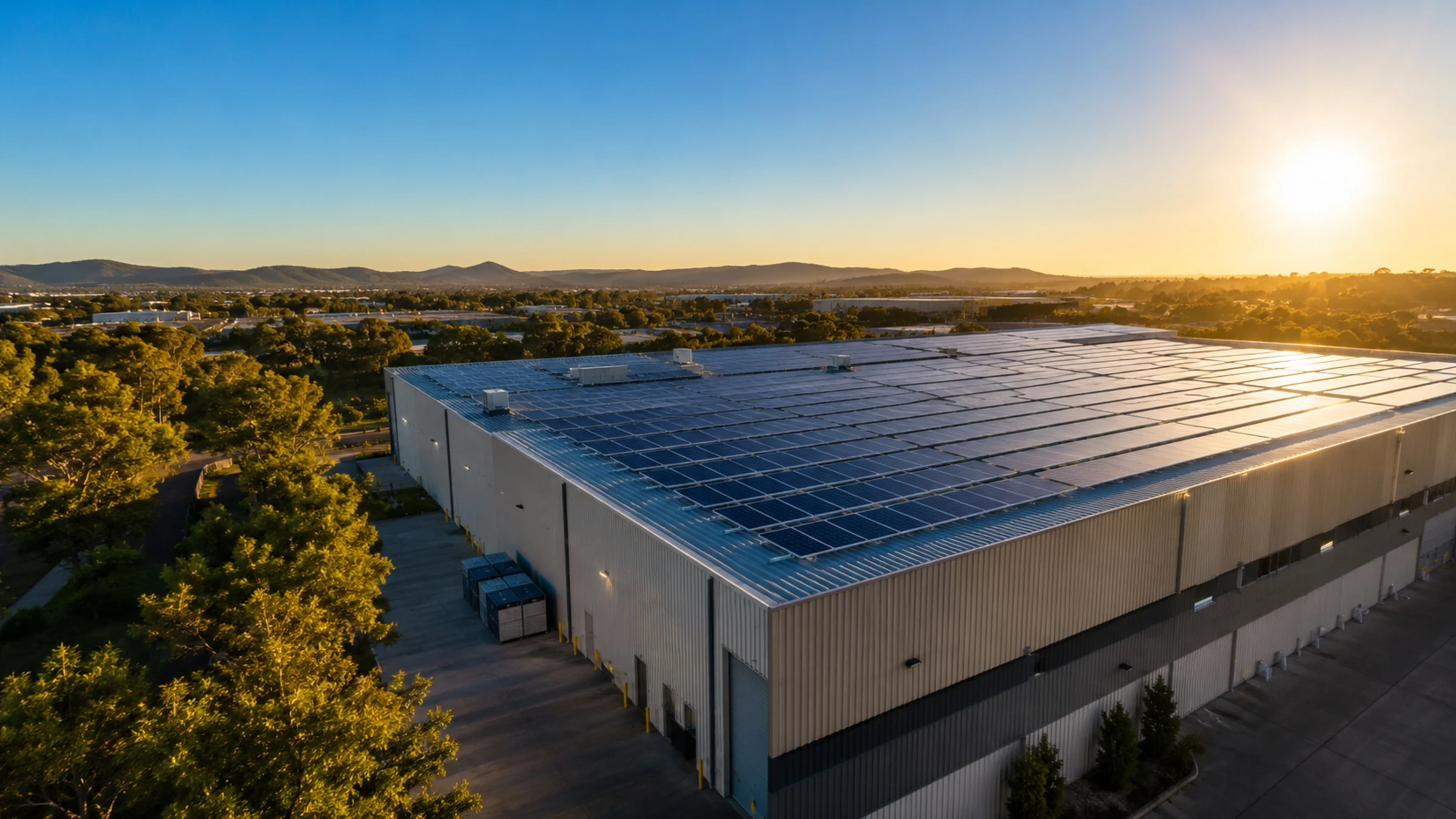
Commercial solar installation that cuts operating costs.
Solar sized to the hours your business actually runs. From 30kW rooftops to 100kW and beyond — modelled on your interval data, with the network application, certificates and ongoing monitoring handled.
What we provide for your business
Interval-data sizing
We size from your half-hourly meter data, tariff and roof — so the system matches the hours your site actually runs.
Three-phase & multi-inverter
Commercial systems are three-phase and usually split across more than one inverter, engineered for the switchboard you have.
Savings modelling you can check
Projected self-consumption, export and bill savings, with the assumptions written down so your accountant or board can test them.
Certificates & finance
The STC discount applied up front where eligible, and finance or power purchase options where outright purchase does not suit.
Monitoring & maintenance
Commercial monitoring, fault alerts and scheduled maintenance, so a tripped inverter is found in a day rather than at the next bill.
Network & compliance
We prepare and lodge the network connection application, coordinate any technical requirements, and handle the compliance paperwork.
How commercial solar installation differs from a home system
The panels are the same kind. Almost everything around them is different: the data you size from, the tariff you save against, who owns the roof, what the network asks for, and how the system is looked after once it is running.
The load runs with the sun
Most businesses use most of their power in daylight hours, so a well-sized system is consumed on site rather than exported. That changes the economics completely compared with a home that is empty all day.
The tariff is more complicated
Business tariffs can include time-of-use energy rates and demand charges, and larger sites often have negotiated contracts. The saving depends on which parts of the bill solar actually touches.
The project has more parties
A landlord, a network engineer, sometimes a council, and an accountant who wants the assumptions in writing. Our job is to make each of those conversations short.
Sizing from interval data, not the annual bill
An annual kWh total says how much power you buy. It says nothing about when — and for a business, when is the whole case.
Getting your interval data
Most business sites have an interval or smart meter that records usage in short intervals through the day. Your retailer or network can provide that data on request using the NMI on your bill, and with your written consent we can request it for you. Twelve months is the goal, so both seasons and any shutdown periods show up.
What we look for in it
- The daytime base load on a normal weekday — the floor the system should sit under
- Weekends, public holidays and shutdowns, when generation may be exported
- Seasonal swings: refrigeration and cooling in summer, heating and short days in winter
- When the monthly peak happens, and whether the sun is up at that time
Demand charges, honestly
A demand charge bills you for your highest usage over a short interval in the charging window, so one bad interval can set the charge for the month. Solar trims it only when that peak lands in strong sun. A peak at 5pm, or on an overcast day, is untouched.
So we model demand savings from your actual peaks and, where they do not line up with generation, say so. Sometimes load scheduling or a battery is the better tool for that part of the bill.
Self-consumption is the economics
Every kWh you use on site avoids your full energy rate. Every kWh you export earns a feed-in rate that is usually a small fraction of it — on the NSW residential benchmarks we model with, about 5c against 32c, and business rates differ. A system sized just under your daytime base load is consumed almost entirely, which is why a smaller system can pay back faster than a bigger one.
| System | Average daily output | Suits | Modelled savings* |
|---|---|---|---|
| 30kW | ~114kWh | Low–medium commercial energy use | ~$9,800 a year |
| 50kW | ~190kWh | Standard commercial & industrial | ~$16,500 a year |
| 100kW | ~380kWh | Large commercial applications | ~$33,000 a year |
*Estimate only — not a quote. Savings assume most generation is used on site; yours depend on your load, tariff and roof. Systems are priced per site after a site review.
Landlord and tenant: who installs, who pays, who benefits
For a business that rents its premises, the first question is not the roof's orientation — it is whose roof it is. A tenant cannot install on it alone. There are three workable paths.
The owner installs
The landlord pays for the system and recovers it through rent or outgoings, or by selling the power to the tenant. It keeps the asset with the building, which suits long tenancies and multi-tenant sites where one system serves common loads.
The tenant installs
The tenant pays and takes the savings, with roof access written into the lease. The lease should cover maintenance access, insurance, roof repairs, and what happens to the system at the end of the term — removal, transfer or sale to the owner.
A third party installs
Under a power purchase agreement, a provider owns the system and sells the power to the occupant at an agreed rate. It needs the owner’s consent and a term that fits the lease, so read the length, escalation and exit terms closely.
Whichever path you are on, we can prepare the technical case and the savings model for the other party, and quote the landlord directly. Lease terms are a matter for your lawyer; the system details they will ask about are ours.
Network connection and the certificate rules
Two sets of rules shape a commercial project before a panel is ordered: what the network will let you connect, and which certificate scheme the system falls under.
Network connection assessment
Every system needs the distribution network’s permission before it is connected. A larger system is assessed individually: the network looks at the local network’s capacity and can set export limits, require export control, or ask for protection settings and other technical changes. The bigger the system relative to the local network, the more detail it asks for and the longer it takes.
Because the answer can change the design — a tight export limit makes a smaller system the better buy — we lodge early and design to the outcome. Planning approval is a separate question: depending on the site and its zoning, a commercial system can need one, and we check before quoting.
STCs up to 100kW, and the new mid-scale rules
Solar systems up to 100kW are small-scale under the Small-scale Renewable Energy Scheme and create STCs up front, with a deeming period that falls each year until the scheme ends in 2030. Connected systems behind one meter point count together toward that limit.
From 1 October 2026, the Clean Energy Regulator extended STC eligibility to solar systems from 100kW to 1MW, with a fixed five-year deeming period. A mid-scale system can take STCs or create REGO certificates instead, but not both for the deeming period. Applications for mid-scale STCs open in mid to late November 2026.
| System | Certificates | Approximate discount* |
|---|---|---|
| 30kW | 207 STCs | $7,866 |
| 50kW | 345 STCs | $13,110 |
| 100kW | 691 STCs | $26,258 |
*Estimate only, at an assumed certificate price of $38ex-GST. The real value depends on the certificate market on the day and on your postcode’s zone.
Roof structure, switchboard and access
On a commercial project these three decide more of the price than the panels do.
Roof structure
A large array adds load across a whole roof, and low-pitch metal roofs often need tilt frames, which add wind load. We check the structure, the sheeting condition and the remaining roof life — there is little point fixing panels to a roof due for replacement.
Main switchboard
Older main switchboards may need modification, or a new section, to take the solar supply and the protection the network asks for. We inspect it early, because this is the line item most likely to move.
Access and trading
Crane or scaffold access, working-at-height controls, and a planned switchboard shutdown. We schedule around trading hours and keep the shutdown as short as the work allows.
Finance, tax and looking after the system
How you pay for a system and how it is looked after once it is running both decide what it actually earns.
Paying for it
Outright purchase gives the best long-run return when cash allows. Finance spreads the cost so repayments can sit near the bill saving. A power purchase agreement avoids the capital cost entirely, in exchange for a share of the saving. Our finance page covers the options we offer.
On tax: depreciation and any incentives depend on your structure and the rules in force when you install, so that is a question for your accountant. We do not give tax advice, but we provide the itemised costs and asset details they will need.
Monitoring and O&M
A commercial system without monitoring fails silently — an inverter trips, a string drops out, and nobody notices until the next bill. Our commercial systems include live monitoring with alerts, and the 100kW system is SCADA-ready.
Maintenance covers inspection of panels, fixings and cabling, electrical testing, inverter checks and cleaning where dust, birds or salt build up. Workmanship on our standard commercial systems carries a 10-yearwarranty, and panels and inverters carry their manufacturers’ product and performance warranties.
From interval data to commissioning
The sequence we follow on a commercial project. The early stages are where a marginal project gets caught, which costs everyone less than finding it late.
- 1
Data and site review
Twelve months of interval data, a copy of your tariff, roof plans or photos, the main switchboard, and who owns the roof. This is where we tell you if the project is marginal.
- 2
Feasibility and design
A layout, a generation model, a self-consumption estimate against your load, structural checks on the roof, and the switchboard and protection changes the design needs.
- 3
Proposal
Named equipment, an itemised price, the certificate treatment, the assumptions behind the savings figure, and the finance or purchase options that suit the site.
- 4
Approvals
The network connection application, and any planning approval the site and its zoning call for. These run before equipment is ordered, because their answers can change the design.
- 5
Installation
Scheduled around trading hours, with the switchboard shutdown planned in advance and kept short. Licensed electricians, accredited installers and site safety documentation in place.
- 6
Commissioning and O&M
Testing, compliance certificates, network sign-off, monitoring set up with alerts, and a maintenance schedule agreed at handover.
Commercial systems
Standard commercial configurations for offices, warehouses and industrial sites. Choose a size to see the full spec, or talk to us about a custom multi-inverter design.
Cut overheads for cafés, clinics and small warehouses.
- Tier 1 solar modules
- 15kW + 15kW inverters
- 72 × 415W panels
Predictable, lower energy costs for warehouses and factories.
- Tier 1 solar modules
- 30kW + 20kW inverters
- 120 × 415W panels
Our largest standard system — serious offset for serious sites.
- Tier 1 solar modules
- 50kW + 50kW inverters
- 240 × 415W panels
Commercial solar in NSW suburbs
Each of these pages deals with the kind of business premises found locally. For the full list of areas, see solar installation across NSW.
Commercial solar installation questions
How much does commercial solar installation cost?
What size commercial solar system does my business need?
Do commercial systems get the STC discount?
We lease our premises. Can we still install solar?
Will solar reduce our demand charges?
How long does the network approval take for a commercial system?
Can we claim a tax deduction or depreciation?
What maintenance does a commercial system need?
Rules checked against Clean Energy Regulator and NSW Government sources, October 2026. Figures are estimates, not quotes.
Commercial solar guides
- Commercial Solar Assessment Liverpool NSW
- Warehouse Solar South West Sydney: 2026 Commercial Guide
- Solar for Shoalhaven Accommodation Businesses: 2026 Guide
- Why Commercial Solar Is a Strategic Necessity for NSW Businesses
- 5 Financial Reasons Businesses Are Investing in Commercial Solar
- Commercial Solar for NSW Businesses: Cutting Operating Costs
See the 30kW, 50kW and 100kW packages, inspect our 50kW commercial solar & 48kWh battery installation in Chester Hill, or for a home, read about residential solar installation.
Get your free solar quote in under 2 minutes.
Tell us a little about your place and we’ll tailor the numbers. Everything in the list below is included, no exceptions.