
Solar for Shoalhaven Accommodation Businesses: 2026 Guide
Own accommodation in Shoalhaven NSW? Learn how seasonal occupancy, pools, hot water, guest loads, roof ownership and monitoring affect commercial solar design.
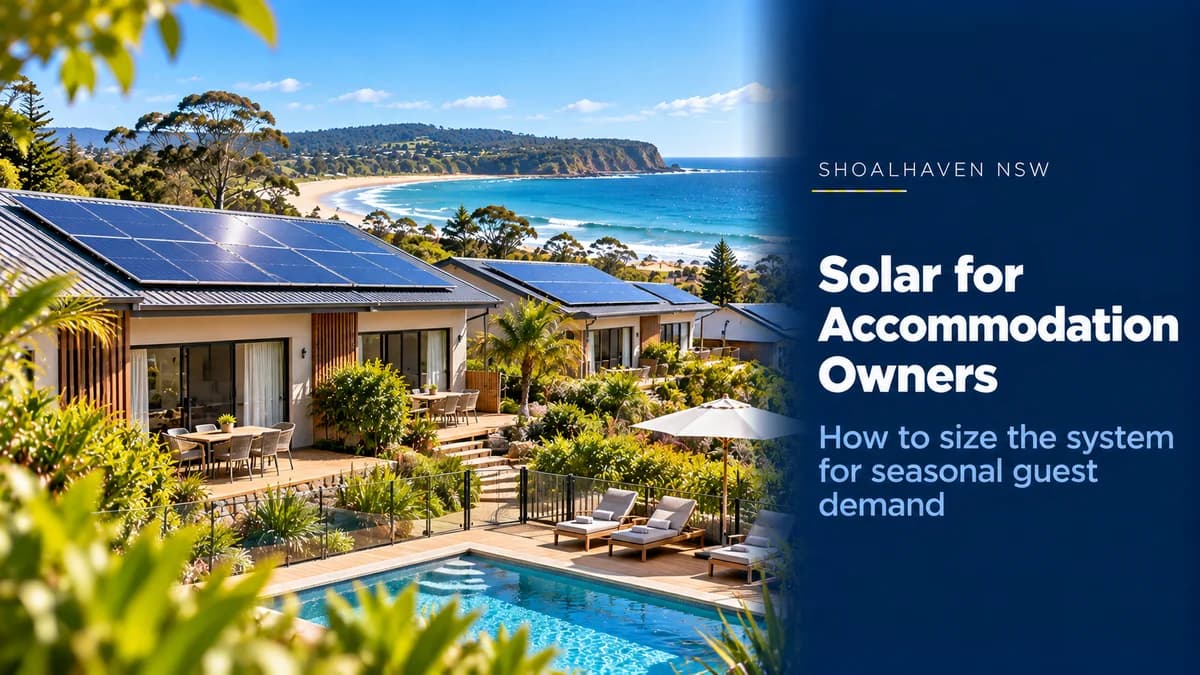
Solar for Shoalhaven Accommodation Owners: How Should You Size the System?
For accommodation businesses in Shoalhaven NSW, solar should not be sized from roof space alone.
See solar in the Shoalhaven for the region. Huskisson covers accommodation and hospitality businesses, and we also have local pages for Vincentia and Sanctuary Point.
Hotels, motels, holiday villas, short-stay properties and resorts can have electricity profiles that change dramatically between:
Summer and winter
Weekdays and weekends
School holidays and quieter periods
Full occupancy and vacant periods
A property may have heavy electricity consumption during Christmas and summer holidays, then operate at significantly lower occupancy for parts of the year.
That creates an important solar-design question:
Should the system be sized around peak occupancy—or around the property's year-round electricity profile?
In most cases, the stronger approach is to analyse:
annual electricity consumption + seasonal occupancy + permanent common-area loads + daytime demand + future energy requirements.
The Australian Government similarly recommends that businesses choose solar according to how much electricity they use, when they use it, available sunny roof space and budget, rather than simply maximising panel capacity.
Explore Kratos commercial solar systems
Why Solar Is Relevant to Shoalhaven Accommodation
Tourism is a significant part of the Shoalhaven economy, and accommodation demand is highly seasonal.
Shoalhaven City Council's 2026 travel guidance reports that accommodation occupancy across the region can peak at approximately 80% between Christmas and New Year. The figure is based on regional Localis accommodation data and should not be interpreted as the occupancy rate of every individual property.
That seasonal pattern matters for solar.
An accommodation property operating near capacity in January may have heavy loads from:
Air conditioning
Hot water
Guest rooms
Laundry
Pool filtration
Commercial kitchens
Refrigeration
The same property may use considerably less electricity during a quieter month.
A solar proposal should therefore reflect the full year, not only the property's busiest electricity bill.
Accommodation Solar: Quick Assessment Checklist
Information | Why It Matters |
12 months of electricity bills | Reveals seasonal energy variation |
Interval meter data | Shows when electricity is consumed |
Occupancy records | Links guest numbers with energy use |
Common-area loads | Reveals electricity used even when rooms are empty |
Pool and spa equipment | Often creates substantial daytime demand |
Hot-water system | Can be a major accommodation load |
Laundry | Often operates during solar-production hours |
Roof ownership | Important for leased or strata properties |
Future EV charging | Can increase productive daytime solar use |
Monitoring | Helps remotely track system performance |
For commercial businesses, Australian Government guidance recommends using interval meter data where available because it gives a more accurate picture of solar-system sizing and savings.
1. Start With Seasonal Occupancy
An accommodation business should ideally compare electricity consumption with booking or occupancy data.
For example:
Peak Summer
Occupancy: 90%
Major loads:
Air conditioning
Hot water
Laundry
Pool
Kitchen
Guest appliances
Shoulder Season
Occupancy: 55%
Some guest loads decrease while common-area electricity continues.
Quiet Period
Occupancy: 25%
Guest consumption falls substantially, but refrigeration, security, Wi-Fi and other permanent loads remain.
This information allows the solar designer to determine whether the system will still be productive outside the peak holiday season.
Why Peak Occupancy Alone Can Oversize Solar
Consider a hypothetical Shoalhaven accommodation property.
Peak-season electricity use
75kWh/day
Off-season electricity use
30kWh/day
Designing solar purely around the 75kWh peak could create substantial exports for much of the year.
That is not automatically a poor design—especially where future demand is expected—but the financial model should show:
summer self-consumption + winter self-consumption + annual exports
rather than assuming the property operates at peak occupancy all year.
The goal is to find a system that performs effectively across the whole operating cycle.
2. Separate Guest Loads From Common-Area Loads
One of the most useful steps is separating electricity consumption into:
Occupancy-Dependent Loads
These increase as guest numbers rise.
Examples include:
Guest-room air conditioning
Hot water
Cooking
Room lighting
Hair dryers
Guest appliances
Permanent or Common-Area Loads
These may continue regardless of occupancy.
Examples include:
Reception
Security systems
Wi-Fi
Refrigeration
Outdoor lighting
Pool pumps
Water pumps
Common ventilation
This distinction matters because common-area loads can create reliable year-round solar self-consumption.
Pool Equipment Can Work Particularly Well With Solar
Accommodation properties with pools can have significant filtration demand.
The advantage is that pool equipment can often operate during the day.
Consider a hypothetical pool pump using:
2kW for 6 hours
Daily consumption:
12kWh
If most of that operation occurs between late morning and afternoon, rooftop solar may supply a meaningful portion directly.
This can be preferable to:
exporting solar during the day → running pool equipment overnight from the grid.
Where operationally practical, controllable equipment should be scheduled around solar-generation hours.
3. Hot Water Can Be a Major Accommodation Load
Guest accommodation can use substantial energy for hot water.
Usage may come from:
Showers
Bathrooms
Kitchens
Laundry
Cleaning
Spa facilities
The ideal solar strategy depends on the hot-water system.
Where compatible equipment allows it, some water heating can potentially occur during strong solar-production periods.
For accommodation properties, this may turn hot water into a useful daytime energy load rather than concentrating all heating overnight.
Before changing operating schedules, however, the owner should consider:
Equipment type
Hot-water storage
Guest demand
Controlled-load tariffs
Hygiene-temperature requirements
Manufacturer instructions
4. Laundry Is Another Solar-Friendly Load
Accommodation operators frequently run:
Washing machines
Commercial dryers
Linen equipment
between guest departures and new check-ins.
This often occurs during daylight hours.
For example:
10 AM–3 PM
can overlap well with rooftop solar production.
A motel or villa complex with significant laundry demand may therefore achieve stronger solar self-consumption than a property outsourcing all linen services.
The solar designer should understand how the business actually operates, not simply the number of guest rooms.
5. Air Conditioning Can Drive Peak Summer Demand
Summer accommodation occupancy and air-conditioning usage often rise at the same time.
This can create a useful solar match because the strongest cooling demand frequently occurs during daylight hours when panels are producing.
Suppose:
Solar production at 2 PM:
20kW
Property electricity demand:
18kW
Much of the solar can potentially be consumed onsite.
But later:
Solar production at 9 PM:
0kW
Property demand:
15kW
That electricity must come from the grid or battery storage.
This demonstrates why interval data is much more valuable than looking only at total monthly kWh.
6. Do Not Ignore Off-Season Base Load
Even when no guests are staying, an accommodation property rarely drops to zero consumption.
Possible base loads include:
Refrigerators
Freezers
Routers
Booking/security equipment
Pool filtration
Water pumps
Hot-water standby
Emergency lighting
CCTV
Suppose an empty property consistently uses:
10kWh/day
That base consumption provides useful year-round demand for solar.
Measuring it prevents the solar designer from incorrectly assuming the property consumes almost nothing when rooms are vacant.
Worked Example: Small Shoalhaven Accommodation Property
Consider a hypothetical property containing:
8 holiday villas
plus:
Swimming pool
Shared laundry
Reception
Outdoor lighting
This is an illustrative model only.
Peak Summer
Property consumption:
60kWh/day
Shoulder Season
Property consumption:
40kWh/day
Low Occupancy
Property consumption:
25kWh/day
Rather than choosing a system using the 60kWh peak alone, the installer should examine:
Annual kWh consumption
Daytime load profile
Solar-generation estimate
Expected self-consumption
Expected exports
The strongest system may be one that offsets a large share of the consistent daytime base load, while providing additional generation when occupancy rises.
7. Should Accommodation Businesses Aim for High Self-Consumption?
Generally, yes.
The Australian Government's business solar guidance notes that for businesses with high electricity use, its SunSPOT modelling may suggest the largest system that still allows approximately 80% of generation to be self-consumed, where practical.
This is not a rule requiring every accommodation business to achieve 80%.
Instead, it highlights an important principle:
Solar used onsite can be more valuable than solar exported.
For a Shoalhaven accommodation operator, this means the proposal should clearly estimate:
Annual generation
Solar used onsite
Solar exported
Grid electricity remaining
Do not judge the proposal only from system kW.
8. Should You Install a Battery?
Possibly—but battery storage should follow the load analysis.
A battery deserves investigation where the property:
Exports substantial solar during the day
Has heavy evening guest demand
Operates year-round
Requires backup for important loads
Wants greater solar self-consumption
For example:
Daytime surplus
25kWh
Evening guest demand
20kWh
That profile may create a useful storage opportunity.
But consider another property:
Daytime surplus
25kWh
Off-season evening demand
5kWh
A large battery may regularly be under-used during quieter periods.
Battery capacity should therefore be designed around seasonal as well as peak usage.
Blackout Backup Needs a Separate Assessment
Accommodation businesses may want backup for:
Reception
Wi-Fi
Security
Refrigeration
Emergency lighting
Critical water pumps
Backing up these essential circuits is very different from attempting to run:
Every room air conditioner
Commercial kitchen
Pool equipment
Electric hot water
through a blackout.
Battery quotes should clearly state:
usable kWh + continuous backup kW + circuits included.
Do not assume a large battery automatically means whole-property backup.
9. Roof Ownership Must Be Confirmed Early
Some accommodation businesses operate from buildings they do not own.
Others may operate within:
Strata properties
Managed complexes
Leased commercial premises
Multiple separately titled villas
Before committing to solar, establish:
Who owns the roof?
Who pays the electricity bill?
Who pays for solar?
Who receives the savings?
Who owns the equipment?
Who handles maintenance?
What happens if the operator leaves?
Australian Government business-solar guidance specifically notes that rented and multi-occupancy premises require additional consideration before installing solar.
The technical design should not proceed without a workable ownership arrangement.
10. One Roof or Multiple Buildings?
Shoalhaven accommodation can take many forms.
A traditional motel may have:
One large continuous roof.
A holiday-villa complex may have:
Eight or ten small separate roofs.
A caravan park may have:
Reception + amenities + cabins + shared facilities.
That changes solar design significantly.
The assessment needs to determine:
Where electricity meters are located
Which buildings share electrical infrastructure
Which roofs are productive
How cabling can be routed
Where inverters can be installed
Whether several smaller arrays or one central system is preferable
Total roof area alone does not answer these questions.
11. Remote Monitoring Is Especially Useful for Accommodation Owners
Solar monitoring can be valuable for any business, but it can be particularly useful where owners or managers are not physically onsite every day.
A monitoring platform can help track:
Daily solar production
Historical generation
Inverter status
Alerts
Consumption, where compatible metering is installed
Grid exports/imports
Kratos states that its systems include Wi-Fi monitoring and that many system issues can be investigated remotely through its support service.
View Kratos monitoring and support information
A fault discovered through monitoring after one day is much less costly than one discovered through an unusually high electricity bill months later.
12. EV Charging Can Become a Guest Amenity
Accommodation operators should also consider whether guest EV charging may become part of the property.
EV chargers can increase electricity demand, but daytime charging may also create productive solar self-consumption.
For example:
Guest vehicle charging:
7kW
Available surplus solar:
6kW
A smart charging system may be able to use much of that available rooftop generation.
For a property planning future EV infrastructure, the solar designer should consider the load before finalising system capacity and switchboard requirements.
13. Shoalhaven Is Within Endeavour Energy's Network
Endeavour Energy identifies Shoalhaven among the local government areas within its electricity distribution network.
That means a grid-connected accommodation solar system still requires appropriate network connection assessment.
The installer should confirm:
Existing electrical supply
Single- or three-phase configuration
Inverter capacity
Network application
Export arrangement
Metering changes
Roof capacity is only one part of the project.
14. Should You Install 10kW, 30kW or More?
There is no universal “accommodation solar system size.”
A small short-stay property may operate electrically much like a large home.
A motel or resort may require commercial-scale solar.
Kratos currently offers commercial systems from approximately 30kW through 100kW+, with system design based on load profile, tariff and available roof or ground space.
A useful starting framework is:
Property Type | Solar Approach |
Single holiday house | Residential-size assessment |
Small villa complex | Custom residential/commercial assessment |
Motel | Commercial load modelling |
Resort | Larger customised commercial system |
Caravan/holiday park | Multi-building site assessment |
System category should follow actual electricity demand and site configuration, not the word used to describe the accommodation business.
What Data Should Accommodation Owners Provide?
For a strong solar proposal, prepare:
Electricity Data
12 months of electricity bills
Smart-meter interval data
Demand charges where applicable
Occupancy Data
Monthly occupancy percentage
Seasonal peaks
Weekend vs weekday patterns
Property Loads
Air conditioning
Hot water
Pool/spa
Laundry
Kitchens
Refrigeration
EV charging
Property Information
Roof ownership
Building layout
Roof condition
Meter locations
Existing solar
Future Plans
Additional rooms
EV chargers
Battery storage
Pool/spa expansion
Electrification
Combining electricity data with occupancy data makes the system-sizing process far more useful.
Frequently Asked Questions
Is solar suitable for accommodation businesses in Shoalhaven?
Does seasonal occupancy make solar less worthwhile?
How busy is Shoalhaven accommodation during summer?
What electricity data should an accommodation business provide?
Are pool pumps useful for solar self-consumption?
Does an accommodation property need a battery?
Can a leased motel install solar?
Which electricity distributor covers Shoalhaven?
Solar for Shoalhaven Accommodation Owners: The Bottom Line
For a Shoalhaven accommodation business, the strongest solar design should follow:
Electricity data → occupancy pattern → common-area loads → daytime consumption → roof ownership → network connection → future demand.
Do not size solar only from the busiest Christmas week.
Do not size it only from total roof area.
And do not automatically add a battery simply because the property operates at night.
Instead, identify the electricity loads that remain consistent throughout the year and determine how much solar the business can productively use during daylight hours.
For accommodation owners, particularly those operating seasonally, that produces a much more realistic solar investment.
Explore Kratos commercial solar solutions
Contact Kratos Energy for a site-specific assessment
For accommodation solar, the right system is not the one designed for your busiest week—it is the one that performs efficiently across the entire operating year.
Solar System Packages
Tier 1 panels & CEC accredited installation.
- Trina 475W or Jinko panels
- 5kW power inverter
- 14 × 475W panels
- Single-phase compatible
- Trina 475W or Jinko panels
- 8–10kW power inverter
- 21 × 475W panels
- Battery & EV ready
- Trina 475W or Jinko panels
- 10kW power inverter
- 27 × 475W panels
- Three-phase compatible