

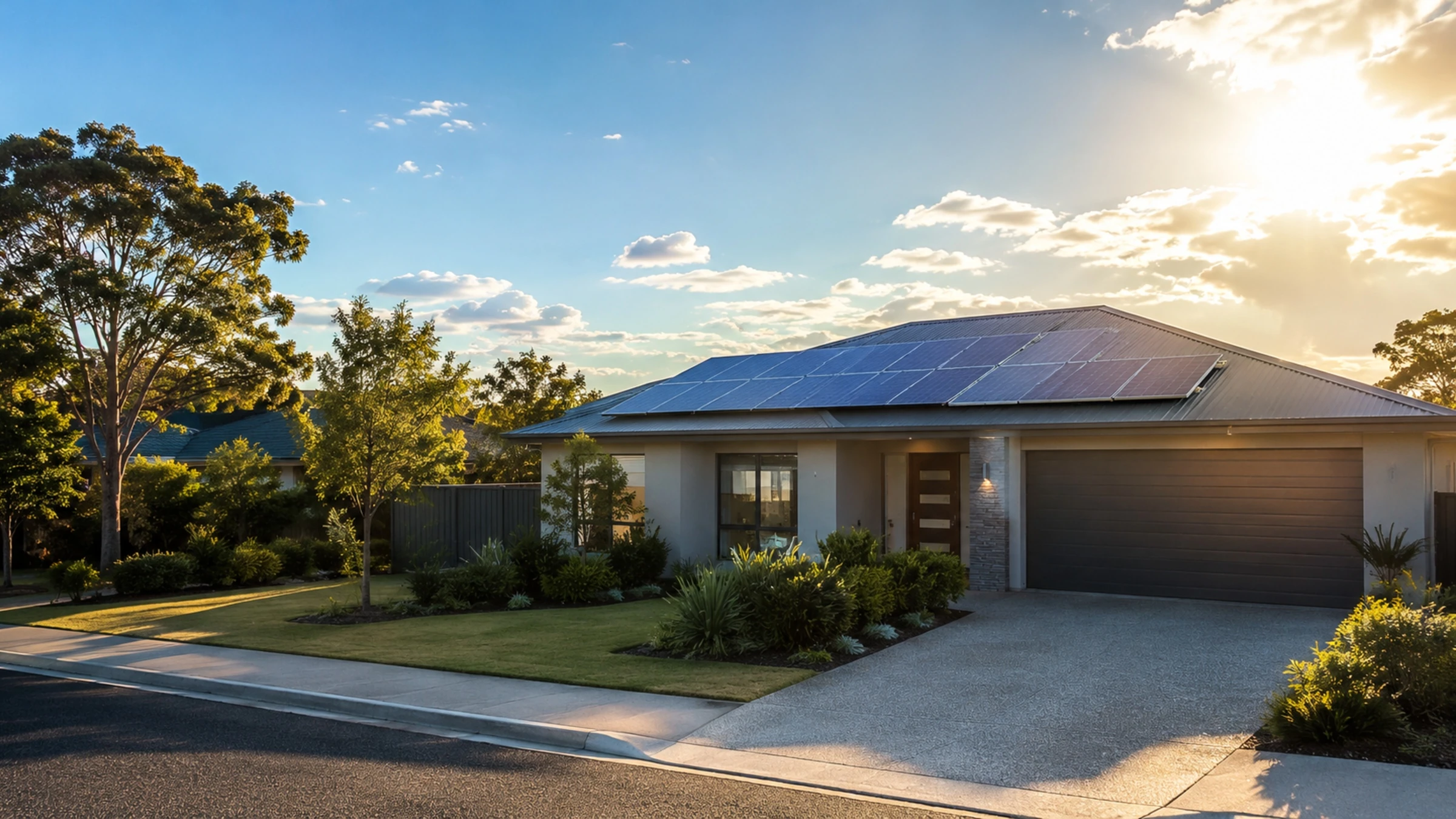
Residential solar installation.
Home solar sized from your bill, not a brochure, by an Australian-owned team. From 6.6kW to 13.2kW — the STC discount taken off up front, the network application handled, and a quote that names every component.
What we provide for your home
Sized from your bill
We size the system from your daily usage, when in the day you use it, your roof and your connection — not from a standard package list.
Battery & EV ready
Home systems are designed so a battery and EV charger can be added later without redoing the solar.
STC discount on the invoice
The STC discount comes off your price at the point of sale, and the paperwork is ours. Finance options are on our finance page.
Named gear, 25-year panel warranty
Trina or Jinko Tier-1 panels on our standard packages, named on the quote, installed by Solar Accreditation Australia accredited installers.
Monitoring from one app
Wi-Fi production monitoring so you can see generation and, with a consumption meter, how much of it your home actually uses.
Approval to aftercare
We lodge the network application, install, commission and hand over the compliance paperwork — and we are who you call afterwards.
What a residential solar installation actually involves
Most of a home solar job happens before anyone is on the roof. Here is the sequence from first contact to switch-on, including the parts installers tend not to mention because they belong to someone else — the network and your retailer.
- 1
Assessment
We look at a recent bill (ideally a full year of them), the roof — material, pitch, orientation, condition and shade — the switchboard, and whether the property is single- or three-phase. A photo of the meter and switchboard answers half of this before anyone climbs a ladder.
- 2
Design and written quote
You get a panel layout, the named panel and inverter models, a generation estimate and every extra priced on its own line. In NSW, residential work over $5,000 needs a written contract, and a deposit cannot be more than 10% of the contract price.
- 3
Network application
The distribution network that owns the poles and wires — not your retailer — has to approve the connection before the system is switched on. We lodge the application and confirm the export limit that comes back.
- 4
Installation day
Licensed electricians mount the rails and panels, run the DC and AC cabling, fit the inverter and isolators, and label the switchboard. Work must meet Solar Accreditation Australia install guidelines for the system to be eligible for STCs.
- 5
Testing, compliance and meter
The system is tested and commissioned, and you receive the certificate of compliance for the electrical work. NSW connections need a Type 4 or 4A smart meter; if yours is an older type, your retailer arranges the change. An inverter should not be switched on against an older Type 6 meter.
- 6
Switch-on and handover
Once the meter is right, we switch on, set up monitoring and walk you through the shutdown procedure and the warranty documents. Then it is worth checking your retail plan, since the best tariff often changes once you have solar.
In NSW only a licensed building or electrical contractor can contract to install rooftop solar, the wiring must be done by a licensed electrician, and installers must be accredited by Solar Accreditation Australia for the job to qualify for the STC discount. Asking for licence and accreditation numbers is normal, and any installer should give them without fuss.
Sizing a system from your bill and your daytime use
The annual total on your bill tells you roughly how big a system could be. When in the day you use that power tells you how big it should be.
Start with daily kWh
Your bill shows average daily usage in kWh. In NSW a kW of panels produces about 4.1 kWh a day averaged across the year — more in summer, noticeably less in June. That gives you a ceiling: a home using 20 kWh a day does not need a system that makes 50.
Winter matters more than the average suggests. If your heaviest use is heating on winter evenings, the panels will cover less of it than the annual figure implies, and the honest answer may be a battery conversation rather than more panels.
Then ask when you use it
Solar earns most when you use it as it is made. On the NSW benchmark rates we model with, a kWh you use yourself avoids about 32c of import, while an exported kWh earns about 5c — roughly 6 times less. Your own tariff will differ; the gap usually does not.
That is why a home with someone in it during the day, a pool pump, or a hot water system and dishwasher on timers gets far more from the same panels than a home that is empty from 8 till 6. Shifting loads into the middle of the day is free, and it often moves the payback more than the choice of panel.
| System | Average daily output | Suits | Estimated price* |
|---|---|---|---|
| 6.6kW | ~26kWh | Just right for most family homes | Starts from $7,410 |
| 10kW | ~40kWh | Medium homes & small businesses | Starts from $10,300 |
| 13.2kW | ~52kWh | Larger homes & small businesses | Starts from $11,250 |
*Estimate only — not a quote. Incl. GST, after the STC discount, for a straightforward install. Your written quote confirms the price after a site assessment.
Not sure where you fit? The system builder works from the appliances you actually run, or send us a bill and we will size it for you.
Single-phase, three-phase and export limits
Two things about your connection decide what you can install and how much of it you can send back to the grid. Both are set by your distribution network, not by the installer.
Single-phase or three-phase
Most older homes have a single-phase supply; many newer and larger homes have three. The network limits how much inverter capacity and export it will accept on each phase, so a single-phase home reaches its ceiling sooner. That is the usual reason a 13.2kW system is specified with a three-phase connection.
You can usually tell from the switchboard — a three-phase main switch is usually three poles wide — but a photo sent to us settles it. Upgrading to three-phase is possible, costs real money and needs the network involved, so it only makes sense when the rest of the plan (a large system, a fast EV charger, ducted air) justifies it.
Export limits and flexible exports, in plain terms
When the network approves your connection it sets how much power your system may push back into the street. A fixed limit is the same number all day, every day. A flexible exportarrangement lets the inverter export more most of the time and turns it down automatically, usually through the inverter’s internet connection, when the local network is congested. NSW networks are moving to offer flexible exports.
A limit does not stop the panels powering your home — it caps only the surplus. It matters most for oversized systems in empty-all-day homes, which is another reason to size from usage. We tell you the limit that applies at your address before you sign.
Tile, Colorbond, flat roofs and shade
The roof decides how the system is mounted, how long the job takes and where the quote can move. These are the cases we see most.
Tile roofs
Concrete and terracotta tiles take hook brackets that sit under the tile and fix to the rafter. The bracket has to match the tile profile, and any tile that cracks — or was already cracked — should be replaced, not glued. Old terracotta is brittle, so allow for some replacements and expect to see them priced.
Colorbond and other metal roofs
Metal roofs are usually the simplest: rails fix through the sheeting into the purlins with sealed fasteners. What matters is the fastener and sealing detail, and on the coast, mounting hardware and fixings specified for salt exposure so dissimilar metals are not left in contact.
Flat and low-pitch roofs
Panels laid flat collect dirt and drain poorly, so low-pitch roofs normally get tilt frames. Frames add wind load, so the fixing method has to suit the roof structure, and the extra hardware should appear on the quote.
Shade, optimisers and microinverters
On a conventional string system, shade on part of the array drags down more than the shaded panels. If shade falls on part of the roof for part of the day — a tree, a chimney, a neighbour’s second storey — panel-level electronics (optimisers or microinverters) limit the loss and give you per-panel monitoring.
They cost more and add components on the roof, so they are worth it only when the shade is real. Often the better answer is simply not putting panels where the shade falls.
What a residential solar quote should itemise
Two quotes for the same size can describe very different systems. A quote you can compare names the equipment and prices the variables, so nothing appears for the first time on installation day.
- Panel make, model, wattage and number of panels
- Inverter make, model and capacity — and whether it is battery-ready
- Mounting system, including tilt frames if any
- The panel layout, with which roof faces are used
- An estimate of annual generation for your roof, not a national average
- The number of STCs and the dollar discount applied
- Switchboard work, tile replacement, second-storey access and meter changes as separate lines
- The export limit that applies, or a statement that it will be confirmed before install
- Whether prices include GST, the deposit and the payment schedule
Three warranties, not one
Product warranty covers defects in the panel or inverter itself and comes from the manufacturer. Inverter terms are typically shorter than panel terms.
Performance warrantyis the manufacturer’s promise about how much output the panel keeps over time. It is a separate document from the product warranty, and on our standard packages the headline panel term is 25 years.
Workmanship warranty comes from the installer and covers the installation — fixings, penetrations, cabling. NSW also gives statutory warranties on residential building work. Ask for each one in writing, and note who you claim against.
The STC discount: a point-of-sale discount, not a grant
What gets called the federal solar rebate is the value of small-scale technology certificates (STCs) your system creates under the Small-scale Renewable Energy Scheme, run by the Clean Energy Regulator.
How it works
The number of certificates depends on the system size, your postcode’s zone and the years left until the scheme ends in 2030. Most owners assign the certificates to the installer, who sells them and takes their value off your price, so you never claim anything and no government payment is involved.
Because the deeming period counts down to 2030, the discount shrinks every January. The dollar value also moves with the certificate market, which is why a quote states the number of STCs as well as the dollar figure.
Worked example for Sydney, 2026
Postcode 2000 is in STC Zone 3 (rating 1.382). A 6.6kW system installed in 2026 creates 45 certificates — roughly $1,710 off the price — and a 10kW system 69, roughly $2,622. Estimates only, at an assumed certificate price; your postcode may sit in a different zone.
Battery and state incentives are separate schemes with their own rules. The rebates page covers them, and the figures there are calculated from the same sources as this page.
How long a home solar installation takes
Where the time goes, so you can tell a realistic timeline from an optimistic one.
Before install
Assessment, design and quote move as fast as you do. Network approval is the part nobody controls: a standard home application is routine, but a request for more inverter capacity or export than the standard allowance takes longer.
On the day
The physical work on a typical single-storey home is short — measured in days, not weeks. Two storeys, a steep or fragile roof, split arrays and switchboard upgrades add time, and we tell you in advance if any apply.
After install
If your meter has to change, your retailer arranges it, and the system stays off until it is done. Then it is switch-on, monitoring set-up and paperwork — and the STC discount is already on the invoice.
Residential systems
Standard sizes for most Australian homes. Pick a starting point below to see the full spec and estimated pricing, or build a custom system to match your exact usage.
The most popular size in Australia — ideal for a 2–4 person home.
- 475W Tier 1 solar panels
- 5kW power inverter
- 14 × 475W panels
Headroom for ducted air-con, a pool, or a future battery & EV.
- 475W Tier 1 solar panels
- 8–10kW power inverter
- 21 × 475W panels
Maximum single-phase output for big households and high usage.
- 475W Tier 1 solar panels
- 10kW power inverter
- 28 × 475W panels (13.3kW)
Residential solar installation questions
How much does residential solar installation cost?
Is the solar rebate a government grant?
What size solar system do I need?
Do I need three-phase power for a bigger system?
Will the network limit how much I can export?
Can you install on a tile roof without causing leaks?
How long does installation take?
Do I need council approval?
Rules and figures checked October 2026. Prices are estimates, not quotes.
Home solar guides
- Solar Panel Cost Sydney 2026: Complete NSW Pricing Guide
- Is Solar Worth It in NSW in 2026? Complete ROI Analysis
- Solar Panels + Battery Storage: Complete ROI Guide for NSW
- Beyond the Meter: Achieving Home Energy Independence in NSW
- How Solar Is Powering Regional NSW Homes & Businesses
- How Much Do Solar Panels Cost in Wollongong? 2026 Prices by Size
- Comparing Solar Quotes in Figtree: What a Good Quote Shows
- Old Solar Inverter in Unanderra? Repair, Replace or Go Hybrid
- Switchboard Upgrade Before Solar: A Corrimal Homeowner's Guide
- 6.6kW vs 10kW Solar Narellan NSW
- Solar for New Homes in Camden: Planning Guide
- Solar System Size Castle Hill: Guide for High-Usage Homes
- Solar Roof Space West Pennant Hills: How Many Panels Fit?
- Solar Inverter Upgrade Seven Hills: 2026 Replacement Guide
- Solar Self-Consumption Western Sydney: Summer Guide
Looking for your area? See solar installation across NSW for suburb pages with local rebate figures. Compare the 6.6kW, 10kW and 13.2kW packages, check finance options, or, for a business, read about commercial solar installation.
Get your free solar quote in under 2 minutes.
Tell us a little about your place and we’ll tailor the numbers. Everything in the list below is included, no exceptions.