

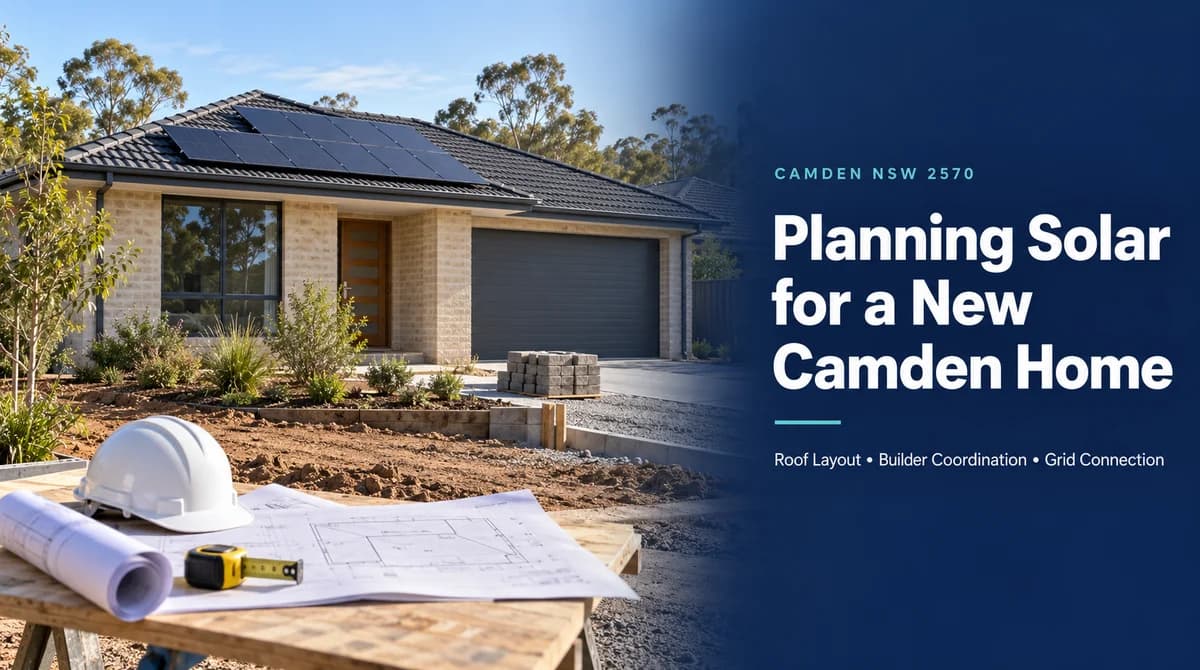
Solar for New Homes in Camden: Planning Guide
Building in Camden NSW 2570? Plan solar with your builder: roof layout, BASIX, conduit, switchboard, metering and Endeavour Energy connection requirements.
Planning Solar for a New Camden Home: A Guide Before You Build
The best time to plan solar for a new home in Camden is while the roof and electrical drawings are still being developed. Agree on the panel layout, cable routes, inverter position and switchboard provisions before the relevant construction work is completed.
Early coordination can help you avoid having to work around poorly placed roof vents, reopen finished walls or redesign electrical provisions after handover. The panels themselves can be installed at an agreed later stage, subject to the building schedule and approval requirements.
For a new home in Camden NSW 2570, solar planning should bring together your builder, solar designer, electrician and certifier. It should also account for the property's planning controls, BASIX commitments and electricity network connection.
When Should You Arrange Solar During a New Build?
Use this as a coordination checklist with your builder. Exact installation timing will depend on site access, construction milestones and the approved design.
Building stage | Solar decision to make | Who should coordinate it? |
|---|---|---|
Before the design is finalised | Reserve suitable roof areas and estimate future electricity use | Homeowner, building designer and solar designer |
Before electrical plans are approved | Agree on inverter position, supply capacity, switchboard space and future equipment | Builder, electrician and solar designer |
Before walls and ceilings are closed | Confirm conduit routes, access and any planned cabling | Builder and relevant licensed installers |
Before solar installation | Confirm equipment, network approval, roof readiness and safe access | Solar installer and builder |
Before handover | Complete required testing, metering arrangements, documentation and monitoring setup | Builder, installer, retailer and certifier, as applicable |
If your builder offers a solar package, ask for its specification early enough to compare it with your household's needs. A brochure description such as “solar included” does not explain the panel capacity, inverter, layout or installation scope. If you want a quicker route for Camden, this is the link https://kratos-energy.com/solar/nsw/camden
Start With the Planning Rules for Your Camden Address
Camden Town and the Wider Council Area Have Different Controls
Camden Council explains that the planning instruments applying to a property depend on its location. The Camden Local Environmental Plan covers established areas such as Camden and Narellan, along with specified release areas including Spring Farm and Elderslie. Different precinct arrangements apply to rezoned areas such as Oran Park and Leppington.
Use the address search on Camden Council's planning controls page to identify the relevant framework, then confirm it with your designer or certifier. A Camden-area postal address does not mean every building site has identical requirements.
For an infill project in or near the historic centre, also check whether the site is a heritage item or falls within a heritage conservation area. Council's heritage planning guidance explains how to identify these properties. Resolve any implications for visible roof equipment while the house design is still flexible.
Check the Home's BASIX Commitments
NSW's Building Sustainability Index, or BASIX, covers water use, energy use and thermal performance for new residential dwellings. The BASIX certificate records the project's sustainability commitments. See the NSW Government's BASIX guidance.
Ask your builder or assessor:
Does the certificate include a solar PV commitment?
What equipment or system details have been specified?
Does the quoted solar installation match the approved documents?
If equipment or roof layout changes, does the certificate or approval need updating?
Keep the builder's specification, solar proposal and approval documents aligned. Do not assume there is one mandatory solar system size for every new Camden home.
Design the Roof Around a Usable Solar Layout
Ask for a panel layout drawn over the actual roof plan before roof fixtures are finalised.
North-facing panels generally provide strong total generation. East-facing panels generate earlier, while west-facing panels generate later in the day. The best arrangement depends on shading and when you expect to use electricity, as explained in the Australian Government's solar design guide.
Review the proposed location of skylights, vents, antennas, roof valleys and other obstructions together. A large roof divided into small sections may offer less useful panel space than a simpler roof with fewer interruptions.
For a new Camden estate, ask the designer to consider adjoining approved buildings where information is available, rather than assuming today's vacant neighbouring lots will remain unshaded. Include potential shading from your own future pergola and landscaping.
Have the builder and installer agree on mounting suitability, roof penetrations, weatherproofing and responsibility for any damage. Keep required access and clearances in the layout rather than treating the roof as entirely available for panels.
Choose System Size Without Relying on an Old Electricity Bill
A new home may have very different electricity demand from your current property. Your existing bills are a starting point, but they should be adjusted for the new home's equipment and occupancy.
Prepare a list covering:
Heating and cooling, including the proposed air-conditioning system.
Hot-water technology and likely operating times.
Cooking appliances, pool equipment and other major loads.
How often someone will be home during daylight hours.
Planned battery storage or EV charging.
Ask for an estimate of daytime, evening and seasonal use. A household with daytime EV charging will need a different assessment from one whose vehicle returns home after sunset.
Compare Kratos Energy's residential solar systems against that forecast. Request the actual panel capacity in kW, inverter rating and estimated monthly generation for each option. Package names alone are not enough to compare designs.
The aim is to understand how much generation you can use directly, store or export, and what additional capacity would cost.
Plan Conduit and Cable Routes Before the Walls Close
Conduit is protective tubing used to route electrical cables. Agree on its purpose and route with the solar designer and builder's electrician before the relevant walls and ceilings are lined.
Ask them to document:
The route between the roof array, inverter and switchboard.
Whether provisions are also needed for a future battery or EV charger.
Any separate communication or monitoring connections.
Who installs each provision and checks that it suits the proposed equipment.
Avoid a vague contract allowance that says only “solar provision included”. Request a marked drawing and written scope. The responsible electrician should select the appropriate conduit, cables and installation method for the design.
Before concealed work is covered, ask the builder for permitted photographs and records showing the agreed routes. These can help a later installer locate the provisions without unnecessary investigation.
Coordinate the Inverter, Switchboard and Electricity Meter
Inverter Position
Reserve a location that meets the manufacturer's requirements, remains accessible and avoids unsuitable heat exposure. Position it with cable routing and future equipment in mind. The government's inverter guide explains inverter types and the role of smart metering.
Switchboard and Supply Capacity
Ask the electrician to assess the complete planned electrical load, including solar, air conditioning, cooking, hot water and EV charging where relevant. Confirm space for required protection, monitoring equipment and any intended future circuits.
Discuss single-phase versus three-phase supply before the connection design is settled. Three-phase supply may suit some equipment combinations, but it is not automatically necessary for every solar home. Have the electrician explain the requirement, cost and network implications for your design.
Metering and Grid Connection
Confirm who will arrange the permanent electricity account, meter installation or configuration, and solar export setup. Do not assume the building's temporary supply or initial meter arrangements complete the solar connection process.
Endeavour Energy publishes a solar connection process covering the application, approval, installation and metering steps. Ask your installer to confirm the distributor for your property and allocate these tasks in the project schedule.
Camden 2570: Check the November 2026 Solar Connection Changes
Endeavour Energy lists postcode 2570 in the first stage of its NSW CER Installer Portal and emergency-backstop rollout, commencing on 2 November 2026. This matters if your new home's solar installation will be completed around or after that date.
The published arrangements concern registration, compatible equipment and communication with the network. Flexible exports also depend on eligibility, suitable inverter equipment and an active internet connection. See Endeavour Energy's current rollout and flexible-export guidance.
Before equipment is ordered, ask the installer to check the requirements against your postcode, connection approval and expected commissioning date. Include reliable connectivity at the inverter location in the plan.
Generating electricity and exporting it are separate matters. A large panel array does not guarantee unrestricted exports. The proposal should explain how network conditions affect the intended system and its savings assumptions.
Prepare for a Battery and EV Charger Without Guesswork
If you intend to add either technology, decide what needs to be allowed for during construction and what can be selected later.
For a future battery, discuss a suitable installation area, electrical provisions and whether a hybrid inverter or later AC-coupled arrangement makes sense. Ask what “battery-ready” means for the exact equipment proposed; it does not guarantee compatibility with every future battery.
If blackout backup matters, identify the circuits you want supported and include the necessary design provisions. Solar panels or a battery alone do not automatically provide whole-home backup. The government's battery guidance explains these limitations.
For an EV charger, confirm the parking position, cable route and available electrical capacity. These are useful construction decisions even if you have not selected the vehicle or charger yet.
Compare the Complete Installation Cost
Ask the builder and solar provider to separate the equipment price from construction-related provisions and exclusions.
Check whether the quote includes conduit, electrical work, roof access, mounting, metering, connection administration, monitoring and any battery-backup equipment. Confirm GST, any incentive assumptions and the final payable amount.
You can explore configurations with the Kratos solar system builder. Treat the result as an initial estimate: the final proposal needs to reflect your construction drawings, electrical design and site conditions.
If you appoint a solar provider separately from the builder, agree in writing on site access, scheduling, roof responsibilities and handover documents. Confirm whether an external contractor can work before handover under the building contract.
Frequently Asked Questions
Should Solar Be Installed Before or After Handover?
Can I Use My Own Solar Installer for a New Camden Home?
Is Solar Compulsory for Every New Camden Home?
Can I Decide on a Battery After Moving In?
What Should I Receive at Solar Handover?
Plan Solar for Your Camden Home With Kratos Energy
Bring solar into the building discussion while the design can still accommodate it.
For a new-home assessment, provide your Camden NSW 2570 address or lot details, site and roof plans, BASIX certificate if available, electrical specification and expected construction dates. Include any battery, EV charging or blackout-backup plans.
Request a solar planning quote for your new Camden home, or call 1300 089 547 to discuss the project with Kratos Energy.
Solar System Packages
Tier 1 panels & CEC accredited installation.
- Trina 475W or Jinko panels
- 5kW power inverter
- 14 × 475W panels
- Single-phase compatible
- Trina 475W or Jinko panels
- 8–10kW power inverter
- 21 × 475W panels
- Battery & EV ready
- Trina 475W or Jinko panels
- 10kW power inverter
- 27 × 475W panels
- Three-phase compatible