
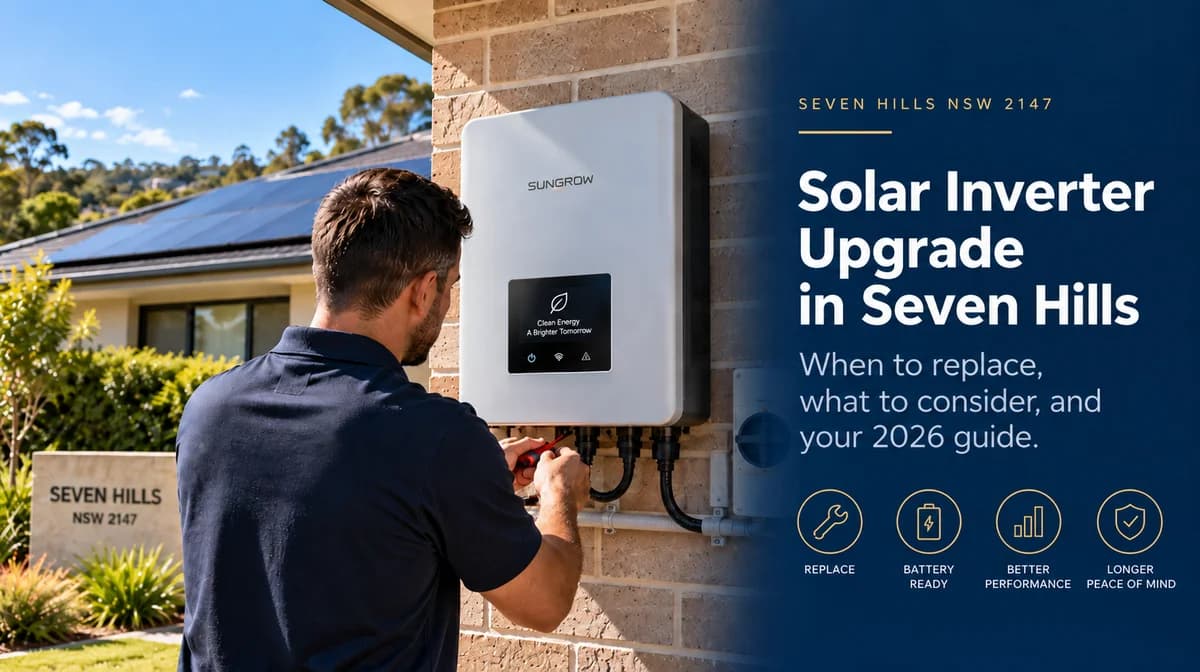
Solar Inverter Upgrade Seven Hills: 2026 Replacement Guide
Replacing an old solar inverter in Seven Hills NSW 2147? Learn when to upgrade, panel compatibility, battery-ready options, warranties and 2026 inverter requirements.
Replacing an Old Solar Inverter in Seven Hills: 2026 Upgrade Guide
If your solar panels are still producing well but the inverter is ageing, failing or no longer meeting your energy needs, you may not need to replace the entire solar system.
For many homes in Seven Hills NSW 2147, replacing the inverter can extend the useful life of an existing rooftop system while adding better monitoring, improved efficiency or battery compatibility.
But an inverter replacement should not be treated as a simple box-for-box swap.
Before upgrading, check:
Why the existing inverter needs replacement
Whether the solar panels are still in good condition
Panel voltage and current compatibility
Single-phase or three-phase supply
Current Australian inverter requirements
Battery plans
Warranty status
Network connection requirements
The right goal is to upgrade what needs upgrading without unnecessarily replacing equipment that is still performing properly.
Kratos Energy currently installs modern solar and hybrid inverter solutions from brands including GoodWe, Sungrow, FoxESS, Sigenergy, ESY Sunhome and Sofar. Explore Kratos solar panels and inverters.
Do You Need to Replace Your Solar Inverter?
An inverter converts the DC electricity generated by your solar panels into AC electricity used by your home.
Unlike solar panels, the inverter is an electronic device containing components that operate continuously whenever the system is producing power.
The Australian Government notes that string inverters commonly last 10 years or more, but they are likely to require repair or replacement during the operating life of the solar panels. (Energy Australia)
Replacement may be worth investigating if your inverter:
Regularly shuts down
Shows persistent fault codes
Has stopped producing electricity
Loses monitoring connection repeatedly
Is outside warranty
Is no longer supported by the manufacturer
Cannot integrate with the battery you want
Uses outdated technology
Needs expensive repairs
A fault does not automatically mean replacement is necessary.
A qualified installer should first diagnose the actual problem. For a quicker route of Seven Hills, visit this link https://kratos-energy.com/solar/nsw/seven-hills
Why Inverter Upgrades Are Relevant in Seven Hills
Seven Hills has a substantial stock of detached residential housing.
According to the 2021 Census, approximately 84.1% of occupied private dwellings in Seven Hills were separate houses. Around 49.6% had three bedrooms, while another 31.2% had four or more bedrooms. (Australian Bureau of Statistics)
Many established homes may already have rooftop solar installed from earlier generations of Australian residential PV systems.
That can create a common upgrade situation:
The panels may still have years of usable life remaining, while the original inverter is approaching replacement.
In that situation, the most economical solution may be to assess the existing array and replace only the inverter.
6 Signs Your Solar Inverter May Need Attention
1. Solar Production Has Dropped Suddenly
If generation falls sharply without an obvious explanation such as weather or heavy shade, the inverter should be checked.
Use your monitoring app or electricity meter to compare production against previous periods.
A sudden drop can indicate:
Inverter fault
Failed solar string
Electrical connection issue
Grid-voltage problem
Monitoring fault
Panel problem
Do not assume the inverter is responsible until the system is tested.
2. The Inverter Shows Persistent Error Codes
Occasional warnings may occur because of temporary grid conditions.
Persistent or recurring faults need investigation.
Take a photograph or screenshot of the error code before resetting anything.
This can help the technician diagnose the issue.
3. The Inverter Is Out of Warranty
Warranty expiry does not mean an inverter must immediately be replaced.
But if an older unit develops a major fault after warranty, compare:
Repair cost vs replacement cost vs future system plans.
Kratos' current solar equipment page states that most of the inverter models it installs carry approximately 10-year standard warranties, with extensions available on selected products. (Kratos Energy)
The exact warranty depends on the model.
4. Replacement Parts or Manufacturer Support Are Difficult to Find
Older inverter brands sometimes leave the Australian market or discontinue specific product lines.
Even if the inverter can technically be repaired, sourcing parts can become difficult.
When replacing an inverter, local warranty support can be just as important as headline specifications.
5. You Want to Add a Solar Battery
This is one of the strongest reasons to reconsider the inverter.
Many older solar inverters were designed only for grid-connected solar.
They may not directly support battery storage.
If you plan to add a battery, you may have two broad choices:
Keep the existing solar inverter
Add an AC-coupled battery system with separate battery electronics.
Replace the inverter
Install a compatible hybrid inverter that can manage both solar and battery storage.
Neither approach is automatically better.
The most economical choice depends on the age of the existing inverter, battery brand, system architecture and backup requirements.
Kratos outlines current storage options on its battery storage page.
6. You Want Better Monitoring or Energy Management
Older inverters may provide limited information beyond total generation.
Modern systems can offer app-based monitoring showing:
Current solar output
Daily generation
Household consumption
Grid import
Solar export
Battery charging
Battery state of charge
This can make it easier to understand whether the system is performing properly and how your household uses solar.
Can You Keep Your Existing Solar Panels?
Often, yes.
Replacing the inverter does not automatically require replacing the panels.
The installer should first check:
Panel condition
Panel model
Age of the array
Electrical characteristics
String configuration
Connectors and cabling
Roof mounting
Signs of damage or deterioration
If the panels remain safe and productive, retaining them can reduce the cost of the upgrade.
The New Inverter Must Match the Existing Panels
This is one of the most important technical checks.
A replacement inverter must be electrically compatible with the existing panel array.
Your installer needs to confirm factors such as:
String voltage
The combined panel voltage must remain within the inverter's allowable operating range.
Maximum current
Modern panels and older panels can have significantly different current characteristics.
MPPT range
The panel strings should operate within the inverter's Maximum Power Point Tracking range.
Number of strings
The new inverter needs enough suitable inputs for the existing array configuration.
System capacity
The relationship between solar-array capacity and inverter capacity needs to remain suitable and compliant.
This is why homeowners should avoid purchasing an inverter independently based only on its advertised kW rating.
Should You Replace a 5kW Inverter With a Larger One?
Not automatically.
Suppose your existing system has:
6.6kW of panels + 5kW inverter
Replacing the inverter with another properly specified 5kW unit may be entirely appropriate.
Moving to a larger inverter only makes sense where the overall design supports it.
A larger inverter can affect:
Network approval
Export settings
Phase requirements
Future panel expansion
System performance
Installation cost
If you plan to expand the solar array, assess the new solar capacity and new inverter together rather than replacing one component first and planning the rest later.
Standard Inverter or Hybrid Inverter?
When replacing an older inverter, one major decision is whether to stay with a standard solar inverter or move to a hybrid inverter.
Feature | Standard Solar Inverter | Hybrid Inverter |
Converts solar power | Yes | Yes |
Battery connection | Usually separate system | Designed for compatible batteries |
Upfront cost | Usually lower | Usually higher |
Future battery flexibility | Lower | Higher |
Monitoring | Available | Often integrates solar + battery |
Best for | Solar-only households | Battery-ready households |
If you are confident you will not install a battery, a standard inverter may remain the simpler option.
If battery storage is likely within the next few years, replacing an ageing inverter with a compatible hybrid system can avoid replacing the inverter again later.
Kratos currently prioritises hybrid and battery-ready inverter options within its residential equipment range. (Kratos Energy)
Battery Compatibility Is Brand and Model Specific
A common mistake is assuming:
“Hybrid inverter = works with every battery.”
It does not.
Battery compatibility depends on:
Inverter manufacturer
Exact inverter model
Battery model
Battery voltage
Communication protocol
Firmware
Phase configuration
Backup hardware
For example, an inverter may technically support batteries but only specific approved battery models.
If battery storage is part of your long-term plan, decide on the likely battery ecosystem before selecting the replacement inverter.
2026 Inverter Compliance: What Has Changed?
Australia's inverter requirements have changed since many older Seven Hills solar systems were installed.
The updated AS/NZS 4777.2:2020 Amendment 2:2024 came into effect on 23 August 2025. Inverters that did not meet the updated requirements were removed from the Clean Energy Council's approved inverter list. (Clean Energy Council)
As a result, a replacement inverter should not simply be chosen because it is electrically similar to the old unit.
The installer should verify that the proposed model is currently approved and meets relevant Australian requirements.
The Clean Energy Council maintains the current approved inverter list, which is used by electricity networks and renewable-energy programs. (Clean Energy Council)
Smart Inverter Requirements Are Also Evolving
Australian electricity networks are increasingly requiring smarter communication capabilities from new and upgraded energy systems.
From late 2026, NSW is introducing additional requirements for new and upgrading solar inverters under the state's Emergency Backstop arrangements, including compliant smart-inverter communications in affected installations. (Endeavour Energy)
This makes professional assessment particularly important when replacing an older inverter.
A unit that was compliant when your original solar system was installed may not necessarily be suitable as a replacement today.
Your installer should confirm the requirements applying to your Seven Hills address and installation date before ordering equipment.
Will Replacing the Inverter Affect Your Existing Solar Approval?
It can.
A like-for-like replacement may be treated differently from:
Increasing inverter capacity
Adding panels
Adding battery storage
Changing phases
Altering export settings
The installer should confirm whether the proposed change requires an updated network application or connection approval.
Do not assume that because the original solar system was approved years ago, any new inverter can simply be connected under the same conditions.
Should You Upgrade the Solar Panels at the Same Time?
Sometimes.
Replacing the inverter creates a good opportunity to assess whether the existing array still matches the household's energy requirements.
Consider upgrading the panels if:
Existing solar capacity is now too small
Several panels are damaged
The array is very old
Roof space allows useful expansion
An EV is being added
A battery requires more surplus generation
Household electricity demand has increased significantly
But replacing good panels purely because the inverter has failed may create unnecessary cost.
A qualified assessment should separate:
what must be replaced
from
what could optionally be upgraded.
Example: Three Seven Hills Upgrade Scenarios
Scenario 1 — Older Inverter, Healthy Panels
Existing system:
6.6kW panels + failed 5kW inverter
Panels still test well.
No battery planned.
Possible approach
Replace the inverter with a modern compliant unit while retaining the existing panels.
Scenario 2 — Ageing Inverter + Battery Planned
Existing system:
6.6kW panels + 9-year-old inverter
Homeowner plans battery storage within 12 months.
Possible approach
Compare:
Repairing the current inverter
Installing an AC-coupled battery later
Replacing the ageing inverter now with a compatible hybrid model
The hybrid option may offer better long-term value if replacement is already approaching.
Scenario 3 — Old Inverter + Higher Electricity Demand
Existing system:
5kW solar
Since installation, the household has added:
Ducted air conditioning
Pool equipment
EV
Possible approach
Instead of replacing the inverter like-for-like, assess a broader solar-system expansion.
The right solution may involve additional panels, a new inverter and potentially battery storage.
What Does a Solar Inverter Upgrade Cost?
There is no single reliable price because the work depends on:
Inverter size
Brand
Single-phase vs three-phase
Standard vs hybrid inverter
Existing wiring
Switchboard condition
Accessibility
Additional compliance work
Network requirements
Monitoring hardware
Battery integration
A quote should clearly separate:
inverter hardware + installation + electrical work + additional upgrade costs.
Avoid comparing replacement quotes using inverter price alone.
What Warranty Should You Check?
Before choosing a new inverter, ask:
Standard warranty period
Whether registration is required
Labour coverage
Replacement freight
Local support arrangements
Optional warranty extension
Who manages the claim
Kratos states that most inverter units in its current equipment range carry a 10-year standard warranty, with selected models offering extensions. (Kratos Energy)
Always confirm the exact warranty for the selected model.
Seven Hills Inverter Upgrade Checklist
Before approving an inverter replacement, make sure the installer checks:
Existing system
Solar array size
Panel make and model
Panel age
Current inverter
Existing string configuration
Electrical compatibility
Panel voltage
Panel current
MPPT requirements
Number of strings
Single-phase or three-phase supply
System condition
Panels
Cabling
Connectors
Isolators
Mounting
Switchboard
Future requirements
Battery storage
EV charging
Additional panels
Backup power
Higher electricity demand
Compliance
Current approved inverter status
Australian inverter standard
Network requirements
Export settings
Required approvals
A good replacement proposal should explain why the proposed inverter is compatible, not simply name the product.
Frequently Asked Questions
How long does a solar inverter last?
Can I replace my solar inverter without replacing my panels?
Can I upgrade from a normal inverter to a hybrid inverter?
Should I buy a bigger inverter when replacing my old one?
Can an old solar system be made battery-ready?
Does every hybrid inverter work with every battery?
Can I replace the inverter myself?
Do new replacement inverters have to meet current standards?
Replacing an Old Solar Inverter in Seven Hills: The Bottom Line
For a home in Seven Hills NSW 2147, an ageing or failed inverter does not automatically mean starting again with an entirely new solar system.
The best approach is to assess:
Existing panels → inverter condition → electrical compatibility → current compliance → battery plans → future electricity demand.
If your panels remain productive, replacing only the inverter may extend the system's useful life at a much lower cost than a complete replacement.
If the existing inverter is already ageing and you plan to add a battery, EV or more panels, the replacement may also be the right time to modernise the broader system.
The important point is to upgrade for a clear reason—not simply because newer equipment exists.
Explore Kratos solar panels and inverters
Explore Kratos battery storage options
Request a tailored Kratos solar assessment
A good inverter upgrade keeps the useful parts of your existing system working—and prepares the rest for what your home needs next.
Solar System Packages
Tier 1 panels & CEC accredited installation.
- Trina 475W or Jinko panels
- 5kW power inverter
- 14 × 475W panels
- Single-phase compatible
- Trina 475W or Jinko panels
- 8–10kW power inverter
- 21 × 475W panels
- Battery & EV ready
- Trina 475W or Jinko panels
- 10kW power inverter
- 27 × 475W panels
- Three-phase compatible