

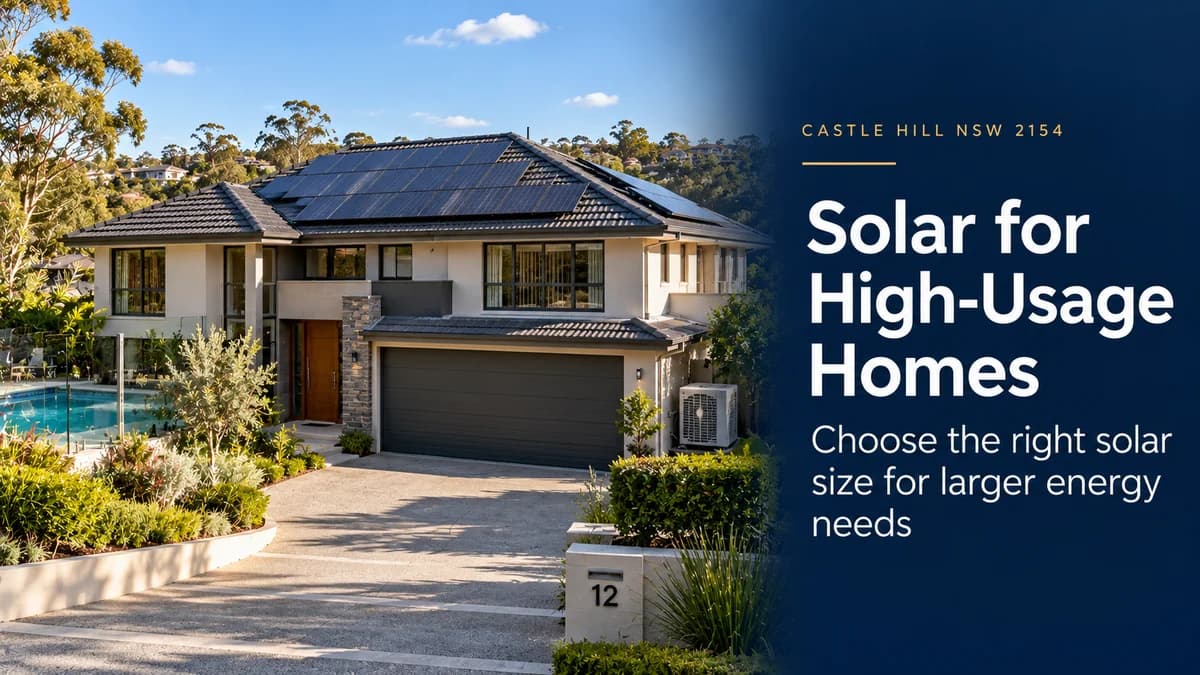
Solar System Size Castle Hill: Guide for High-Usage Homes
Choosing solar for a high-usage Castle Hill home? Compare 6.6kW, 10kW and 13kW systems for ducted air-con, pools, EVs and higher electricity bills.
Solar System Size Castle Hill: What Do High-Usage Homes Actually Need?
If your Castle Hill NSW 2154 home has ducted air conditioning, a swimming pool, electric hot water, home-office equipment or future EV charging, a standard solar package may not automatically be the right fit.
The correct solar system size for a Castle Hill home should be based on how much electricity you use, when you use it, available roof space and how much solar can be consumed directly rather than simply exported.
For many higher-usage households, the real comparison is often between 10kW and 13kW solar, rather than automatically choosing the common 6.6kW system. For a quicker route of Castle Hill, visit this link https://kratos-energy.com/solar/nsw/castle-hill
Kratos currently lists indicative average generation of approximately:
Solar System | Indicative Daily Generation* | Typical Starting Point |
6.6kW | ~26 kWh/day | Moderate household usage |
10kW | ~40 kWh/day | Higher usage, ducted air-con, pool or future EV |
13kW | ~52 kWh/day | Larger homes and high energy loads |
*Indicative Kratos figures. Actual production varies with roof orientation, shade, weather, season and system design.
For broader NSW solar information, see the Kratos Energy NSW solar guide.
Why Solar Sizing Matters in Castle Hill
Castle Hill has a housing profile where larger household energy loads can be particularly relevant.
According to the 2021 Census, around 73.7% of occupied private dwellings in Castle Hill were separate houses, while approximately 59.9% had four or more bedrooms. The average household contained about three people.
That does not mean every large Castle Hill house is a high electricity user.
However, larger properties are more likely to have potential loads such as:
Ducted air conditioning
Swimming pools and filtration pumps
Multiple refrigerators or freezers
Electric ovens and induction cooking
Home-office equipment
Electric hot water
Battery storage
EV charging
This is why solar should be sized from actual electricity consumption, not simply the number of bedrooms.
Start With 12 Months of Electricity Bills
Before choosing between 6.6kW, 10kW or 13kW solar, calculate your real energy demand.
Use at least 12 months of electricity bills if possible.
Look for:
Total electricity consumption in kWh
Average daily usage
Summer peak consumption
Winter consumption
Changes caused by air conditioning
Daytime versus night-time usage
Example
Suppose a quarterly bill shows:
3,150 kWh used over 90 days
Average daily electricity use is:
3,150 ÷ 90 = 35 kWh/day
That immediately tells you much more than the dollar value of the bill.
A household averaging around 35kWh per day should generally investigate larger residential solar options rather than automatically accepting a standard 6.6kW recommendation.
However, the next question is just as important:
When is that 35kWh being used?
Daytime Usage Can Make a Larger Solar System More Valuable
Solar provides its greatest direct benefit when electricity is used while the panels are generating.
Imagine two Castle Hill homes both use 35kWh per day.
Home A
Most consumption occurs during daylight hours because of:
Working from home
Pool filtration
Daytime air conditioning
Electric hot water
Household appliances
This property may be able to directly consume a large amount of solar generation.
Home B
The home is mostly empty during the day and electricity consumption rises sharply after 5 PM.
Without a battery, a larger proportion of solar may be exported rather than used directly.
The same daily electricity consumption can therefore lead to two different solar designs.
How Much Solar Do You Need for Ducted Air Conditioning?
Ducted air conditioning can be one of the largest electrical loads in a family home.
But system sizing should not rely only on the advertised size of the air-conditioning unit.
The most useful information is actual electricity consumption during hot-weather periods.
Check:
Summer electricity bills
Smart-meter interval data
Solar-monitoring data if you already have solar
How many hours the system operates
Whether it runs mainly during the day or evening
Whether different zones are regularly used
A household running ducted cooling throughout sunny summer afternoons can potentially use a significant amount of solar directly.
This is one reason Kratos positions its 10kW solar system for homes requiring additional headroom for ducted air conditioning, pools, batteries and EVs.
For even higher electricity demand, its 13kW solar system is designed for larger homes and high energy loads.
How Much Electricity Does a Pool Pump Add?
Pool equipment can significantly increase daytime electricity consumption.
A simple calculation is:
Pump power in kW × hours operated = daily kWh
For example:
If a pool pump draws approximately:
1kW
and operates for:
6 hours
then it uses roughly:
1 × 6 = 6kWh per day
Actual pump consumption will vary by model, speed and operating schedule.
The advantage is that pool filtration can often be scheduled during solar-production hours.
Instead of exporting solar and later buying electricity from the grid, the home can use solar directly to operate the pump.
For a high-usage Castle Hill household, moving pool operation into the middle of the day can improve solar self-consumption without increasing battery size.
6.6kW vs 10kW vs 13kW Solar in Castle Hill
6.6kW Solar
A 6.6kW system can still suit homes with moderate electricity consumption.
Kratos currently estimates approximately 26kWh/day of average generation for its 6.6kW package.
It may be suitable when:
Average consumption is moderate
Ducted air conditioning is used occasionally
There is no large pool load
EV charging is not planned
Roof space is limited
Future energy consumption is unlikely to rise significantly
For a genuinely high-usage household, however, it may provide limited headroom.
10kW Solar
A 10kW system is often worth investigating where a home has:
Higher daytime energy use
Ducted air conditioning
Pool filtration
Electric hot water
A future battery
A planned EV
Kratos lists indicative generation of around 40kWh/day for its 10kW system.
For many high-usage family homes, this provides a useful middle ground between system size, roof area and available generation.
13kW Solar
A 13kW system deserves consideration where electricity consumption is consistently high.
Kratos lists indicative generation of approximately 52kWh/day for its current 13kW package.
It may make sense where the household has several major loads, such as:
Ducted air conditioning
Pool equipment
Electric hot water
Multiple occupants
Home office
Battery storage
EV charging
Higher future electricity demand
However, a 13kW system should not be selected simply because roof space is available.
You still need to determine how the additional solar will be used, stored or exported.
A Practical Solar Sizing Guide for Castle Hill
These ranges are useful for preliminary comparison—not final system design.
Average Household Consumption | Solar Size Worth Investigating |
Under 15 kWh/day | 6.6kW may be sufficient |
15–25 kWh/day | Compare 6.6kW and 10kW |
25–40 kWh/day | 10kW deserves strong consideration |
40+ kWh/day | Compare 10kW, 13kW or customised design |
The final system can move up or down depending on:
Daytime self-consumption
Roof orientation
Shading
Export limits
Battery plans
EV charging
Seasonal demand
Do not use the table as a substitute for an actual load assessment.
Do Not Size Solar From Your Highest Bill Alone
A high summer bill can make a very large solar system look necessary.
But solar sizing should use annual consumption, not only the worst quarter.
For example:
Summer
45kWh/day because ducted air conditioning runs heavily.
Autumn
26kWh/day.
Winter
30kWh/day.
Spring
24kWh/day.
The best system should reflect the entire year.
Otherwise, the array may generate far more electricity than the household can use during lower-consumption months.
Smart-meter interval data is particularly useful because it shows when energy is being consumed rather than only the total amount.
Future EV Charging Can Change Your Solar Requirement
If you plan to buy an EV, include it in the original solar calculation.
But first determine when the vehicle will charge.
Daytime EV charging
If the car is regularly at home during daylight hours, rooftop solar can charge the vehicle directly.
This can make a larger solar system particularly valuable.
Overnight EV charging
If the car usually arrives home after sunset, solar cannot directly supply most charging without battery storage.
In that situation, you may need to assess:
A larger battery
Off-peak grid charging
Time-of-use tariffs
A combination of solar and battery storage
Future EV demand should be designed into the system rather than added as an afterthought.
Why Roof Space Still Matters
A high electricity bill does not automatically mean your roof can support the ideal system size.
Solar design also needs to account for:
Roof orientation
Shading
Chimneys
Skylights
Roof vents
Different roof faces
Panel dimensions
Required clearances
A well-positioned 10kW array can be more useful than attempting to force a larger number of panels onto poor-quality roof areas.
If you want a postcode-based estimate before a site assessment, enter 2154 into the Kratos Solar Output Calculator and compare 6.6kW, 10kW and 13.2kW generation.
The calculator gives a useful location-based starting point, but actual roof orientation and shade still need to be assessed separately.
Export Limits Matter More on Larger Solar Systems
This is particularly important when comparing 10kW and 13kW systems.
Castle Hill is within the Endeavour Energy network area. Endeavour Energy approves a maximum export capacity for each solar connection, and actual exports can vary according to local network conditions and the amount of solar being consumed by the property.
That means:
A 13kW solar system does not necessarily mean you can export 13kW to the grid.
The system may still be worthwhile if the household can use the additional generation directly.
Endeavour Energy currently provides a fast-track connection process for many systems where total inverter capacity is below 10kW on single-phase supply or 30kW on three-phase supply, subject to the relevant technical requirements.
Flexible exports are also being progressively introduced. Endeavour Energy says eligible customers can export up to 10kW per phase most of the time, but the rollout is postcode-based. Castle Hill homeowners should therefore confirm the current eligibility and export conditions for postcode 2154 when the system is being designed.
Why Self-Consumption Matters More Than Simply Exporting More Solar
Suppose your solar generates an additional 10kWh during the day.
If your household immediately uses that electricity for:
Air conditioning
Pool filtration
Hot water
EV charging
then those 10kWh reduce the amount of electricity you need to purchase from the grid.
If those same 10kWh are exported, you receive the applicable feed-in tariff instead.
Kratos' current NSW solar guide uses indicative figures of around 32c/kWh for grid electricity and 5c/kWh for exported solar, illustrating why self-consumption can have substantially greater value than exporting the same energy. Actual retail and feed-in rates depend on your electricity plan.
For high-usage Castle Hill households, system design should therefore focus heavily on matching generation to daytime loads.
Should You Add a Battery?
A battery becomes worth investigating when a large portion of your solar generation would otherwise be exported while substantial electricity is purchased from the grid after sunset.
For example:
Daytime
Large 10kW or 13kW array produces surplus solar.
Evening
Ducted air conditioning, cooking and household loads continue after solar generation falls.
A battery can move some of the excess daytime energy into the evening.
However, battery size should be based on:
Excess daytime generation
Evening electricity consumption
Backup requirements
Battery usable capacity
Future EV charging
Do not automatically pair the largest available battery with a large solar system.
High-Usage Castle Hill Home: Example
Consider a family home using:
38kWh/day on average
with:
Ducted air conditioning
Pool pump
Home office
Electric cooking
Assume around 24kWh is consumed between morning and late afternoon.
That property may have strong potential to use a larger solar system directly.
A 10kW or 13kW design could therefore be worth modelling, depending on:
Roof space
Seasonal electricity use
Network approval
Export limit
Future EV or battery plans
Now consider another home also using 38kWh/day, but only 10kWh occurs during daylight hours.
That property may need a different strategy—potentially including battery storage or load shifting.
Same bill. Different solar design.
Before Choosing a Solar System, Check These 7 Numbers
A good solar proposal for a high-usage Castle Hill home should consider:
1. Average daily electricity consumption
How many kWh does the home use across the year?
2. Summer peak consumption
How much does air conditioning increase demand?
3. Daytime electricity consumption
How much solar can be used directly?
4. Pool and other controllable loads
Can these operate during solar-production hours?
5. Expected solar generation
What will 6.6kW, 10kW or 13kW produce on your roof?
6. Approved export capacity
How much excess generation can be exported?
7. Future loads
Will you add an EV, battery, electric hot water or more air conditioning?
Without these numbers, recommending a system size is largely guesswork.
Frequently Asked Questions
What solar system size is best for a high-usage Castle Hill home?
Is 6.6kW enough for a large Castle Hill home?
Is 10kW solar good for ducted air conditioning?
Is 13kW solar too large for a house?
How much electricity does a 10kW solar system generate?
How much does a 13kW solar system generate?
Can I export all the electricity from a 13kW solar system?
Which electricity network covers Castle Hill?
Should I add more solar if I plan to buy an EV?
Find the Right Solar System Size for Your Castle Hill Home
For a high-usage property in Castle Hill NSW 2154, choosing the correct solar system requires more than looking at one electricity bill.
The strongest design should consider:
12 months of electricity consumption
Daytime usage
Ducted air-conditioning demand
Pool-pump operation
Roof space and shading
Export limits
Battery plans
EV charging
Future household demand
A 10kW system can provide useful headroom for many higher-usage homes, while a 13kW system may be worth considering where daytime energy demand and future loads are significantly higher.
The decision should ultimately be based on what your household can use, store and export.
Compare Kratos residential solar systems
Solar System Packages
Tier 1 panels & CEC accredited installation.
- Trina 475W or Jinko panels
- 5kW power inverter
- 14 × 475W panels
- Single-phase compatible
- Trina 475W or Jinko panels
- 8–10kW power inverter
- 21 × 475W panels
- Battery & EV ready
- Trina 475W or Jinko panels
- 10kW power inverter
- 27 × 475W panels
- Three-phase compatible