

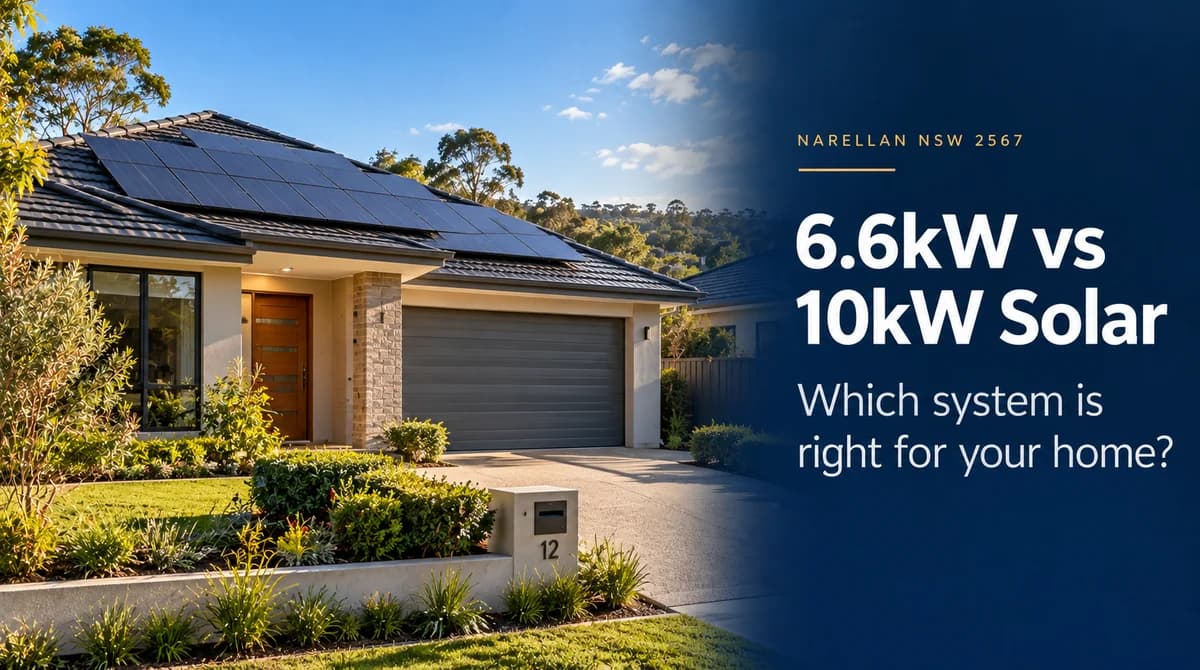
6.6kW vs 10kW Solar Narellan NSW | Kratos Energy
Comparing 6.6kW vs 10kW solar in Narellan? See expected output, roof requirements, household usage, batteries, EVs and which system may suit your home.
6.6kW vs 10kW Solar in Narellan: Which System Is Right for Your Home?
If you are considering solar for a home in Narellan NSW 2567, one of the first decisions is likely to be system size:
Should you install a 6.6kW solar system or move up to a 10kW system?
There is no single answer that suits every Narellan household.
For homes with moderate electricity consumption, a 6.6kW solar system can provide a strong balance between generation, roof space and upfront investment. For households with higher electricity use, ducted air conditioning, a pool, battery storage or plans for an electric vehicle, a 10kW solar system may provide more useful generation and greater flexibility for the future.
The right system should be based on your electricity consumption, usable roof space, daytime energy usage and how your household's energy needs may change over the next five to ten years.
If you are comparing solar options across the state, Kratos Energy's NSW solar guide provides additional information about solar generation, rebates and savings in New South Wales.
6.6kW vs 10kW Solar in Narellan: Quick Comparison
Factor | 6.6kW Solar System | 10kW Solar System |
Best suited to | Small to medium households | Medium to high-energy households |
Kratos indicative generation | Around 26 kWh/day | Around 40 kWh/day |
Roof space required | Lower | Higher |
Ducted air conditioning | Can be suitable depending on usage | Greater generation headroom |
Pool equipment | Possible | Better suited to higher loads |
Future EV charging | Moderate flexibility | Greater flexibility |
Battery readiness | Suitable | More solar available for storage |
Future electricity growth | Moderate | Stronger long-term headroom |
Primary advantage | Lower system size with solid household generation | Higher generation and future flexibility |
Actual solar production varies according to roof orientation, tilt, shading, weather, equipment, inverter configuration and site conditions.
Why Solar System Sizing Matters in Narellan
Narellan is not simply another suburb name to add to a generic solar comparison.
The local housing profile makes system sizing particularly relevant.
According to the 2021 Australian Census, approximately 90.6% of occupied private dwellings in Narellan were separate houses. The average dwelling had approximately 3.4 bedrooms.
That does not automatically mean every Narellan property should install a larger solar system. However, it does show that detached residential housing forms a significant part of the suburb's housing profile.
For homeowners, the key question is therefore not:
“What is the biggest solar system I can install?”
It is:
“What system size best matches the way my household uses electricity?”
A three or four-bedroom home with ducted air conditioning, electric cooking, a pool pump, home-office equipment or future EV charging can have a very different energy profile from a smaller household even when both properties are located in the same postcode.
That is why a 6.6kW vs 10kW solar comparison in Narellan should begin with energy consumption rather than system price alone.
Is a 6.6kW Solar System Enough for a Narellan Home?
For many households, yes.
A 6.6kW solar system remains a practical option for homeowners who want meaningful daytime generation without moving immediately to a larger residential system.
Kratos currently positions its 6.6kW solar system as a popular option for standard two-to-four-person homes.
The current Kratos package lists indicative generation of approximately 26 kWh per day, although actual production depends on the property and installation conditions.
A 6.6kW system may suit your Narellan home if:
Your household electricity consumption is moderate.
You have two to four people living in the home.
Your daytime energy usage is reasonably consistent.
You have limited usable roof space.
You are not running several high-consumption appliances simultaneously.
You are not expecting a major increase in electricity demand.
Your priority is reducing grid electricity purchases without unnecessarily oversizing the system.
For the right household, installing more panels does not automatically mean receiving better financial value.
The objective should be to produce electricity that can be effectively used by the home.
When Does a 10kW Solar System Make More Sense in Narellan?
A 10kW system becomes more attractive when household electricity consumption is higher or is expected to increase.
Kratos currently describes its 10kW solar system as providing additional headroom for homes with loads such as ducted air conditioning, pools, future batteries and EVs.
Its current indicative generation figure is approximately 40 kWh per day, subject to site and operating conditions.
A 10kW system may be worth considering if your home has:
Higher daytime electricity consumption
Ducted air conditioning
A swimming pool or pool heating equipment
Electric hot water
Multiple people working from home
A home battery or plans to install one
An electric vehicle or plans to buy one
A growing family
Sufficient usable roof space
Higher expected future electricity demand
The advantage of the larger system is not simply producing more solar electricity today.
It can also provide additional capacity as the household becomes increasingly electric.
Start With Your Electricity Bill, Not the Number of Panels
Before deciding between 6.6kW and 10kW solar in Narellan, look at your recent electricity bills.
Find your average daily consumption in kilowatt-hours (kWh).
As a simple starting point:
Lower electricity consumption
A household using roughly 10–15 kWh per day may find a 6.6kW system provides more than enough generation under suitable conditions.
Medium electricity consumption
A household using approximately 15–25 kWh per day may need to compare both options more closely.
Daytime consumption, roof conditions, battery plans and future loads become especially important here.
Higher electricity consumption
Homes consuming approximately 25 kWh per day or more may benefit from the additional generation available from a larger system, particularly if a significant portion of that electricity is used during daylight hours.
These are general examples rather than system-sizing rules.
Two homes consuming exactly 20 kWh per day could still require different solar designs if one uses most electricity during the day and the other uses it mainly after sunset.
When You Use Electricity Matters as Much as How Much You Use
Solar panels generate electricity during daylight hours.
That means the value of your system depends heavily on how much solar electricity you can use directly in your home.
Consider two households.
Household A
Electricity consumption occurs throughout the day because people work from home, the washing machine and dishwasher operate during solar hours, air conditioning runs during the afternoon and pool equipment operates while the panels are generating.
This household may achieve relatively high solar self-consumption.
Household B
The house is largely empty throughout the day and most electricity consumption occurs between 5 PM and 10 PM.
Without battery storage, much of its daytime solar generation may be exported rather than consumed directly.
This is why simply choosing the largest possible system based on annual electricity consumption can be misleading.
Your daily consumption pattern matters.
How Much Solar Can 6.6kW and 10kW Systems Generate in Narellan?
Solar generation varies throughout the year.
Summer output will normally be higher than winter output, while cloud cover, orientation, shading, panel quality and temperature can all affect production.
Kratos currently uses indicative generation figures of approximately:
6.6kW solar: around 26 kWh per day
10kW solar: around 40 kWh per day
These figures should be treated as indicative averages rather than guaranteed daily production.
For a more location-specific estimate, use the Kratos Solar Output Calculator.
Enter postcode 2567, select your preferred system size and compare estimated daily, monthly and annual generation.
This is a more useful starting point than relying on a generic Australian solar-output figure because location plays an important role in expected generation.
Roof Space Can Decide Between 6.6kW and 10kW
A 10kW solar array naturally requires more panel capacity and therefore more usable roof area than a 6.6kW system.
However, total roof size is not the same as usable solar roof space.
A solar design needs to account for:
Roof orientation
Roof pitch
Shading from trees
Nearby buildings
Chimneys
Skylights
Roof vents
Antennas
Different roof faces
Installation clearances
Panel dimensions
This means a property with a large roof may still have limited high-quality solar space.
Conversely, a relatively simple and well-oriented roof may allow panels to be positioned more effectively.
The goal should not be to cover every available section of roof.
It should be to place panels where they can contribute effectively to overall system performance.
What Should Narellan Homeowners Consider Before Choosing a System?
A useful system-size decision should consider more than today's electricity bill.
Ask yourself the following questions.
1. How much electricity do we currently use?
Review at least several recent electricity bills rather than relying on one unusually high or low billing period.
Seasonal air-conditioning use can significantly change household consumption.
2. How much electricity do we use during daylight hours?
The more solar electricity you consume directly, the less electricity you need to purchase from the grid.
3. Is our electricity consumption likely to increase?
Think beyond today's appliances.
Future energy requirements could include:
Electric vehicle charging
Battery storage
Heat-pump hot water
Induction cooking
Additional air conditioning
Pool or spa equipment
Home-office equipment
4. Do we have enough usable roof space?
A site assessment should determine how much of the roof is genuinely suitable for productive solar generation.
5. Are we considering a battery?
Battery plans can materially affect how a solar system should be sized.
Planning a Battery? System Size Becomes Even More Important
Battery storage allows some excess solar electricity generated during the day to be stored and used later.
That can make additional solar generation more useful for households that consume a significant amount of electricity after sunset.
For example, excess afternoon generation might later support:
Evening lighting
Cooking
Television and appliances
Air conditioning
Overnight household loads
However, installing a larger system purely because a battery may be added later is not automatically the right decision.
Solar capacity, battery usable capacity, inverter compatibility, household demand and network requirements need to work together.
A well-designed solar-and-battery system should be treated as one energy system, rather than separate products selected independently.
Planning to Buy an EV? Think About Tomorrow's Electricity Use
Electric vehicles are another reason to consider future electricity demand when selecting solar capacity.
An EV effectively introduces a new electrical load to the home.
If the vehicle can regularly charge during solar-generation hours, additional solar capacity may allow a greater proportion of charging energy to come directly from rooftop solar.
For a household currently suited to 6.6kW, a planned EV could therefore shift the long-term calculation toward 10kW.
The important point is not that every EV owner needs 10kW solar.
It is that future EV charging should be included in the system design before the panels are installed.
A Narellan-Specific Factor: Endeavour Energy Flexible Exports
This is one of the most important local considerations for homeowners in Narellan 2567.
Narellan is within the Endeavour Energy network area, and postcode 2567 is included in the first stage of the utility's upcoming NSW CER Installer Portal and emergency backstop rollout.
Endeavour Energy states that the first stage will commence on 2 November 2026 and includes postcode 2567.
The network is also moving toward flexible solar exports for eligible new and upgraded solar systems.
Under flexible exports, eligible customers can export up to 10kW per phase most of the time, with export limits adjusted according to network conditions.
A fixed-export alternative is also available under the published arrangements, subject to Endeavour Energy's conditions.
You can read the current requirements directly on the Endeavour Energy Flexible Exports page.
Why does this matter when comparing 6.6kW and 10kW?
Because solar system capacity and grid-export capacity are not the same thing.
A 10kW solar system may produce more electricity, but the financial value of that additional generation depends on how much your household consumes, stores or is permitted to export at any given time.
For Narellan homeowners, network conditions should therefore form part of the system-design discussion rather than being considered only after installation.
Solar in Narellan: Think Beyond Feed-In Tariffs
Years ago, solar was often discussed primarily in terms of how much electricity could be exported to the grid.
Today, household self-consumption has become increasingly important.
If every kilowatt-hour generated by your panels is immediately used to power an appliance, that electricity does not need to be purchased from your retailer.
Electricity exported to the grid instead earns the applicable feed-in tariff, which may be significantly lower than the retail electricity price.
This means system value increasingly depends on matching solar generation to household consumption.
For many homeowners, the question is no longer simply:
“How much solar can I export?”
It is:
“How much of my own solar electricity can I actually use?”
6.6kW vs 10kW: Which One Is Better for Different Narellan Households?
Scenario 1: Smaller household with moderate electricity use
A couple or small family with moderate electricity consumption, no pool, no EV and limited future load growth may find 6.6kW provides a practical balance.
Likely starting point:
6.6kW
Scenario 2: Family home with ducted air conditioning
A larger household regularly running ducted air conditioning and multiple appliances may benefit from additional solar generation.
Likely starting point:
Compare both systems, with 10kW worth serious consideration.
Scenario 3: Pool + air conditioning + high daytime usage
Pool pumps and cooling loads can create significant daytime demand—the same period in which solar generation is available.
Likely starting point:
10kW may offer stronger generation headroom.
Scenario 4: EV planned within the next few years
Even if today's electricity bill suggests 6.6kW is adequate, future vehicle charging may substantially increase household electricity consumption.
Likely starting point:
Evaluate 10kW as part of the long-term design.
Scenario 5: Battery planned now or later
Either system can work with battery storage depending on the equipment and design.
However, households seeking to store larger amounts of excess daytime solar may benefit from considering additional generation capacity.
Likely starting point:
Design solar and battery together rather than choosing capacity separately.
6.6kW or 10kW Solar in Narellan: The Final Decision
There is no universal winner.
A 6.6kW solar system may be the better option when:
Household electricity consumption is moderate.
Available roof space is limited.
Future electricity demand is unlikely to increase significantly.
The objective is a straightforward residential solar installation.
A 10kW solar system may be the stronger option when:
Electricity consumption is already high.
Ducted air conditioning is frequently used.
The property has a pool or other significant electrical loads.
A battery is planned.
An EV is planned.
Household electricity consumption is expected to increase.
Suitable roof space is available.
For homeowners in Narellan NSW 2567, the best decision should combine household energy consumption, usable roof space, solar generation potential, future energy requirements and Endeavour Energy connection conditions.
Do not choose 6.6kW simply because it is smaller.
Do not choose 10kW simply because it generates more electricity.
Choose the system that matches the way your household will actually use energy.
Frequently Asked Questions
Is a 6.6kW solar system enough for a Narellan home?
How much electricity can a 6.6kW solar system generate?
How much electricity can a 10kW solar system generate?
Is 10kW solar too large for a residential property in Narellan?
What postcode should I use to estimate solar output in Narellan?
Does Narellan have special solar export requirements?
Should I choose a larger solar system if I plan to buy an EV?
Should I choose 10kW if I am adding a battery?
Find the Right Solar System for Your Narellan Home
Kratos Energy assesses factors including:
Household electricity consumption
Daytime energy usage
Roof orientation and usable area
Shading
Current and future electrical loads
Battery requirements
EV charging plans
Inverter configuration
Relevant network requirements
Whether 6.6kW or 10kW solar is the better option for your Narellan home depends on how all of these factors work together.
Get a tailored solar assessment and compare the right system size for your property.
Solar System Packages
Tier 1 panels & CEC accredited installation.
- Trina 475W or Jinko panels
- 5kW power inverter
- 14 × 475W panels
- Single-phase compatible
- Trina 475W or Jinko panels
- 8–10kW power inverter
- 21 × 475W panels
- Battery & EV ready
- Trina 475W or Jinko panels
- 10kW power inverter
- 27 × 475W panels
- Three-phase compatible