
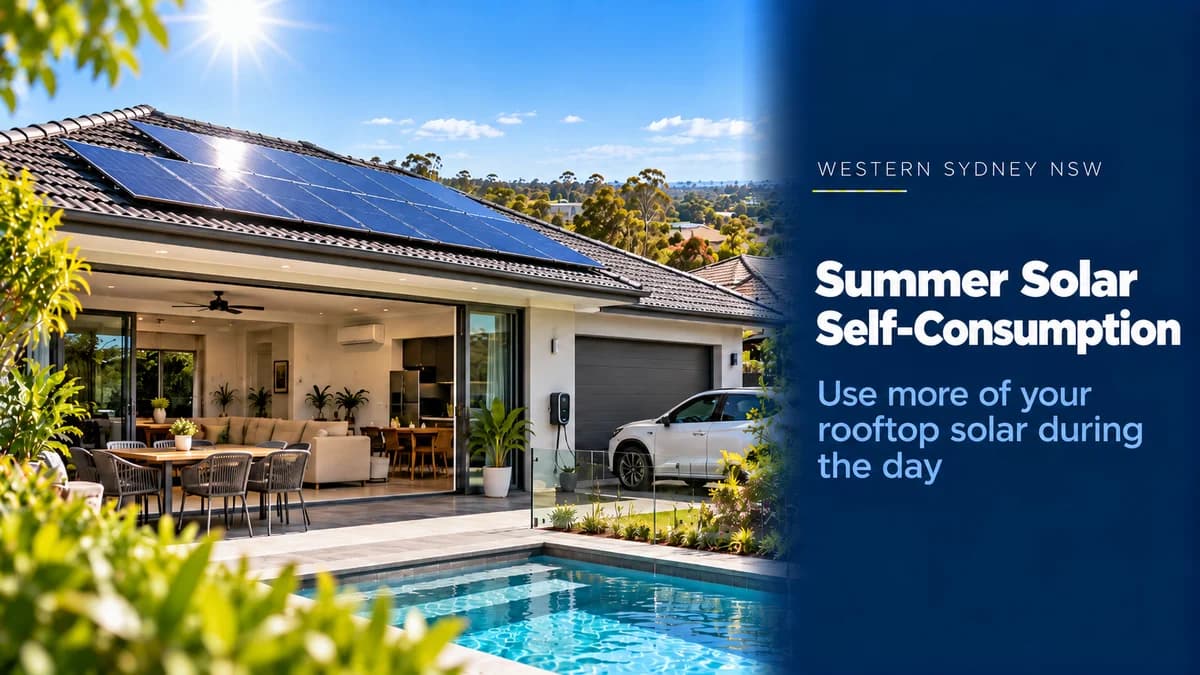
Solar Self-Consumption Western Sydney: Summer Guide
Learn how Western Sydney homes can use more rooftop solar in summer by timing air-conditioning, pools, EV charging and appliances around daytime generation.
Summer Solar Self-Consumption in Western Sydney: How to Use More of What You Generate
Western Sydney can produce strong rooftop solar generation through summer—but generating more solar is not the same as using more solar yourself.
See solar in Western Sydney for the whole region, or the local pages for Erskine Park, Glenmore Park, St Clair, Seven Hills, Kings Langley, Glenwood, Parklea and Wentworthville.
That distinction matters.
If your panels generate electricity while nobody is using much power at home, the excess is generally exported to the grid.
If your household runs air conditioning, pool equipment, hot water, appliances or EV charging while the panels are producing, more of that electricity can be self-consumed directly inside the home.
For homeowners in Western Sydney, where summer cooling demand can be significant, matching household loads to solar-production hours can materially change how effectively a rooftop system is used.
The Australian Government recommends using appliances when solar is generating and identifies 10 AM–4 PM in summer as a typical high-value period for solar self-consumption.
Kratos Energy designs residential systems around roof conditions and household electricity use, with monitoring that allows homeowners to track generation and self-consumption.
Explore Kratos residential solar systems
Solar Generation vs Solar Self-Consumption
These two terms should not be treated as the same thing.
Solar Generation
This is the total electricity your solar panels produce.
Example:
Your system produces:
35kWh in one summer day
That is total generation.
Solar Self-Consumption
This is the portion of that solar electricity used directly inside your home.
Example:
Solar generation:
35kWh
Solar used directly by the home:
21kWh
Solar exported:
14kWh
Self-consumption rate:
21 ÷ 35 × 100 = 60%
So the system generated 35kWh, but the household self-consumed 60% of it.
That is the distinction this article focuses on.
Why Self-Consumption Matters
Every kWh of rooftop solar used directly means one less kWh that needs to be purchased from the electricity retailer.
The Australian Government describes solar self-consumption as using your own solar generation to power household appliances, thereby reducing grid purchases.
This is often more financially valuable than exporting the same kWh and receiving a feed-in tariff.
So the question should not only be:
“How much solar did my system generate?”
It should also be:
“How much of that generation did my home actually use?”
Why This Matters Particularly in Western Sydney
Western Sydney experiences significantly hotter summer conditions than coastal parts of Sydney.
NSW Planning states that Western Sydney experiences an average of 15.4 days above 35°C each year and can be 6–10°C hotter than eastern Sydney during extreme heat events.
That makes cooling one of the most important summer electricity loads for many households.
Instead of seeing air conditioning only as an electricity cost, a solar-equipped household can think about when cooling occurs.
For example:
Air conditioning at 1 PM
may be supplied partly or substantially from rooftop solar.
The same air conditioning at:
8 PM
must generally come from the grid or a battery.
This timing difference is central to summer self-consumption.
Summer Self-Consumption: Quick Guide
Household Load | Better Solar Timing |
Air conditioning | Late morning–afternoon |
Pool pump | Daytime |
Dishwasher | Late morning–early afternoon |
Washing machine | Daytime |
Clothes dryer | Daytime if practical |
Heat-pump hot water | Strong solar period |
EV charging | Daytime when vehicle is home |
Battery charging | Excess solar period |
The Australian Government specifically recommends shifting cooling, pool pumps, laundry and EV charging into solar-generation hours where practical.
Worked Example: Western Sydney Summer Home
Consider a hypothetical Western Sydney household.
This is an illustrative model—not a Kratos customer result.
Solar system
10kW
Summer-day solar generation
Assume:
42kWh
Household consumption
Total:
30kWh
At first glance, it might appear the solar system easily covers the household's electricity use.
But timing matters.
Scenario 1: Low Daytime Self-Consumption
Suppose most household members are away during the day.
Between 10 AM and 4 PM, the home uses only:
Refrigerator
Standby appliances
Basic cooling
Wi-Fi
Daytime household consumption:
8kWh
Solar generation during the day:
42kWh
That means approximately:
34kWh
could potentially be exported, subject to generation profile and other losses.
Later, the family returns home and uses:
Air conditioning
Cooking
Laundry
Entertainment
Hot water
Evening grid import:
22kWh
The home generated plenty of solar.
But it used relatively little of it directly.
Scenario 2: Higher Summer Self-Consumption
Now change the household schedule.
During solar hours, the family:
Pre-cools the house
Runs the pool pump
Runs dishwasher and washing machine
Heats water
Charges an EV for part of the afternoon
Daytime consumption increases from:
8kWh → 22kWh
Solar generation remains:
42kWh
Potential export falls from:
34kWh → around 20kWh
More importantly, the household has avoided buying some of that electricity later.
Total solar generation did not increase.
Self-consumption increased.
That is the objective.
Pre-Cooling Can Shift Air-Conditioning Demand
Air conditioning is one of the strongest opportunities for Western Sydney homes.
The Australian Government specifically recommends running cooling during sunlight hours where practical.
A household might, for example:
12 PM–3 PM
Cool the home while rooftop solar output is strong.
Then:
5 PM–8 PM
Reduce compressor demand by maintaining a reasonable indoor temperature rather than trying to cool a very hot house from scratch.
This does not mean running air conditioning unnecessarily.
The aim is to move some cooling energy into the solar window where practical.
Good insulation, shading and sensible thermostat settings still matter.
Example: Cooling Load and Solar
Imagine your air conditioner draws an average of:
3kW
during a three-hour afternoon period.
Energy consumed:
3kW × 3 hours = 9kWh
If the solar system is producing enough electricity during that period, much of the 9kWh can potentially come directly from the roof.
If the same 9kWh of cooling occurs after sunset:
Solar contribution = 0kWh
unless a battery is supplying stored energy.
That is why the timing of summer cooling demand matters so much.
Pool Pumps Are Another Strong Daytime Load
Pool filtration is often flexible enough to run during daylight hours.
Suppose a pool pump uses:
1.2kW
and operates for:
5 hours
Daily consumption:
6kWh
If it runs overnight, that 6kWh is generally bought from the grid.
If it runs from approximately:
10 AM–3 PM
it can potentially absorb 6kWh of rooftop generation that might otherwise have been exported.
The Government specifically lists pool pumps among appliances suitable for daytime scheduling with solar.
EV Charging Can Significantly Increase Self-Consumption
EV charging can be an even larger flexible household load.
If an EV is at home during the day, a smart charger can use surplus solar rather than exporting that electricity.
Kratos currently offers solar-matched EV charging, including 7kW and 22kW home charging options.
For example:
Solar surplus:
5kW
EV charge demand:
5kW
Instead of:
5kW → grid export
the flow becomes:
5kW → EV
That is direct solar self-consumption.
Explore Kratos smart EV charging
Do Not Turn Everything On at Noon
There is an important limit to load shifting.
Running every appliance at the same time does not necessarily maximise savings.
Suppose at 1 PM your solar system is producing:
7kW
while you simultaneously run:
Air conditioning — 3kW
EV charger — 5kW
Pool pump — 1kW
Dishwasher — 1.5kW
Total load:
10.5kW
The house may still need to import roughly:
3.5kW
from the grid at that moment.
A better approach may be to sequence flexible loads.
For example:
10 AM–12 PM: pool pump
12 PM–2 PM: air conditioning + dishwasher
2 PM–4 PM: EV charging
Your exact schedule should follow real monitoring data rather than a generic timetable.
Use Your Monitoring App to Find the Best Window
The strongest self-consumption strategy is based on your own energy data.
Look for:
Solar generation curve
When does output rise, peak and fall?
Export periods
When is the home regularly sending electricity to the grid?
Household consumption
Which appliances are operating during those periods?
Evening imports
Which loads could potentially be shifted earlier?
Kratos' current residential systems include Wi-Fi production monitoring and are designed so homeowners can track generation and self-consumption.
If your monitoring shows high exports between:
11 AM and 3 PM
that is the first period to investigate for load shifting.
How Much Solar Might a Western Sydney Home Generate?
Actual generation depends on:
Postcode
System size
Roof orientation
Shade
Weather
Panel performance
Kratos' Solar Output Calculator notes that a typical Australian 6.6kW system may produce around 25–30kWh/day on annual average, with summer days generally above the annual average and winter days below it.
That is important.
A strong summer solar day can create significant midday surplus.
The challenge is not always producing enough electricity.
It is using enough of it while it is being produced.
Estimate solar generation for your Western Sydney postcode
Should You Install a Larger Solar System to Improve Self-Consumption?
Not automatically.
A larger system increases generation.
It does not automatically increase the percentage of solar used directly.
Consider:
6.6kW System
Generation:
28kWh
Home directly uses:
18kWh
Self-consumption:
64%
Now imagine installing a larger array.
10kW System
Generation:
42kWh
Home directly uses:
20kWh
Self-consumption:
48%
The larger system generated much more energy.
But the self-consumption percentage actually fell because more electricity was exported.
That does not automatically make the larger system a poor investment.
It simply demonstrates that:
Generation and self-consumption are different metrics.
System sizing should consider both.
Self-Consumption Rate vs Solar Coverage
Two more terms can be confused.
Self-Consumption Rate
What percentage of your solar generation is used inside the home?
Formula
Solar used onsite ÷ solar generated
Solar Coverage
What percentage of your household electricity demand is supplied by solar?
Formula
Solar used onsite ÷ total household consumption
Example:
Solar generated:
40kWh
Solar used onsite:
20kWh
Household consumption:
30kWh
Self-consumption:
50%
Solar coverage:
67%
Both numbers are useful, but they answer different questions.
When Does a Battery Help?
A battery can increase self-consumption by storing daytime excess solar and using it later.
Kratos describes its battery systems as storing daytime generation for use after sunset.
For example:
Daytime excess solar:
12kWh
Evening household demand:
10kWh
Without storage:
12kWh → exported
then later:
10kWh → grid import
With an appropriately sized battery:
some of that daytime surplus can instead become:
Solar → battery → evening home
That raises overall self-consumption.
Explore Kratos home battery storage
But Improve Direct Self-Consumption First
Battery storage introduces:
Upfront cost
Conversion losses
Battery degradation
Additional system complexity
So before using a battery to shift every possible load, check whether some consumption can simply happen while the sun is shining.
For example:
Solar → pool pump
is more direct than:
Solar → battery → pool pump later
where daytime operation is practical.
A battery is particularly useful for loads that genuinely need to occur after sunset.
Summer Self-Consumption Example
Consider a household producing:
40kWh/day
and using:
32kWh/day
The table below shows why timing matters.
Energy Profile | Low Daytime Use | Optimised Daytime Use |
Solar generation | 40kWh | 40kWh |
Direct solar use | 12kWh | 23kWh |
Solar exported | 28kWh | 17kWh |
Household consumption | 32kWh | 32kWh |
Self-consumption rate | 30% | 58% |
Grid electricity required | Higher | Lower |
The solar system has not changed.
The household's electricity consumption has not changed.
Only the timing changed.
That is the principle behind self-consumption optimisation.
What Loads Should You Shift First?
Prioritise appliances that:
Use significant electricity
and:
Can operate flexibly during the day
A practical priority list is:
Air conditioning
EV charging
Pool filtration
Heat-pump hot water
Dishwasher
Washing machine
Clothes dryer
The Australian Government similarly highlights cooling, pool pumps, EV charging and major appliances as candidates for daytime scheduling.
Western Sydney Heat Makes Building Efficiency Important Too
Solar can offset cooling electricity.
But reducing cooling demand can be equally valuable.
NSW planning guidance highlights strategies such as:
External shading
Natural ventilation
Roof and façade design
Insulation
Vegetation
Heat-reflective materials
as ways to reduce heat absorption and indoor cooling demand.
So a strong summer energy strategy combines:
efficient home + sensible cooling + rooftop solar + smart timing.
Solar should not be used as an excuse to waste energy simply because generation is high.
6.6kW vs 10kW vs 13kW in Western Sydney
Kratos currently offers residential starting configurations around:
6.6kW
10kW
13kW
Custom designs.
A larger system can make sense where the home has substantial daytime loads such as:
Ducted air conditioning
Pool equipment
EV charging
Battery charging
Work-from-home demand
But the system should still be designed from:
household consumption + roof + self-consumption potential + future demand.
Do not choose system size purely from roof capacity.
Western Sydney Summer Self-Consumption Checklist
Before changing your system or buying a battery, check:
Solar
Daily summer generation
Midday production
Export periods
System size
Household Loads
Cooling
Pool pump
Hot water
Laundry
EV charging
Timing
Which loads currently happen after sunset?
Which can safely move into 10 AM–4 PM?
Can timers or smart controls automate them?
Monitoring
Self-consumption
Grid imports
Solar exports
Peak-demand periods
Future
EV?
Battery?
Larger air-conditioning system?
Pool?
More daytime occupancy?
These answers provide a much better energy strategy than simply trying to maximise total solar generation.
Frequently Asked Questions
What is solar self-consumption?
What is the best time to use solar power in summer?
Should I run air conditioning during the day with solar?
Does more solar generation mean higher self-consumption?
Can pool pumps increase solar self-consumption?
Can an EV increase self-consumption?
Does a battery increase solar self-consumption?
Is Western Sydney particularly suited to summer solar self-consumption?
Summer Solar Self-Consumption in Western Sydney: The Bottom Line
For a Western Sydney home, summer solar performance should not be judged from generation alone.
The stronger question is:
How much of that generation are you actually using?
Start with:
Monitor exports → identify flexible loads → move suitable consumption into solar hours → reassess imports → then consider storage.
Cooling is particularly important in Western Sydney.
Pool pumps, hot water, appliances and EV charging can also provide useful daytime demand.
The aim is not to consume more electricity unnecessarily.
It is to shift electricity you were already going to use into the period when your own roof is producing it.
Explore Kratos residential solar systems
Estimate your solar output by postcode
Contact Kratos Energy for a tailored solar assessment
The best summer solar system is not simply the one that generates the most electricity—it is the one your household can use intelligently while the sun is shining.
Solar System Packages
Tier 1 panels & CEC accredited installation.
- Trina 475W or Jinko panels
- 5kW power inverter
- 14 × 475W panels
- Single-phase compatible
- Trina 475W or Jinko panels
- 8–10kW power inverter
- 21 × 475W panels
- Battery & EV ready
- Trina 475W or Jinko panels
- 10kW power inverter
- 27 × 475W panels
- Three-phase compatible