

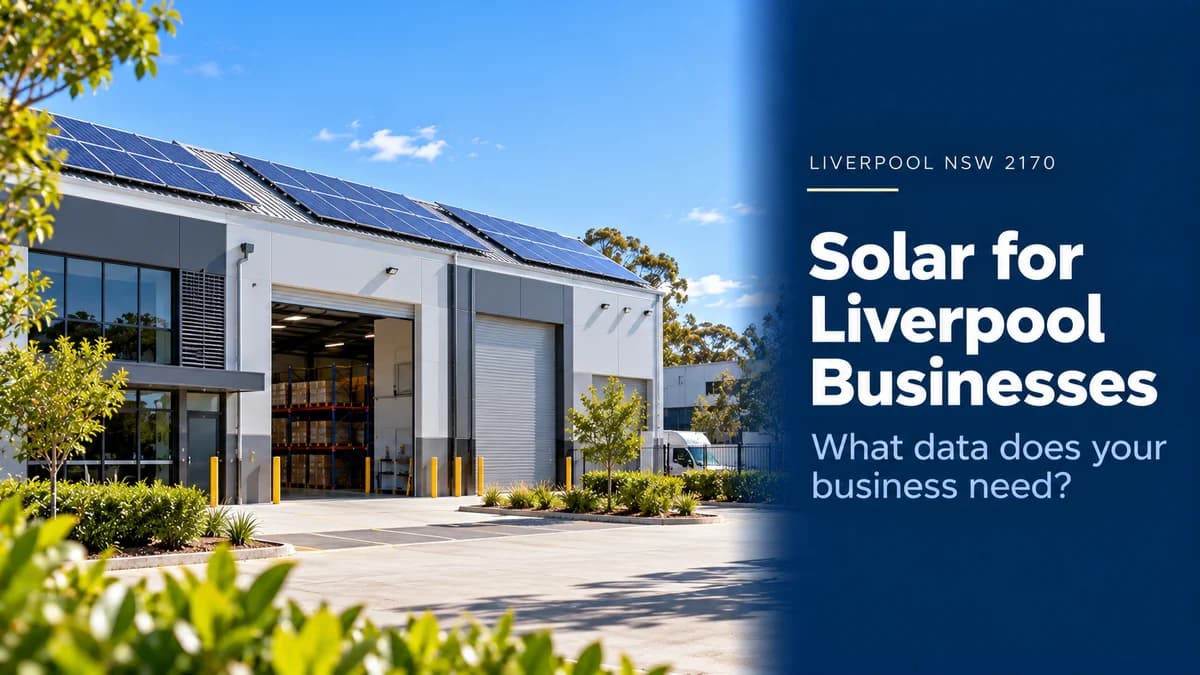
Commercial Solar Assessment Liverpool NSW
Planning commercial solar in Liverpool NSW 2170? See the bills, interval data, roof details, operating hours and network information needed for an accurate solar assessment.
Solar for Liverpool Businesses: What Data Do You Need for a Commercial Solar Assessment?
For a business in Liverpool NSW 2170, a useful commercial solar proposal should not begin with:
“How many panels can fit on the roof?”
It should begin with:
“How and when does this business use electricity?”
Commercial solar economics depend heavily on daytime consumption, electricity tariffs, operating hours, roof availability and network connection conditions.
Before a system can be sized properly, an installer should normally understand:
At least 12 months of electricity bills
Smart-meter or interval consumption data
Business operating hours
Roof or ground-space availability
Property ownership or lease arrangements
Existing switchboard and electrical supply
Major electrical equipment
Future electricity demand
Network connection and export requirements
Kratos Energy's commercial solar solutions are built around energy audits, load profiles, tariffs and site-specific system design rather than standard residential-style packages. (Kratos Energy)
Commercial Solar Assessment: Quick Checklist
Information | Why It Matters |
12 months of bills | Shows annual energy use, tariff and seasonal changes |
Interval data | Shows exactly when electricity is consumed |
Operating hours | Helps match solar production to business demand |
Roof ownership | Confirms who can approve the installation |
Roof condition | Identifies structural or replacement issues |
Main switchboard | Helps determine connection requirements |
Supply phase/capacity | Important for inverter and system design |
Major equipment | Identifies large daytime electrical loads |
Future loads | EVs, HVAC or machinery can change system size |
Network assessment | Determines connection and export conditions |
The more accurate the input data, the more useful the savings and payback model can be.
Why Commercial Solar Is Relevant in Liverpool
Liverpool is a major commercial and industrial centre in South-West Sydney.
Liverpool City Council reported in 2025 that the city had approximately 22,304 registered businesses supporting more than 114,000 local jobs, with transport, postal and warehousing its largest industry by economic value. (Liverpool City Council)
That business mix creates several property types that can potentially suit commercial solar:
Warehouses
Logistics facilities
Retail premises
Workshops
Manufacturing sites
Offices
Medical facilities
Service businesses
Many of these businesses operate heavily during daylight hours—the same period when rooftop solar is generating.
But two Liverpool businesses with the same roof size can require completely different solar systems if their electricity profiles differ. More details...
1. Start With 12 Months of Electricity Bills
One electricity bill is rarely enough for commercial solar design.
A better starting point is 12 months of bills, because commercial consumption can change significantly across seasons.
The bills should help identify:
Total annual kWh consumption
Monthly or quarterly usage
Electricity tariff
Usage charges
Demand charges, where applicable
Network charges
Controlled or separate loads
Solar exports if a system already exists
Why 12 months?
Consider a business that uses:
40,000 kWh in summer
but only:
18,000 kWh in winter
Designing solar using only the summer bill could result in excessive generation for much of the year.
The objective is to understand the site's annual demand profile.
2. Interval Data Is More Important Than the Bill Total
For commercial solar, interval data is one of the most useful inputs.
A bill tells you:
how much electricity was used.
Interval data tells you:
when it was used.
Smart-meter data can show consumption across short time intervals throughout each day.
That helps identify:
Morning demand
Midday demand
Afternoon demand
Overnight baseload
Weekend usage
Seasonal patterns
Maximum-demand periods
Example
Two businesses each use:
300 kWh/day
But:
Business A
Uses 250 kWh between 7 AM and 5 PM.
Business B
Uses only 100 kWh during the day and 200 kWh overnight.
Business A may have much greater potential to use solar directly.
Same daily consumption. Different commercial solar opportunity.
3. Operating Hours Help Determine Self-Consumption
Commercial solar is often particularly effective when the business operates while the sun is shining.
Examples include:
Warehouse
6 AM–6 PM
High daytime lighting, ventilation, office and machinery loads.
Retail store
9 AM–6 PM
Air conditioning, refrigeration, lighting and equipment align with solar production.
Workshop
7 AM–4 PM
Tools, compressors and machinery create daytime demand.
Restaurant
May have strong lunch and evening loads, requiring a different assessment.
This is why a commercial assessment should record:
Opening time
Closing time
Days per week
Weekend operation
Seasonal shutdowns
Public-holiday closures
The aim is to determine how much solar can be consumed directly by the business.
4. Identify Your Largest Electrical Loads
The installer should understand what is driving the electricity bill.
Typical commercial loads include:
Air conditioning
Refrigeration
Cold rooms
Pumps
Compressors
Manufacturing equipment
Lighting
Commercial kitchens
Servers
Machinery
EV chargers
These loads can strongly influence solar sizing.
For example, a warehouse running large refrigeration equipment throughout the daytime may use solar very differently from a similarly sized warehouse used mainly for storage.
A good assessment should therefore connect:
electricity data → business equipment → operating schedule.
5. Future Electricity Demand Matters Too
Commercial solar should not be designed only around today's load.
Ask whether the business expects to add:
Electric vehicles
Fleet charging
Additional refrigeration
New machinery
Expanded production
Additional air conditioning
Battery storage
A second tenancy
Longer operating hours
Suppose current daytime demand suggests a 50kW system.
If the business plans to install multiple EV chargers within two years, a larger system or battery-ready design may deserve consideration from the beginning.
Future expansion should be documented before final system sizing.
6. Roof Ownership Can Decide Whether the Project Moves Forward
Commercial properties are frequently leased.
That makes roof ownership and approval important.
Owner-occupied property
The business owner controls both the energy bill and building, usually simplifying the approval process.
Tenant-operated property
The tenant may pay the electricity bill while the landlord owns the roof.
In this situation, clarify:
Who pays for the solar installation?
Who owns the system?
How long remains on the lease?
Who receives the electricity savings?
Who maintains the equipment?
What happens when the lease ends?
Who approves roof penetrations and access?
A solar project can have excellent technical economics but still be unsuitable if the lease arrangement does not support the investment period.
7. Assess the Roof Before Finalising System Size
Commercial buildings often have large roofs, but total roof area is not the same as usable solar area.
The assessment should consider:
Roof dimensions
Roof orientation
Shade
Roof material
Structural condition
Skylights
HVAC equipment
Ventilation
Roof access
Fire and maintenance access
Existing services
For older commercial buildings, roof condition can be particularly important.
If major roof replacement is likely within the next few years, completing that work before solar may avoid the cost of removing and reinstalling the system later.
8. Check the Main Switchboard and Electrical Supply
A commercial solar system ultimately connects into the property's electrical infrastructure.
The assessment should record:
Single-phase or three-phase supply
Main switchboard condition
Available switchboard capacity
Existing protection equipment
Supply capacity
Metering configuration
Existing generation equipment
Larger commercial systems may require more detailed engineering than a standard residential installation.
Kratos currently offers commercial systems from approximately 30kW through 100kW+, including customised designs. (Kratos Energy)
9. Network Connection Must Be Assessed Early
Liverpool postcode 2170 sits within the Endeavour Energy network area and is included in the first stage of the NSW CER Installer Portal rollout beginning 2 November 2026. Endeavour Energy says the new process will apply to new and upgraded consumer-energy-resource systems up to 200kW in applicable rollout areas. (Endeavour Energy)
For businesses, network assessment can affect:
Inverter capacity
Export limits
Required technical studies
Connection costs
System design
Installation timeline
Endeavour Energy specifically recommends that businesses assess their energy needs, roof space and future plans before selecting a solar or battery system. (Endeavour Energy)
For larger embedded-generation systems, a detailed network assessment may be required rather than the fast-track process used for smaller installations. (Endeavour Energy)
This is why commercial solar should not be designed solely around roof capacity.
How Export Limits Affect Commercial Solar
Imagine a Liverpool warehouse has enough roof space for 150kW of solar.
That does not automatically mean it should export 150kW.
The system could instead be designed so that much of the solar generation is consumed inside the facility.
For example:
Solar output: 120kW
Business demand at that moment: 100kW
Potential export: 20kW
High daytime self-consumption can make a large commercial system valuable even where export capacity is restricted.
The assessment therefore needs to model:
generation + onsite demand + permitted export
together.
What About Demand Charges?
Some commercial electricity tariffs include demand charges based partly on the site's highest demand during specified periods.
Solar may reduce demand charges in some circumstances, but it does not automatically eliminate them.
For example:
If a business's highest demand occurs at:
2 PM
solar may help reduce that peak.
If maximum demand consistently occurs at:
8 PM
rooftop solar alone may have little impact on that peak.
Interval data is therefore essential before including demand-charge savings in the business case.
Any financial proposal should explain separately:
Energy-charge savings
Export revenue
Potential demand-charge impact
Fixed charges that remain
Do You Need Battery Storage?
Not every Liverpool business needs a battery.
Battery storage deserves investigation when the site has:
Significant solar exports
High evening electricity use
Demand-management opportunities
Backup requirements
EV charging
Time-of-use pricing
For a warehouse that consumes most solar generation immediately during working hours, solar alone may already deliver strong utilisation.
A business closing at 5 PM but consuming heavily overnight may have a stronger case for storage.
Battery sizing should therefore follow the load analysis rather than being added automatically.
Example: Liverpool Warehouse Solar Assessment
Consider an illustrative Liverpool warehouse.
Annual consumption:
180,000 kWh
Operating hours:
7 AM–6 PM, Monday–Saturday
Major loads:
Lighting
Office air conditioning
Forklift charging
Ventilation
Warehouse equipment
Interval data shows:
75% of electricity is consumed during daylight operating hours.
The roof can accommodate more than 100kW of panels.
What should happen next?
The assessment should compare multiple system sizes rather than immediately installing the maximum capacity.
For example:
50kW → higher self-consumption, lower upfront cost
100kW → greater generation, potentially greater exports
100kW + battery → different capital cost and load-management strategy
The best option depends on the business's tariffs, network conditions, budget and future plans.
This is an illustrative example—not a Liverpool customer result.
What Should the Commercial Solar Financial Model Show?
Before committing to a project, the proposal should clearly show its assumptions.
Look for:
Metric | What It Should Explain |
System size | Proposed solar capacity |
Annual generation | Estimated kWh/year |
Self-consumption | Solar used directly onsite |
Export | Expected surplus generation |
Electricity tariff | Rate used in savings model |
Annual savings | Estimated bill reduction |
System cost | Complete installed project cost |
Payback | Simple payback assumptions |
Future loads | Whether expansion is included |
Network conditions | Export/connection assumptions |
If the savings calculation cannot show where its numbers came from, ask for more detail.
What Information Should You Send Before Requesting a Quote?
For a faster commercial solar assessment in Liverpool NSW, prepare:
Electricity information
12 months of electricity bills
Interval or smart-meter data where available
Property information
Site address
Roof ownership
Lease status
Roof plans or aerial/site plans if available
Business information
Operating hours
Days of operation
Major electrical equipment
Planned future loads
Electrical information
Main switchboard photos
Meter photos
Existing solar details
Single-phase or three-phase supply where known
You do not need to perform the engineering yourself.
The purpose is to give the solar designer enough information to produce a realistic first assessment.
Frequently Asked Questions
What information is needed for a commercial solar quote in Liverpool?
Why does commercial solar need interval data?
Is commercial solar suitable for warehouses in Liverpool?
Can a tenant install commercial solar?
Is a 100kW system automatically better than 50kW?
Which electricity network covers Liverpool NSW 2170?
Does Kratos install commercial solar?
Commercial Solar Assessment in Liverpool: The Bottom Line
For a Liverpool NSW business, the best commercial solar proposal starts with data—not panel count.
Before choosing a system, establish:
Bills → interval data → operating hours → major loads → roof rights → electrical infrastructure → future demand → network conditions.
Once those inputs are understood, a commercial solar designer can model:
Appropriate system size
Expected generation
Self-consumption
Exports
Annual bill savings
Payback
Battery requirements
Kratos Energy provides commercial solar design from smaller business rooftops through to 100kW+ customised systems. Its current project portfolio also includes a 50kW commercial solar + 48kWh battery installation in Sydney, demonstrating the type of combined solar-and-storage configuration available for commercial sites. (Kratos Energy)
Explore Kratos commercial solar solutions
Contact Kratos Energy about your business site
A good commercial solar assessment does not begin by filling the roof. It begins by understanding where the electricity bill actually comes from.
Solar System Packages
Tier 1 panels & CEC accredited installation.
- Trina 475W or Jinko panels
- 5kW power inverter
- 14 × 475W panels
- Single-phase compatible
- Trina 475W or Jinko panels
- 8–10kW power inverter
- 21 × 475W panels
- Battery & EV ready
- Trina 475W or Jinko panels
- 10kW power inverter
- 27 × 475W panels
- Three-phase compatible