

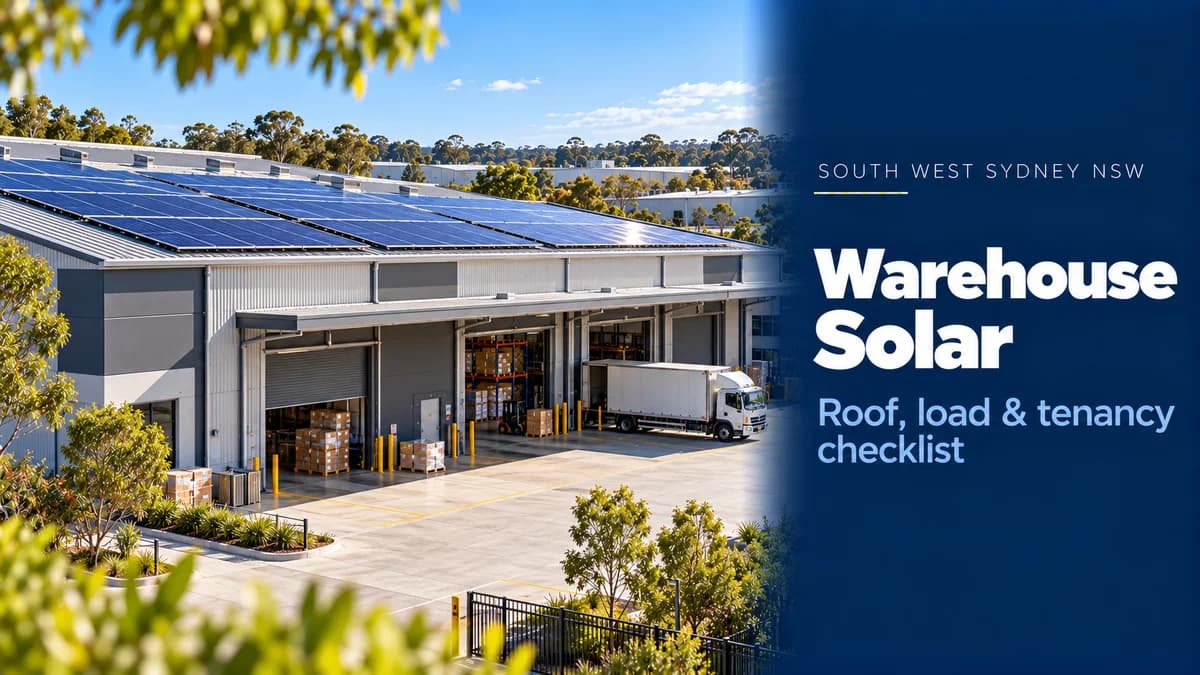
Warehouse Solar South West Sydney: 2026 Commercial Guide | Kratos
Planning warehouse solar in South West Sydney? Learn how roof size, interval data, daytime loads, tenancy, demand charges, grid connection and 30–100kW+ systems affect ROI.
Solar for Warehouses in South West Sydney: What Should Businesses Assess First?
Warehouses can be strong candidates for commercial solar—but a large roof does not automatically mean the largest possible solar system is the right choice.
For a warehouse in South West Sydney, system design should begin with the site's actual electricity profile:
How much electricity does the facility use?
When is that electricity used?
How much productive roof area is available?
Is the building owned or leased?
Are demand charges included in the tariff?
Is electricity used overnight?
Will EV charging, automation or refrigeration increase future demand?
How much solar can the site use before exporting to the grid?
For most warehouses, the key objective is to maximise valuable onsite solar consumption rather than simply fill the roof with panels.
Kratos Energy currently designs commercial systems from 30kW through 100kW+, using load profiles, electricity tariffs and available roof or ground space to determine appropriate system capacity.
Explore Kratos commercial solar systems
Why Warehouse Solar Is Relevant in South West Sydney
The NSW Government defines South West Sydney as including the Canterbury-Bankstown, Fairfield and Liverpool local government areas.
Warehousing and logistics are particularly important around Liverpool. Liverpool City Council reported in 2026 that Transport, Postal and Warehousing is the city's largest industry by value, worth approximately $2.3 billion annually.
That makes commercial solar particularly relevant to facilities such as:
Distribution centres
Storage warehouses
Freight businesses
Wholesale facilities
Light manufacturing sites
Industrial workshops
Refrigerated warehouses
Many of these facilities combine large roof areas with substantial daytime electricity demand—a combination that can suit rooftop solar well.
But each site still requires its own assessment.
Warehouse Solar: Quick Assessment Checklist
Information | Why It Matters |
12 months of electricity bills | Shows annual and seasonal consumption |
Interval meter data | Shows exactly when electricity is used |
Operating hours | Determines solar/load overlap |
Demand charges | Can materially affect the business case |
Roof dimensions | Establishes physical solar capacity |
Roof condition | Identifies repair/replacement issues |
Roof ownership | Important for leased warehouses |
Switchboard and supply | Affects electrical design |
Network connection | Determines allowable connection/export |
Future loads | EVs, automation and HVAC may increase demand |
Night-time use | Helps assess battery value |
The Australian Government specifically recommends using interval meter data for business solar modelling because it produces a more accurate estimate of solar and battery performance than annual consumption alone.
1. Start With 12 Months of Electricity Data
For warehouse solar, one electricity bill is not enough.
At minimum, review a full year of bills to identify:
Annual kWh consumption
Seasonal changes
Usage rates
Demand charges
Supply charges
Existing feed-in credits
Peak electricity periods
A warehouse using 300,000kWh per year may appear suitable for a large solar installation.
But that number alone does not tell you whether the electricity is consumed at:
11 AM
or:
11 PM.
That difference can completely change the most appropriate solar size.
2. Interval Data Is More Valuable Than the Annual Total
Smart-meter or interval data shows electricity consumption throughout each day.
This lets the solar designer compare:
warehouse demand vs expected solar production hour by hour.
Consider two hypothetical warehouses.
Warehouse A
Annual consumption:
250,000kWh
Most electricity is used:
7 AM–5 PM
Warehouse B
Annual consumption:
250,000kWh
Most electricity is used:
6 PM–6 AM
Both consume exactly the same annual electricity.
But Warehouse A can potentially consume a much larger share of rooftop solar directly.
Warehouse B may require a different combination of:
solar + battery + tariff management.
This is why annual kWh alone is not enough for warehouse design.
3. Identify the Warehouse's Daytime Base Load
A particularly useful number is the site's minimum daytime demand.
Suppose a warehouse rarely falls below:
35kW between 9 AM and 4 PM
because it continuously operates:
Lighting
Ventilation
Office equipment
Conveyor systems
Refrigeration
Forklift charging
Machinery
That consistent daytime load may allow a significant amount of solar generation to be consumed onsite.
By contrast, a storage warehouse with only:
5–10kW daytime demand
may export considerably more electricity from the same rooftop system.
A commercial proposal should therefore show:
How much solar will be self-consumed?
not simply:
How much solar will be generated?
Why Self-Consumption Matters
Solar electricity used inside the warehouse replaces electricity that would otherwise be purchased from the retailer.
Solar exported to the grid may receive a feed-in credit, depending on the electricity plan.
The Australian Government notes that feed-in tariffs are generally lower than the cost of purchasing grid electricity, so using solar onsite normally creates more value than exporting it.
For a warehouse, the ideal pattern is often:
Solar production → warehouse equipment
rather than:
Solar production → grid export
That is one reason daytime industrial businesses can be well suited to commercial solar.
4. How Much Roof Space Is Actually Usable?
Warehouse roofs can look enormous from satellite imagery.
But not every square metre can necessarily hold solar panels.
A proper site assessment should consider:
Roof orientation
Roof pitch
Structural capacity
Roof material
Skylights
HVAC equipment
Ventilation
Shade
Roof drainage
Fire access
Maintenance access
Existing electrical equipment
A 5,000m² warehouse roof does not automatically provide 5,000m² of usable solar area.
The final array should be designed around the productive and technically suitable sections of the roof.
5. Check Roof Condition Before Installing Solar
Commercial panels may remain in service for decades.
If the warehouse roof is likely to require major replacement in the near future, installing solar first could create additional costs later.
The business may then need to pay for:
panel removal → roof replacement → panel reinstallation.
Before approving the installation, assess:
Roof age
Corrosion
Existing leaks
Structural condition
Planned roofing work
For older industrial buildings, a structural engineering assessment may also be required as part of the project.
The objective is to install solar on a roof capable of supporting the system for the expected project life.
6. 30kW, 50kW or 100kW Solar?
Kratos currently offers standard commercial configurations at:
30kW
Positioned for lower-to-medium commercial energy demand and smaller warehouses.
50kW
Designed for standard commercial and industrial applications including warehouses and factories.
100kW
Designed for larger commercial sites, with customised systems also available above this capacity.
These are starting configurations—not automatic recommendations.
The correct capacity should be determined from actual electricity usage.
Worked Example: A South West Sydney Warehouse
Consider a hypothetical warehouse operating:
Monday–Saturday, 6 AM–6 PM
with:
Annual electricity consumption: 180,000kWh
and substantial daytime loads from:
Lighting
Ventilation
Forklift charging
Office air conditioning
Warehouse machinery
Interval data shows that approximately:
75% of electricity is used during daylight operating hours.
The warehouse has enough roof space for more than 100kW of solar.
Instead of immediately installing the maximum possible array, the business could compare several options.
Option A — 30kW Solar
Kratos' current 30kW package uses an indicative production figure of approximately:
114kWh/day
under its reference assumptions.
Potential advantage
A high proportion of generation could be consumed directly by a warehouse with strong daytime demand.
Potential limitation
The system may offset only a relatively small portion of a high-consumption facility.
Option B — 50kW Solar
Kratos' current 50kW commercial package uses an indicative generation figure of:
~190kWh/day
and specifically positions the system for warehouses, factories and other commercial/industrial applications.
View the Kratos 50kW commercial solar system
For our example warehouse, this may provide a stronger match to daytime load without necessarily creating very large exports.
But the result should still be checked against interval data.
Option C — 100kW Solar
Kratos' current 100kW package uses an indicative figure of approximately:
380kWh/day
under its reference assumptions.
A warehouse with large and consistent daytime demand may be able to use much of that generation.
A lower-load warehouse may export or curtail considerably more.
So the decision should not simply be:
“We have enough roof for 100kW.”
It should be:
“Can our business productively use the electricity from 100kW?”
All production figures above are indicative Kratos reference figures rather than site-specific generation guarantees. Actual performance depends on roof orientation, shade, weather, equipment and system losses.
7. Demand Charges Can Change the Financial Model
Commercial electricity bills often include more than a standard c/kWh usage charge.
Many business tariffs include a demand charge, which is based on the site's highest grid demand during a specified period.
For example, suppose the warehouse reaches its monthly maximum demand at:
2 PM
while solar is producing strongly.
Solar could reduce the amount of grid power being drawn at that moment and may therefore reduce the measured peak.
But if maximum demand occurs at:
9 PM
solar alone cannot directly reduce that peak.
This is why commercial proposals should not promise demand-charge savings without analysing the site's interval data and tariff structure.
8. Could a Battery Help a Warehouse?
Possibly—but batteries should not automatically be added to every commercial solar installation.
The Australian Government notes that business batteries can help where a site needs to:
Use solar after generation falls
Reduce peak-period electricity purchases
Manage demand charges
Provide backup for suitable loads.
A warehouse may be a stronger battery candidate if it has:
Significant afternoon or evening consumption
High peak-demand charges
Large daytime solar exports
Critical backup loads
Overnight refrigeration
Electric fleet charging
A warehouse that uses nearly all of its solar directly during the day may achieve a strong result without battery storage.
Example: Solar + Battery for Commercial Operations
Kratos completed a 50kW commercial solar system with 48kWh of battery storage in Chester Hill, Sydney, in July 2026.
The installation uses commercial solar alongside battery storage, showing how generation and storage can be combined where the site's operating profile justifies it.
View Kratos commercial solar projects
A warehouse should still be modelled from its own consumption data rather than copying another project's solar-to-battery ratio.
9. Warehouse Tenancy Can Be as Important as Solar Output
Many South West Sydney warehouses are leased rather than owner-occupied.
That creates another layer of questions.
Before installing solar on a leased warehouse, clarify:
Who owns the roof?
Who pays the electricity bill?
Who pays for the solar system?
How long remains on the lease?
Who receives the financial benefit?
Who owns the equipment when the lease ends?
Who pays for future maintenance?
Can panels remain if the tenant leaves?
A technically excellent project can still have a poor commercial structure if the business expects to leave the property before recovering its investment.
For leased facilities, the landlord, tenant and solar provider should understand the project structure before installation.
10. Future Warehouse Loads Should Be Included
Warehouse electricity consumption can change substantially over time.
A commercial assessment should ask whether the business expects to add:
Electric delivery vehicles
Forklift charging
Refrigeration
Automated picking systems
Additional machinery
Data equipment
Expanded offices
Air conditioning
Longer operating hours
Western Sydney is continuing to attract major freight, logistics and distribution investment. NSW planning documents identify warehousing, logistics and industrial development as important components of the region's employment areas, while current Aerotropolis investment includes large distribution projects and automated logistics facilities.
Solar installed today should therefore consider credible future electrical demand, not just the last electricity bill.
11. Grid Connection and Export Need Early Attention
Commercial solar needs electricity-network approval.
For South West Sydney, do not assume the network distributor solely from the words “South West Sydney.” The exact distributor and connection requirements should be confirmed from the site's electricity bill and address.
The network assessment can influence:
Inverter capacity
Export limit
Protection requirements
Metering
Engineering studies
Connection cost
Project timing
Kratos states that its commercial service includes grid-connection coordination and technical compliance as part of the project process.
The connection assessment should happen early enough that a system is not financially modelled around exports that cannot ultimately be approved.
A Major 2026 Change for 100kW–1MW Warehouse Solar
Commercial businesses planning systems above 100kW should be aware of a significant change beginning 1 October 2026.
The Clean Energy Regulator has expanded the Small-scale Renewable Energy Scheme to eligible solar PV systems between:
100kW and 1MW
installed from 1 October 2026.
Eligible mid-scale systems can access upfront support through Small-scale Technology Certificates (STCs) and receive a fixed five-year deeming period under the expanded scheme.
However, the Clean Energy Regulator says STC applications for these new mid-scale installations are not expected to open until mid-to-late November 2026 while its systems and processes are implemented.
This is particularly relevant for warehouses whose roof and electricity demand justify a system larger than the traditional 100kW small-scale threshold.
Businesses considering these systems should confirm:
Final regulatory eligibility
Installation requirements
Accreditation requirements
Certificate process
Financial treatment
with their solar provider before relying on the incentive in the project business case.
12. Do Not Compare Warehouse Solar Quotes Using Price Alone
Two 100kW quotes can describe very different projects.
Compare:
Item | What to Verify |
Panel capacity | Actual installed DC kW |
Inverter capacity | AC capacity and configuration |
Annual generation | Estimated kWh/year |
Self-consumption | Percentage used onsite |
Export assumption | Expected grid exports |
Demand savings | Evidence from interval data |
Structural work | Included or excluded |
Switchboard work | Included or excluded |
Network application | Responsibility and cost |
Monitoring | Commercial performance visibility |
Warranty | Equipment and workmanship |
Maintenance | Ongoing support arrangements |
The lowest installed price does not necessarily produce the lowest cost per useful kWh generated over the life of the system.
What Data Should You Send for a Warehouse Solar Assessment?
For a useful first assessment, prepare:
Electricity
12 months of electricity bills
NEM12 or interval meter data where available
Current retailer tariff
Demand-charge information
Warehouse
Site address
Roof plans if available
Building dimensions
Roof age and material
Ownership or lease status
Operations
Operating hours
Days per week
Major electrical equipment
Refrigeration or HVAC
Forklift/EV charging
Planned expansion
Electrical
Main switchboard photos
Meter photos
Existing solar details
Known supply capacity
The solar designer can then move from a generic quote to an actual commercial energy model.
Frequently Asked Questions
Is warehouse solar worth considering in South West Sydney?
What size solar system does a warehouse need?
Is 50kW solar enough for a warehouse?
Can warehouse solar reduce demand charges?
Does a warehouse need a battery?
Can a tenant install solar on a warehouse?
Can warehouses larger than 100kW receive STCs?
Warehouse Solar in South West Sydney: The Bottom Line
For a warehouse in South West Sydney, the best commercial solar system should be determined by:
Interval data → operating hours → daytime base load → roof condition → tenancy → tariff → network connection → future demand.
A large roof is an opportunity.
It is not the system-sizing calculation.
A 30kW system may be highly effective for a smaller facility.
A 50kW system may provide a strong match for a warehouse with steady daytime demand.
A 100kW or larger installation may suit major industrial facilities—but only where the site's consumption, roof and network connection support it.
And with the expanded SRES applying to eligible 100kW–1MW systems installed from 1 October 2026, larger warehouse projects now have another financial factor to assess carefully.
Explore Kratos commercial solar solutions
View Kratos commercial solar projects
Contact Kratos Energy for a commercial site assessment
For warehouse solar, the strongest system is not necessarily the one that covers the most roof—it is the one that converts the most useful daytime electricity demand into onsite solar consumption.
Solar System Packages
Tier 1 panels & CEC accredited installation.
- Trina 475W or Jinko panels
- 5kW power inverter
- 14 × 475W panels
- Single-phase compatible
- Trina 475W or Jinko panels
- 8–10kW power inverter
- 21 × 475W panels
- Battery & EV ready
- Trina 475W or Jinko panels
- 10kW power inverter
- 27 × 475W panels
- Three-phase compatible