

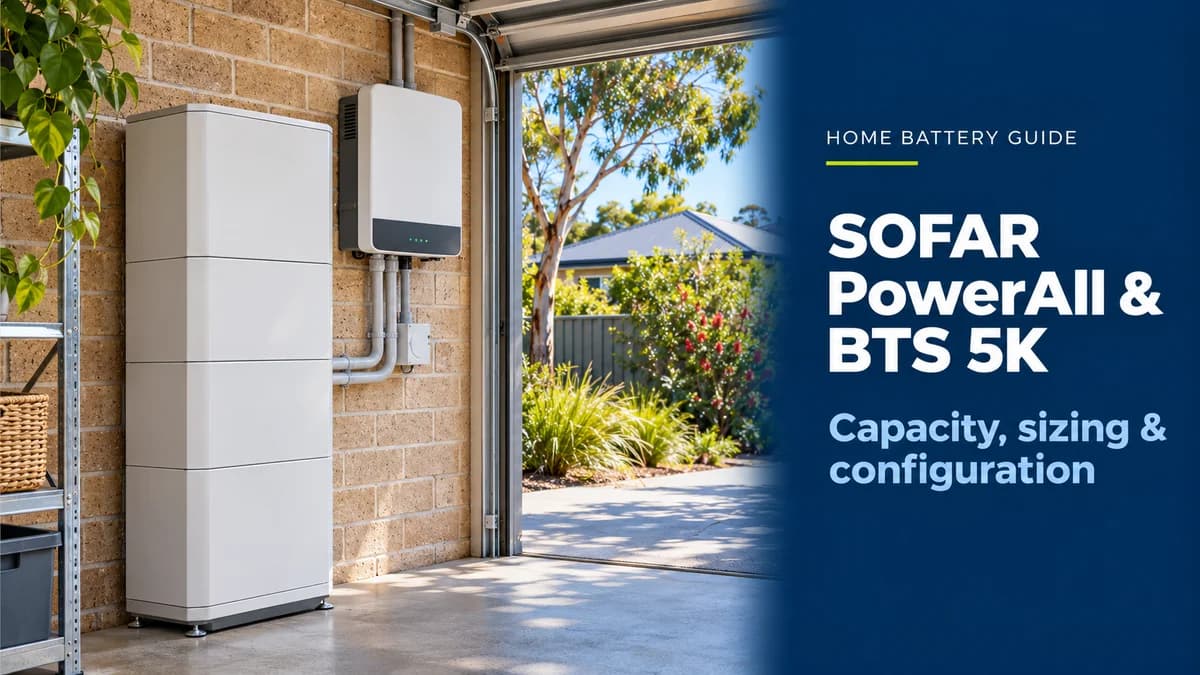
SOFAR PowerAll and BTS 5K: Specifications and Configuration Guide
Provide technical-minded homeowners, solar shoppers, and electricians with exact, verified component specifications, stacking limits, physical dimensions, electrical ratings, and Australian installation clearance rules for the SOFAR PowerAll and BTS 5K storage platform.
SOFAR PowerAll and BTS 5K: Specifications and Configuration Guide
A SOFAR storage proposal should identify the battery modules, control equipment and compatible inverter. This guide explains how to read those specifications and which details need confirmation for your installation.
PowerAll and BTS 5K are different labels
PowerAll describes a residential energy-storage system offering. BTS 5K identifies a battery module used within supported configurations. The battery distribution unit manages the connected battery arrangement, while the inverter handles the electrical interface with the home and solar system.
Names alone are not enough to confirm compatibility. Your quote should list the model and revision of each component and show the permitted configuration in the relevant installation manual.
BTS 5K module specifications
The following values come from SOFAR's BTS 5K V2.1 datasheet dated 6 January 2026. They are reference values for that document, not confirmation that every Australian package uses the same revision.
Parameter | Published value |
|---|---|
Battery chemistry | Lithium iron phosphate (LFP) |
Total energy | 5.12 kWh |
Usable capacity | 4.992 kWh |
Rated power | 2.5 kW |
Nominal voltage | 400 V DC |
Dimensions, width × height × depth | 708 × 420 × 170 mm |
Weight | 50 kg |
Ingress protection | IP65 |
Charging temperature | 0°C to +50°C |
Discharging temperature | −10°C to +50°C |
These are module figures. They do not include the full system's inverter, distribution equipment, mounting, cable space or installation clearances. Temperature limits do not guarantee full power throughout that range.
Nominal capacity is not usable capacity
Nominal energy describes the module's stated storage size. Usable energy describes the capacity available under the manufacturer's specified conditions. Energy delivered to household appliances also reflects conversion losses, operating settings and any backup reserve.
SOFAR's older BTS documentation lists different usable-energy figures. Do not mix an older usable-capacity table with a newer module datasheet or assume one figure automatically applies to a quote.
How module counts affect nominal storage
Number of 5.12 kWh modules | Total nominal energy |
|---|---|
1 | 5.12 kWh |
2 | 10.24 kWh |
3 | 15.36 kWh |
4 | 20.48 kWh |
5 | 25.60 kWh |
6 | 30.72 kWh |
This table is capacity arithmetic, not an approved wiring or stacking schedule. The inverter, battery generation and distribution arrangement determine permitted module counts, number of towers and required components. Do not assume six modules use one controller or one vertical stack.
Installation information to request
A model-specific equipment list and compatibility confirmation.
A layout including mounting support, full dimensions and service access.
Required separation from openings, habitable spaces and other hazards.
The inverter's continuous and backup output, including per-phase limits.
Connection approval requirements and any export limits.
The Australian warranty documents and monitoring arrangements.
A qualified installer should apply the current installation requirements and manufacturer instructions. This overview is not a wiring or DIY installation guide. Our switchboard upgrade guide covers another common part of the site assessment.
Monitoring, expansion and VPP use
Confirm the supplied logger, communications connection and app. For future expansion, request the supported process for the exact system. For a virtual power plant, confirm acceptance with the provider; a communications feature in a datasheet is not proof of enrolment eligibility.
Common questions
Can module power ratings simply be added together?
Can a BTS battery connect directly to a different brand's inverter?
Which usable capacity belongs in a rebate estimate?
Plan your configuration
Use Design My Solar Plan to outline demand, browse our home battery storage options, or contact Kratos Energy to discuss the equipment and layout for your property.
Manufacturer references: BTS 5K V2.1 datasheet and BTS system manual.
Solar System Packages
Tier 1 panels & CEC accredited installation.
- 475W Tier 1 solar panels
- 5kW power inverter
- 14 × 475W panels
- Single-phase compatible
- 475W Tier 1 solar panels
- 8–10kW power inverter
- 21 × 475W panels
- Battery & EV ready
- 475W Tier 1 solar panels
- 10kW power inverter
- 28 × 475W panels (13.3kW)
- Three-phase compatible