

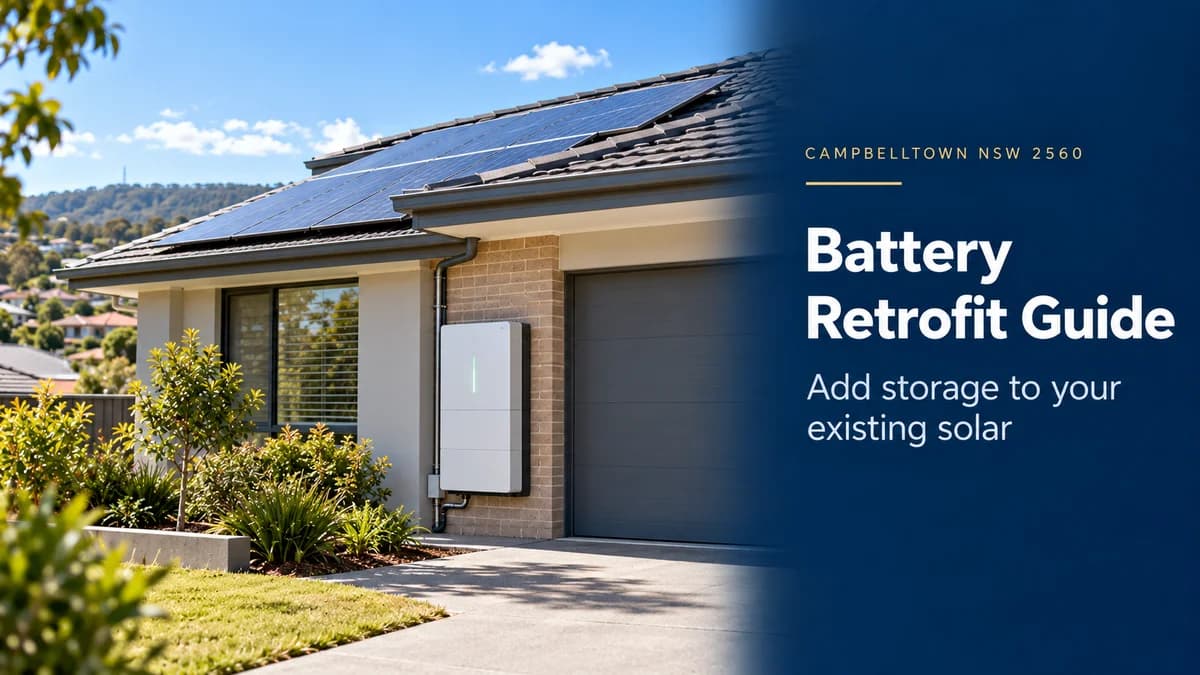
Battery Retrofit Campbelltown: Add Storage to Existing Solar
Already have solar in Campbelltown NSW 2560? Learn how to add a battery, check inverter compatibility, size storage, plan blackout backup and estimate 2026 rebates.
Battery Retrofit Guide for Campbelltown: Adding Storage to Existing Solar
Already have rooftop solar on your Campbelltown NSW 2560 home and considering battery storage?
In many cases, you can add a battery without replacing your entire solar system.
The right retrofit depends on your existing inverter, solar-system size, daytime exports, evening electricity consumption, electrical supply and whether you want blackout backup.
For an existing solar owner, the process should start with an assessment—not with choosing the biggest battery available.
The five questions to answer first are:
Is the existing solar system still performing properly?
Can the current inverter work with the proposed battery?
How much excess solar is available for charging?
How much electricity do you use after sunset?
Do you want essential-load or whole-home blackout backup?
Kratos Energy offers solar-connected battery systems designed around existing generation and household consumption. Explore Kratos battery storage solutions
Can You Add a Battery to Existing Solar in Campbelltown?
Yes, in many cases.
Australia's Cheaper Home Batteries Program specifically supports eligible battery systems connected to new or existing rooftop solar, so battery retrofits are now a major part of the Australian market. The Clean Energy Regulator reported that a substantial proportion of 2026 battery installations were retrofits to existing solar systems. (Energy Australia)
There are two main technical pathways.
Existing System | Common Retrofit Approach | What Changes? |
Working standard solar inverter | AC-coupled battery | Existing inverter often stays |
Compatible hybrid inverter | Direct compatible battery connection | Battery + controls added |
Old or failing inverter | Replace with hybrid inverter | Inverter + battery upgrade |
Solar system too small | Solar expansion + battery | Panels/inverter may also change |
The best solution depends on the equipment already installed. For a quicker route of Campbelltown, visit this link https://kratos-energy.com/solar/nsw/campbelltown
Step 1: Check Your Existing Solar System
Before installing a battery, the installer should assess the solar system you already own.
Check:
Solar-array capacity
Panel age and condition
Inverter make and model
Inverter age
Current solar generation
Average solar exports
Single-phase or three-phase supply
Switchboard condition
Existing network approval
If your panels are producing reliably and your inverter is relatively new, there may be no reason to replace them.
The aim should be:
Keep equipment that still adds value and upgrade only what the battery installation requires.
Step 2: Decide Between AC and DC Coupling
AC-Coupled Battery
AC coupling is a common way to retrofit a battery to an existing solar system.
Your existing solar inverter continues converting panel electricity into AC electricity, while the battery uses a separate battery inverter or integrated power-conversion system.
A simplified flow is:
Solar panels → existing solar inverter → home → battery
The Australian Government notes that AC coupling is the usual arrangement when adding a battery to an existing solar system. (Energy Australia)
AC coupling can suit you if:
Your existing inverter still works well
The inverter has useful warranty life remaining
You do not want to replace functioning equipment
Your preferred battery has its own inverter
You want a relatively straightforward retrofit
Hybrid-Inverter Retrofit
A hybrid inverter manages both compatible solar panels and battery storage.
Replacing your existing inverter with a hybrid model may make sense when:
The existing inverter is old
It is already experiencing faults
You plan to expand the solar array
You want an integrated solar-and-battery platform
Your preferred battery requires a compatible hybrid inverter
Replacing a healthy inverter purely because you are adding a battery may not always provide the best value.
Step 3: Measure How Much Solar You Actually Export
A battery needs electricity to charge.
Before selecting capacity, check how much solar your home currently exports during daylight hours.
Example A
Average excess solar:
12kWh/day
Night-time grid use:
9kWh/day
This household may have enough recurring solar surplus to make good use of a battery around its evening-demand range.
Example B
Average excess solar:
4kWh/day
Night-time grid use:
12kWh/day
A large battery may regularly remain partly empty unless the household:
Adds more solar
Uses off-peak grid charging
Changes energy-use patterns
Selects a smaller battery
This is why battery size should not be chosen from your solar-system kW rating alone.
Step 4: Size the Battery Around Evening Consumption
One of the best battery-sizing starting points is:
How much electricity do you use between solar production falling and the following morning?
As a general assessment guide:
Evening / Overnight Use | Capacity Worth Investigating* |
4–7 kWh | 5–8 kWh usable |
7–10 kWh | 8–12 kWh usable |
10–14 kWh | 12–16 kWh usable |
14–20 kWh | 16–24 kWh usable |
*Indicative ranges only. Final capacity should consider solar surplus, reserve settings, losses, power output and future demand.
A 20kWh battery is not automatically better than a 10kWh battery.
If your home can only recharge and use 8–10kWh regularly, additional capacity may deliver limited everyday benefit.
Step 5: Check Battery and Inverter Compatibility
Battery compatibility is not universal.
Even if an inverter is advertised as hybrid, it does not necessarily work with every battery.
The installer should confirm:
Exact inverter model
Battery model
Supported battery voltage
Communication protocol
Firmware
Maximum charge rate
Maximum discharge rate
Usable battery capacity
Backup compatibility
This is particularly important when retrofitting an older solar system.
Do not purchase a battery based only on capacity or brand reputation before compatibility is confirmed.
Step 6: Decide Whether You Need Blackout Backup
A home battery does not automatically mean your home will stay powered during an outage.
Backup operation requires the correct:
Battery
Inverter
Switching equipment
Electrical configuration
Backup circuits
The Australian Government specifically notes that batteries can provide electricity during outages if configured to do so. (Energy Australia)
There are two common approaches.
Essential-Load Backup
Only nominated circuits stay powered.
Typical choices include:
Refrigerator
Lighting
Wi-Fi
Selected power outlets
Security equipment
This generally reduces the battery power required during an outage.
Whole-Home Backup
A larger portion of the home remains available.
However, appliances such as:
Ducted air conditioning
Electric ovens
Induction cooktops
Pool pumps
EV chargers
can create very high instantaneous demand.
For backup design, battery power in kW matters as much as battery capacity in kWh.
Step 7: Check the Switchboard and Phase Configuration
Adding a battery can involve more than mounting equipment on a wall.
The installer should inspect:
Main switchboard
Available breaker space
Metering
Earthing
Existing solar protection
Single-phase or three-phase supply
Backup-circuit configuration
Older properties may require switchboard work before the battery can be installed safely and compliantly.
This should be identified in the quote—not added unexpectedly during installation.
Campbelltown Network Connection: What Changes?
Campbelltown is within the broader Endeavour Energy network area, so solar-and-battery systems must comply with the applicable network connection process.
Endeavour Energy states that a licensed installer normally manages the application, system design, installation and safety checks. It also advises customers to notify the network when upgrading solar or battery equipment and to ensure systems remain within applicable export limits. (Endeavour Energy)
A battery retrofit may require network consideration if you are also:
Replacing the solar inverter
Increasing inverter capacity
Adding more solar panels
Changing export settings
Modifying the existing generation connection
Your installer should confirm the requirements for the specific Campbelltown property before finalising the design.
Should You Add More Solar at the Same Time?
Sometimes.
Consider expanding the solar array if your existing system produces very little surplus electricity.
For example:
Existing solar: 5kW
Daytime household use: high
Regular solar export: only 2–4kWh/day
Proposed battery: 13.5kWh
In this situation, the battery may have limited solar energy available for charging.
A wider upgrade could include:
additional panels + suitable inverter + battery
But additional solar also affects:
Roof space
Inverter capacity
Network approval
Export settings
Total project cost
Solar expansion and battery sizing should therefore be assessed together.
2026 Battery Rebate for Existing Solar Owners
Eligible Campbelltown homeowners with existing solar may qualify for the Australian Government's Cheaper Home Batteries Program.
The program supports eligible small-scale batteries connected to new or existing rooftop solar. (Energy Australia)
From 1 May 2026, battery support is tapered by usable capacity:
First 14kWh — full applicable STC factor
Above 14kWh to 28kWh — 60% factor
Above 28kWh to 50kWh — 15% factor
The Clean Energy Regulator says the revised structure is designed to maintain support broadly equivalent to around a 30% reduction in installation cost across battery sizes, although the actual dollar benefit depends on certificate values and eligibility. (Clean Energy Regulator)
Kratos' calculator can estimate the current support based on usable battery capacity and postcode. Use the Kratos Battery Rebate Calculator
Do not select an oversized battery simply because additional capacity attracts a larger total rebate.
Battery Retrofit Example
Consider a Campbelltown homeowner with:
Existing solar: 6.6kW
Existing inverter: 5kW, four years old
Average daytime export: 11kWh
Evening grid consumption: 9kWh
Goal: Reduce night-time imports + essential-load backup
A sensible assessment may compare:
Option 1 — AC-Coupled Battery
Keep the working inverter and add compatible battery equipment.
Option 2 — Hybrid Upgrade
Replace the existing inverter and install an integrated solar-and-battery platform.
Because the current inverter is only four years old, the AC-coupled option may avoid replacing useful equipment.
But if the homeowner intends to expand solar or needs specific backup functionality, the hybrid option may still provide better long-term value.
The correct answer depends on the complete system—not battery capacity alone.
What Should a Battery Retrofit Quote Include?
Before accepting a Campbelltown battery quote, check that it clearly shows:
Item | What to Confirm |
Existing solar assessment | Panels and inverter checked |
Battery | Brand, model and usable kWh |
Battery power | Continuous and peak kW |
Inverter | Existing retained or replacement specified |
Backup | None, essential loads or whole-home |
Switchboard work | Included or excluded |
Network approval | Who handles it |
Monitoring | Solar, battery and household consumption |
Rebate | Clearly shown as an estimate/final deduction |
Warranty | Battery, inverter and workmanship terms |
A retrofit quote should explain how the new battery integrates with what you already own.
Frequently Asked Questions
Can I add a battery to my existing solar system in Campbelltown?
Do I need to replace my existing solar inverter?
What size battery should I add?
Can my battery run the house during a blackout?
Can I add more solar while installing a battery?
Can an existing solar owner receive the federal battery rebate?
Which electricity network covers Campbelltown?
Adding a Battery to Existing Solar in Campbelltown: The Bottom Line
For an existing solar owner in Campbelltown NSW 2560, a good battery retrofit follows a simple sequence:
Assess existing solar → measure exports → measure night-time consumption → check compatibility → decide backup requirements → size the battery → confirm network and rebate requirements.
You may be able to keep your current panels and inverter.
Or your system may benefit from a wider solar, inverter and battery upgrade.
The important point is to make that decision from real generation and consumption data—not from a standard battery package.
Explore Kratos battery storage solutions
Estimate your 2026 battery rebate
Request a tailored Kratos solar and battery quote
A good battery retrofit should make better use of the solar you already own—not force you to start again.
Solar System Packages
Tier 1 panels & CEC accredited installation.
- Trina 475W or Jinko panels
- 5kW power inverter
- 14 × 475W panels
- Single-phase compatible
- Trina 475W or Jinko panels
- 8–10kW power inverter
- 21 × 475W panels
- Battery & EV ready
- Trina 475W or Jinko panels
- 10kW power inverter
- 27 × 475W panels
- Three-phase compatible