
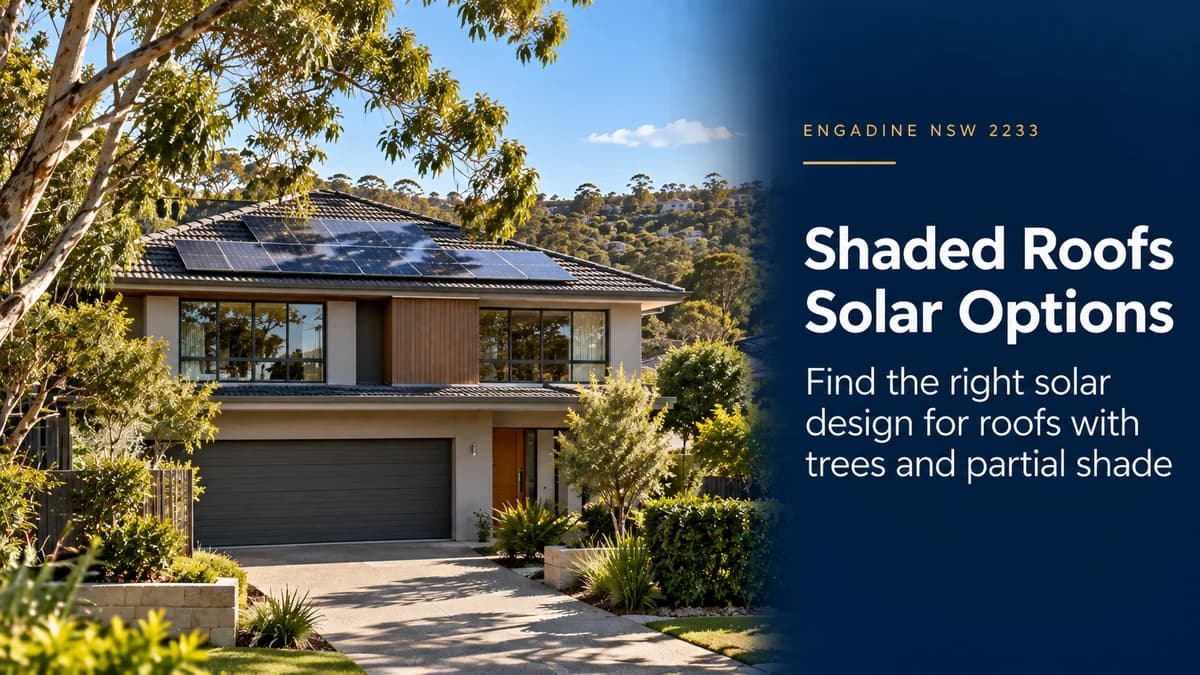
Shaded Roof Solar Engadine NSW: What Are Your Options?
Can solar work on a shaded roof in Engadine NSW 2233? Learn how shade affects output, panel placement, optimisers, microinverters and solar design.
Shaded Roofs: Solar Options in Engadine
Trees, neighbouring buildings, chimneys and different roof levels can all cast shade across rooftop solar panels.
If you live in Engadine NSW 2233, that does not automatically mean your property is unsuitable for solar.
Modern solar systems can often be designed around partial or seasonal shading using careful panel placement, multiple inverter inputs, power optimisers or microinverters. However, the amount, location and timing of the shade must be assessed before deciding whether solar makes financial sense.
The key question is not:
“Is there any shade on my roof?”
It is:
“How much productive sunlight does each part of my roof receive throughout the year?”
Can Solar Work on a Shaded Roof in Engadine?
Yes, depending on the severity of the shade.
A small amount of early-morning or late-afternoon shade may have a relatively limited effect on annual generation.
Persistent shade across the best roof area for several hours around the middle of the day can have a much greater impact.
The Australian Government notes that solar output is affected by the position and height of shading objects, time of day and season, and recommends designing the system specifically around the shaded areas rather than assuming the entire roof performs equally.
A useful shade assessment should therefore identify:
Which parts of the roof receive shade
What causes the shade
What time the shade appears
How long it lasts
How it changes between summer and winter
Whether nearby trees are likely to grow
Which roof sections remain productive
The objective is to install panels where they can generate useful electricity—not simply fit the maximum number of panels onto the roof. If you want a quicker route for Engadine, this is the link https://kratos-energy.com/solar/nsw/engadine
Why Shading Matters for Solar Panels
Solar panels generate electricity from sunlight.
When a panel is shaded, its electricity production falls.
The actual impact depends on the solar system's electrical design.
In a traditional string-inverter system, several panels are connected together. Heavy shading on one panel can sometimes influence the performance of the string, depending on panel electronics, bypass diodes, string configuration and inverter operation.
Modern system design gives installers several ways to reduce this problem.
The best solution depends on where the shade occurs, rather than simply choosing the most expensive inverter technology.
Engadine Roofs: Why a Shade Assessment Makes Sense
Engadine is primarily a residential suburb.
According to the 2021 Australian Census, 79.4% of occupied private dwellings in Engadine were separate houses, compared with 65.6% across NSW. Around 42.9% had three bedrooms and another 41.6% had four or more.
This creates substantial rooftop-solar potential, but it does not mean every roof has the same solar exposure.
Parts of the wider Sutherland Shire also contain established vegetation and mature trees. A local Sutherland Shire Community Energy case study documented a home where substantial seasonal tree shade affected parts of the roof, yet a carefully modelled solar system still generated around 80% of the theoretical production of an equivalent unshaded installation in its first year. That is one individual case—not a prediction for Engadine homes—but it demonstrates why measuring shade is more useful than automatically rejecting a partially shaded roof.
For a home in Engadine 2233, the correct approach is therefore to assess the individual roof.
5 Solar Options for a Partially Shaded Engadine Roof
1. Put Panels Only on the Best Roof Sections
The simplest solution is often the best.
If one part of the roof receives strong sunlight while another remains heavily shaded, it may make more sense to leave the poor-performing area unused.
For example:
North roof: strong sunlight
West roof: good afternoon sunlight
East roof: partial morning shade
South-west roof: heavy tree shade
A well-designed system might use the north and west sections rather than covering every available surface.
This may result in fewer panels but better production per panel.
2. Split Panels Across Different Roof Orientations
Solar panels do not all have to face the same direction.
The Australian Government notes that east-facing panels generate more electricity earlier in the day, while west-facing panels generate later in the afternoon. Using multiple orientations can also help align solar generation with household electricity consumption.
For an Engadine roof where shade affects one orientation but not another, splitting the array may allow the installer to make better use of available sunlight.
For example:
East array: morning generation
North array: strong daytime generation
West array: afternoon generation
The inverter and string configuration must be designed correctly for the different orientations.
3. Use Separate MPPTs Where Appropriate
Modern string inverters commonly contain multiple Maximum Power Point Trackers (MPPTs).
An MPPT allows the inverter to manage different groups of panels independently.
This can be useful when:
Panels face different directions
One roof section experiences more shade
Roof pitch differs between sections
Separate arrays operate under different conditions
For example, panels on a relatively clear north-facing roof could be connected separately from panels on a partly shaded west-facing roof.
This prevents significantly different roof conditions from unnecessarily being treated as one identical array.
The number of MPPTs and allowable string configurations varies between inverter models, so this should be determined during system design.
4. Consider Power Optimisers for Uneven Shade
A power optimiser is installed at individual panel level and can allow panels to operate more independently than a conventional string arrangement.
Optimisers may be useful when:
Shade affects only certain panels
Different panels experience shade at different times
The roof has multiple orientations
Chimneys, vents or trees create irregular shading
They also typically provide panel-level monitoring.
However, optimisers should not be treated as a way to make a heavily shaded roof suddenly perform like an unshaded one.
If a panel receives very little sunlight, electronics cannot replace the missing solar energy.
The first priority should still be good panel placement.
5. Consider Microinverters for Complex Roofs
Microinverters convert electricity from DC to AC at each individual solar panel rather than using one central string inverter.
This allows panels to operate more independently.
They can be useful for roofs with:
Multiple orientations
Irregular shading
Complex roof geometry
Different panel groups
A requirement for panel-level monitoring
Microinverters can reduce the effect of one shaded panel on neighbouring panels.
However, they usually cost more than a conventional string-inverter system.
For a lightly shaded roof where the shade can simply be avoided, paying for microinverters across every panel may not provide enough additional benefit.
The technology should match the roof.
String Inverter vs Optimisers vs Microinverters
System Design | Best Suited To | Main Advantage | Consideration |
Standard string inverter | Mostly unshaded roof | Simple and cost-effective | Less flexible with complex shading |
Multi-MPPT string inverter | Different roof orientations | Separates different panel groups | Requires correct string design |
Power optimisers | Partial/irregular shade | Panel-level optimisation | Additional equipment and cost |
Microinverters | Complex roof/shading | Independent panel operation | Higher upfront cost |
There is no single technology that is automatically best for every shaded roof.
A proper shade study should determine whether additional electronics are actually necessary.
Kratos Energy lists the solar panels and inverter technologies used across its residential installations here:
Explore Kratos Energy solar panels and inverters
When Is Shade Most Harmful?
Not all shade has the same value.
Early-Morning Shade
If trees shade panels shortly after sunrise but the roof receives good sunlight for the rest of the day, the annual impact may be relatively limited.
Late-Afternoon Shade
Similar logic applies if panels receive strong sunlight throughout most of the day before becoming shaded in late afternoon.
Midday Shade
Shade during the strongest solar-production period can have a much larger effect.
Winter Shade
Winter can be particularly important because the sun sits lower in the sky.
Trees or buildings that cause little trouble in summer may cast much longer shadows during winter.
Energy.gov.au specifically notes that shading varies throughout the year and tends to become more significant during winter or early and late in the day when the sun is lower.
This is why a shade assessment should consider annual sun paths, not just what the roof looks like during one site visit.
Should You Remove Trees for Solar?
Not automatically.
Trees can provide:
Summer cooling
Privacy
Habitat
Landscaping value
Shade for the home
Removing a mature tree purely to install extra solar panels may not always be the best outcome.
Instead, investigate whether:
Panels can be moved to another roof section
Selective pruning could help
Different panel orientations can be used
The system can be slightly smaller
Optimisers or microinverters would help
If branches require pruning, energy.gov.au recommends using an appropriately qualified arborist or landscaper and checking whether council approval is required for tree work.
The solar design should work with the property wherever practical.
Can High-Efficiency Panels Help on a Shaded Roof?
High-efficiency panels can be valuable when the main constraint is limited good-quality roof space.
Suppose only 35 square metres of the roof receives consistently useful sunlight.
Using panels with higher power output per square metre may allow greater solar capacity to be installed within that productive area.
But efficiency should not be confused with shade immunity.
A high-efficiency panel still produces less electricity when sunlight is blocked.
For a shaded roof, the priority order should generally be:
Good solar access → good layout → correct electrical design → suitable equipment
rather than simply purchasing the highest-wattage panel.
How Much Generation Will Shade Cost You?
There is no reliable universal percentage.
Shade loss depends on:
Percentage of panel area affected
Time of day
Length of shading
Season
Panel orientation
String design
Inverter technology
Bypass diode behaviour
Tree growth
A roof losing some early-morning production might still provide excellent annual output.
Another roof under heavy midday shade for much of the year may have poor economics.
This is why statements such as:
“Shade reduces solar by 20%”
are not useful without a site-specific assessment.
A professional solar proposal should ideally show the estimated annual generation after shade losses, not only the system's theoretical unshaded output.
Use Postcode 2233 as a Starting Point—Then Adjust for Shade
Kratos Energy's Solar Output Calculator can provide an indicative generation estimate based on location and system size.
For Engadine, enter postcode:
2233
The calculator can estimate daily, monthly and annual production for different system sizes.
However, postcode calculations cannot see your actual trees, chimney or neighbouring buildings.
Treat the result as an unshaded or general-location benchmark, then compare it with the shade-adjusted estimate prepared for your specific roof.
Calculate solar output for Engadine postcode 2233
This comparison is useful because it shows how much generation the proposed layout may lose to real site conditions.
When Might Solar Not Be Worth Installing?
Sometimes the correct recommendation is not to install panels on a particular roof section.
Solar may require reconsideration where:
Most usable roof area experiences heavy year-round shade
Midday solar access is extremely limited
Tree removal or major structural work would be required
The available unshaded area supports too few panels to meet the homeowner's objective
Shade-adjusted generation produces an unattractive financial return
In those situations, the installer should be willing to say so.
A quote showing the maximum number of panels that physically fit on the roof is not the same as a good solar design.
Engadine Is Within the Ausgrid Network
Engadine is served by the Ausgrid electricity network. Ausgrid's own network information and outage records identify Engadine within its service area.
For new and upgraded solar systems, connection requirements also need to be considered alongside roof design.
Ausgrid states that from late 2026 new and upgrading solar installations will need compatible smart-inverter functionality as NSW's Emergency Backstop requirements are phased in. Ausgrid is also introducing fixed and flexible export arrangements for applicable new and upgraded systems. Existing systems that are not being upgraded are not affected in the same way.
Your installer should therefore confirm both:
What works best on your roof
and
What can be connected under the current Ausgrid requirements.
What Should an Engadine Shade Study Include?
Before accepting a proposal for a partially shaded roof, ask the installer to show:
Roof layout
Where will every panel be positioned?
Shade sources
Which trees, buildings, vents or structures create shade?
Seasonal impact
How does shade change between summer and winter?
Estimated losses
What percentage of annual generation is expected to be lost?
System architecture
Why has a string inverter, optimiser or microinverter solution been selected?
Alternative layouts
Would fewer panels in better locations produce a stronger result?
Annual production
What is the expected shade-adjusted annual generation in kWh?
Future changes
Could tree growth or nearby development increase shading later?
This information makes it much easier to compare solar proposals properly.
Frequently Asked Questions
Can I install solar if my Engadine roof has tree shade?
Do solar panels work in partial shade?
Are microinverters better for shaded roofs?
Do power optimisers fix solar shading?
Should I cut down trees before installing solar?
Does winter shade matter?
Can a solar calculator accurately estimate shade?
Which electricity network covers Engadine?
Solar on a Shaded Roof in Engadine: The Bottom Line
A shaded roof does not automatically rule out solar.
For an Engadine NSW 2233 property, a good solar design should:
Measure the actual shade.
Prioritise the most productive roof areas.
Consider morning, afternoon and seasonal shading.
Separate different roof conditions where appropriate.
Use optimisers or microinverters only when they add genuine value.
Estimate generation after shade losses.
Confirm the current Ausgrid connection requirements.
The most important step is therefore not choosing a panel brand.
It is understanding the roof.
If your Engadine property has trees, neighbouring buildings or complex roof sections, Kratos Energy can assess the available solar area and compare design options before recommending a system.
Solar System Packages
Tier 1 panels & CEC accredited installation.
- Trina 475W or Jinko panels
- 5kW power inverter
- 14 × 475W panels
- Single-phase compatible
- Trina 475W or Jinko panels
- 8–10kW power inverter
- 21 × 475W panels
- Battery & EV ready
- Trina 475W or Jinko panels
- 10kW power inverter
- 27 × 475W panels
- Three-phase compatible