
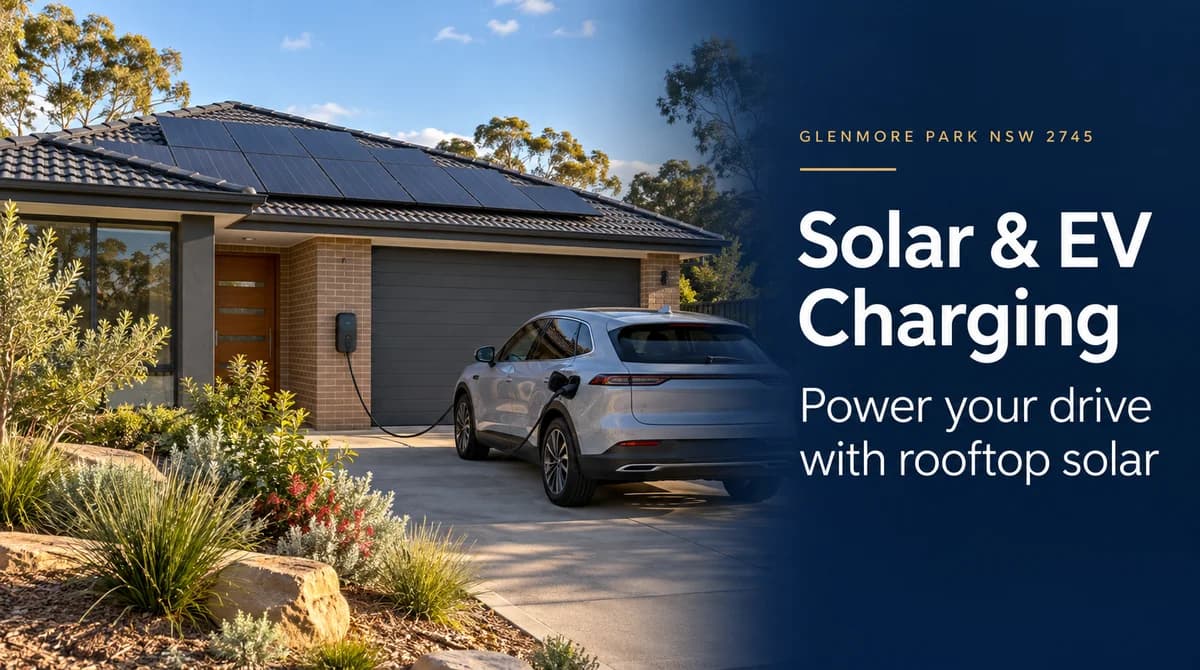
Solar & EV Charging Glenmore Park
Planning solar EV charging in Glenmore Park? Compare daytime solar, overnight tariffs, charger speeds and switchboard requirements for your home.
Solar and EV Charging in Glenmore Park: A Practical Homeowner’s Guide
Combining rooftop solar with an electric vehicle can help reduce the electricity you buy for driving. But the right setup depends on when your car is parked at home, how far you travel and how much surplus solar your roof produces.
For homeowners in Glenmore Park NSW 2745, the starting point is straightforward: estimate your driving energy needs, check when charging can happen, and assess your home’s electrical capacity.
A commuter whose car is away throughout the day will need a different charging strategy from someone who works from home or regularly parks in the driveway during solar hours.
Can You Charge an Electric Car With Solar Panels?
Yes. Rooftop solar can supply electricity to a home EV charger while the system is generating.
However, the electricity available for charging depends on what the rest of the house is using.
For example:
Solar generation at that moment: 5kW
Household demand: 2kW
Remaining solar available for EV charging: 3kW
If the charger draws 7kW, approximately 4kW must come from the grid or a connected home battery, assuming the system can supply it.
Charging during daylight does not automatically mean charging entirely from solar.
A compatible solar-aware charger can adjust charging to available surplus. For example, myenergi describes charging modes that use solar, grid electricity or a combination, depending on the selected settings. Source: myenergi Australia
How Much Electricity Will Your EV Need?
Size the charging plan around your driving, rather than the vehicle’s full battery capacity.
Use this starting calculation:
Daily distance × vehicle consumption ÷ 100 = driving energy used
Illustrative example
Assume:
Daily driving: 40km
Vehicle consumption: 16kWh per 100km
Charging efficiency: 90%
Driving energy:
40 × 16 ÷ 100 = 6.4kWh
Electricity needed at the charger:
6.4 ÷ 0.90 ≈ 7.1kWh
Under these assumptions, replacing the day’s driving requires approximately 7.1kWh of electricity.
These are illustrative figures, not a Glenmore Park driving average or a guarantee for a particular vehicle. Use your car’s actual consumption and allow for motorway driving, weather, heating, cooling and charging losses.
Daytime Solar or Overnight Charging?
Compare the options against your routine.
Charging approach | When it may suit | Main consideration |
Direct daytime solar | Car regularly parked at home during daylight | Enough surplus must remain after household consumption |
Scheduled overnight charging | Car away during the day | Check the overnight rate and the rest of the electricity plan |
Solar on days off, grid charging when needed | Mixed work and travel routine | Charging availability must cover weekly driving |
Home battery supplying the EV | Storage has sufficient spare energy and output | Include battery cost, losses and competing household needs |
For a Glenmore Park household with weekday commuting and weekend driving, a combination may be practical: use available solar when parked at home, then schedule any necessary grid charging. If you want a quicker route for Glenmore Park, this is the link https://kratos-energy.com/solar/nsw/glenmore-park
What Does Solar EV Charging Cost?
Solar charging avoids buying electricity at the applicable import rate. However, using surplus solar also means giving up any feed-in payment you would otherwise receive.
The Australian Government explains that self-consumption is often more valuable than export because feed-in tariffs are typically lower than electricity purchase rates. Source: Solar Consumer Guide
Using the 7.1kWh charging requirement above:
Electricity source | Illustrative rate | Cost or export income forgone |
Surplus rooftop solar | 5c/kWh feed-in tariff forgone | A$0.36 |
Lower-cost grid period | 15c/kWh | A$1.07 |
Higher-cost grid period | 35c/kWh | A$2.49 |
These are assumed rates, not current retailer offers. The solar figure represents forgone export income only; it excludes solar installation costs. Grid figures exclude daily supply charges and other fees.
This comparison shows why charging time matters. It does not establish the payback period for a solar system, charger or battery.
What Size Solar System Do You Need for an EV?
There is no fixed rule that owning an EV requires a 10kW or 13kW solar system.
Your installer should consider:
Existing household electricity consumption.
Additional charging energy.
When the car is available to charge.
Roof area, orientation and shading.
Seasonal generation and inverter limits.
Whether a second EV is likely.
For an existing solar system, inspect export data before adding panels.
If your household regularly exports 10kWh while the car is parked at home, that may provide useful charging energy. If exports are only 2kWh, charging will require more grid electricity, additional generation or a different schedule.
Daily totals also need a timing check. Surplus generated while the car is away cannot charge it directly.
Explore a starting configuration through Kratos Energy’s Design Your Solar tool, then have the proposal checked against your household and vehicle usage.
Do You Need a 7kW, 11kW or 22kW Charger?
Charging speed is limited by the lowest applicable limit: the electrical installation, charger setting or vehicle’s onboard AC charger.
Charger rating | Typical supply arrangement | Key check |
Around 7–7.4kW | Single phase | Available household supply capacity |
11kW | Three phase | Whether the vehicle accepts 11kW AC |
22kW | Three phase | Whether the vehicle accepts 22kW AC |
A 22kW charger will not deliver 22kW to a vehicle limited to 11kW AC. Manufacturer specifications also distinguish single-phase and three-phase charging capabilities. Source: myenergi charger specifications
For the illustrative 7.1kWh daily top-up, a sustained 7kW input would take roughly one hour. At a sustained 3kW input, it would take around 2.4 hours. Actual charging may vary with solar availability, controls and vehicle conditions.
Choose enough charging speed for your available parking time; maximum advertised speed is not always necessary.
Check Switchboard Capacity Before Installation
Before choosing a charger for your Glenmore Park property, arrange an assessment by a licensed electrician.
Ask them to check:
Single-phase or three-phase supply.
Main supply capacity and existing maximum demand.
Switchboard condition and space for required protection.
Cable route and distance to the parking location.
Earthing and charger protection requirements.
Simultaneous loads such as cooking, cooling and hot water.
Applicable distributor requirements if supply alterations are needed.
Also ask whether dynamic load management is appropriate. A compatible system can reduce EV charging power when household demand rises, helping keep consumption within the configured supply limit.
A charger installation quote should identify any required switchboard work, additional cabling or supply upgrades separately.
Do You Need a Home Battery for Solar EV Charging?
No. An EV can use rooftop solar directly without a stationary home battery.
Storage becomes relevant when you want to move daytime generation into evening or overnight use. However, the battery must also serve any household loads assigned to it.
Suppose an illustrative household needs:
8kWh for evening appliances.
7.1kWh at the EV charger.
That is 15.1kWh of electricity demand, before allowing for home-battery conversion losses and any backup reserve. A battery offering 10kWh of usable storage cannot cover both demands completely from one full discharge.
Compare the additional cost of storage with alternatives such as daytime charging on selected days or an appropriate overnight tariff. You can review Kratos Energy’s home battery storage options as part of that assessment.
Compare the Whole Electricity Plan
A low EV charging rate can be attractive, but check what the household pays outside that window.
Compare:
Charging-window hours and eligibility.
Daytime and evening import rates.
Daily supply charges.
Solar feed-in tariffs.
Any demand charges, caps or additional fees.
Time-of-use periods vary between plans. Demand tariffs can also add charges linked to high simultaneous electricity use. The Australian Energy Regulator’s Energy Made Easy tariff guide explains these differences.
Use annual household consumption and expected EV charging when comparing plans, rather than choosing solely on the cheapest advertised charging rate.
Frequently Asked Questions
Can I charge my EV using an existing solar system?
Will a 6.6kW solar system be enough?
Can I charge entirely from solar?
Is overnight charging cheaper than solar charging?
Do I need three-phase power?
Can I add another EV later?
Plan Solar and EV Charging Together
For your Glenmore Park NSW 2745 home, a useful proposal should show how solar generation, household appliances and vehicle charging work together.
Provide your electricity bills, existing solar details, EV model, typical kilometres and parking schedule. Ask for clearly stated assumptions covering charging energy, solar contribution, remaining grid use and installation requirements.
Request a tailored solar assessment from Kratos Energy and include your EV charging plans so they can be considered in the system design.
Solar System Packages
Tier 1 panels & CEC accredited installation.
- Trina 475W or Jinko panels
- 5kW power inverter
- 14 × 475W panels
- Single-phase compatible
- Trina 475W or Jinko panels
- 8–10kW power inverter
- 21 × 475W panels
- Battery & EV ready
- Trina 475W or Jinko panels
- 10kW power inverter
- 27 × 475W panels
- Three-phase compatible