

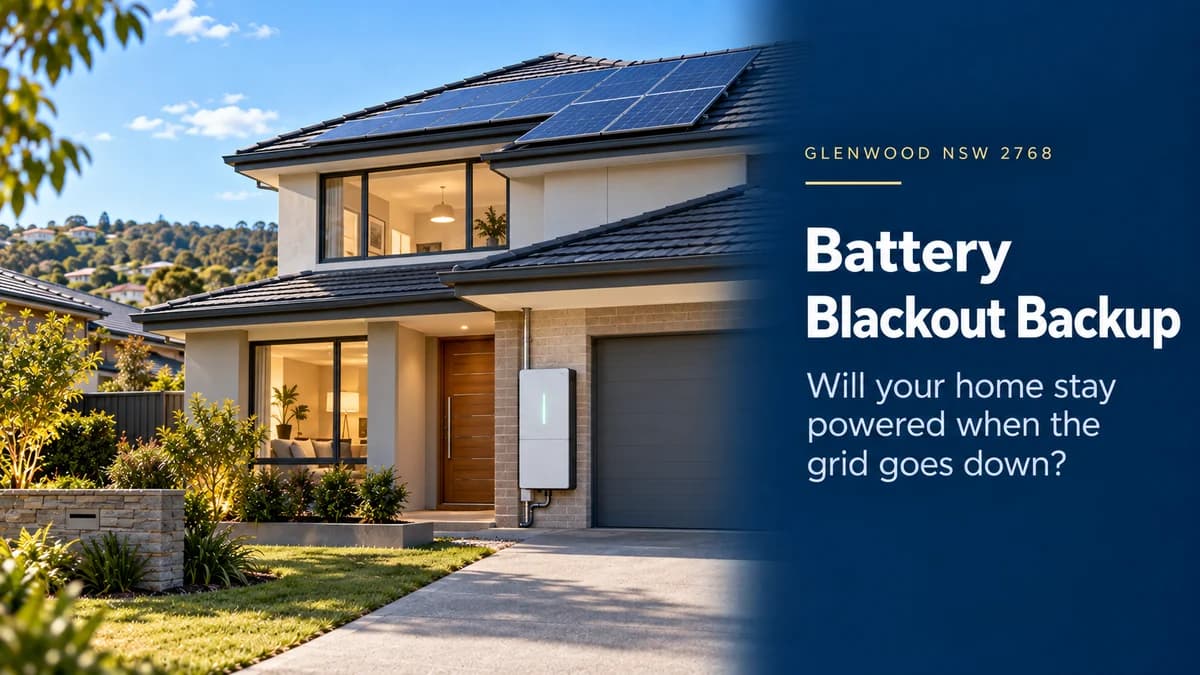
Solar Battery Blackout Backup Glenwood: 2026 Guide
: Will a solar battery keep your Glenwood NSW 2768 home running in a blackout? Learn essential-load vs whole-home backup, battery kWh, output power and surge requirements.
Will a Glenwood Battery Work in a Blackout?
If you are considering a solar battery for your Glenwood NSW 2768 home, one question matters more than battery capacity alone:
Will the battery actually keep the house running when the grid goes down?
The answer is yes—if the system is specifically designed and configured for backup operation.
A battery that stores excess solar for evening use is not automatically a blackout-backup system. Backup requires compatible inverter technology, switching equipment, appropriate wiring and enough battery energy and power for the loads you want to operate.
For most households, the first decision is whether you need:
Essential-load backup for lights, fridge, Wi-Fi and selected outlets, or
Whole-home backup for a much larger portion of the property.
That decision affects battery capacity, inverter power and installation cost.
Kratos Energy offers residential storage options that can be designed around solar use, battery capacity and backup requirements. Explore Kratos battery storage solutions.
Battery Storage and Blackout Backup Are Not the Same Thing
This is the most important point to understand.
A standard home battery can store excess daytime solar and discharge it later to reduce grid electricity purchases.
But during a blackout, grid-connected equipment must safely isolate from the electricity network.
The Australian Government explains that not all battery systems provide backup power. A battery must be configured for backup, and an islandable solar-and-battery system needs to disconnect safely from the grid before continuing to power the home. (Energy Australia)
So when comparing battery quotes, do not ask only:
“How many kWh is the battery?”
Also ask:
“What happens when the grid fails?”
Why Backup Planning Matters for Glenwood Homes
Glenwood is predominantly a detached-house suburb.
According to the 2021 Census, approximately 97.2% of occupied private dwellings in Glenwood were separate houses, while 83.4% had four or more bedrooms. The average household contained around 3.5 people. (Australian Bureau of Statistics)
That does not mean every Glenwood home has high electricity demand.
However, larger family homes can have multiple loads operating at the same time, such as:
Refrigerators and freezers
Lighting
Wi-Fi and home-office equipment
Ducted air conditioning
Electric cooking
Pool equipment
Garage doors
Security systems
EV chargers
This is why blackout backup should be designed from the home's actual loads, not simply from house size. More details ...
Essential-Load Backup vs Whole-Home Backup
Essential-Load Backup
Essential backup keeps selected circuits operating during a power outage.
A typical essential-load board might include:
Refrigerator
Freezer
Basic lighting
Wi-Fi/router
Selected power outlets
Security system
Garage-door opener
The Australian Government specifically identifies loads such as lighting and refrigeration as examples of circuits that can be backed up selectively. (Energy Australia)
Why choose essential-load backup?
It generally requires less battery power and allows stored energy to last longer.
For many households, this provides the best balance between resilience and cost.
Whole-Home Backup
Whole-home backup aims to keep most or all normal household circuits available during a blackout.
That sounds ideal, but it requires more careful engineering.
Large appliances can include:
Ducted air conditioning
Electric oven
Induction cooktop
Pool pump
Electric hot water
EV charger
A battery may have enough stored energy to run these appliances for several hours but still lack enough instantaneous power to start or operate them together.
Whole-home backup therefore needs to be designed around both:
battery capacity (kWh) and battery output (kW).
kWh vs kW: The Key Blackout Difference
These two specifications are often confused.
kWh — Energy Capacity
This tells you how much energy the battery can store.
For example, a battery with 13.5kWh usable capacity contains more stored energy than one with 8kWh.
kW — Power Output
This tells you how much electrical load the battery can support at one moment.
The Australian Government notes that battery output power limits the number and size of appliances that can operate simultaneously. (Energy Australia)
A simple way to think about it:
kWh determines how long the battery may last.
kW determines what the battery can run at the same time.
For blackout backup, both numbers matter.
Why Surge Power Matters
Some appliances briefly require much more power when starting than when running normally.
This is called starting surge or inrush current.
Potential examples include:
Refrigerators
Freezers
Air-conditioning compressors
Pool pumps
Water pumps
Other motor-driven appliances
Imagine your backup system has enough continuous output for the household's normal essential loads.
If several motor-driven appliances start together, the short-term demand can exceed the inverter's surge capability.
The system may then:
Restrict the load
Shut down temporarily
Require some appliances to be switched off
A proper backup design should therefore assess both:
continuous household load + short-duration starting surge.
Glenwood Blackout Backup: Essential-Load Assessment
Before selecting a battery, make a list of what you genuinely need during an outage.
An illustrative essential-load assessment could look like this:
Appliance / Circuit | Backup Priority | Typical Consideration |
Refrigerator | High | Continuous cycling + starting surge |
Freezer | High | Starting surge |
Wi-Fi/router | High | Low continuous load |
Basic lighting | High | Usually low load with LEDs |
Selected outlets | Medium | Depends on what is plugged in |
Security system | High | Low continuous demand |
Garage door | Medium | Short, higher-power operation |
Television | Low/Medium | Moderate load |
Ducted air conditioning | Optional | High power requirement |
Oven / induction cooking | Optional | High instantaneous load |
EV charger | Usually excluded | Very high load |
This is an illustrative planning table, not a load calculation for a specific Glenwood property.
Your installer should assess the actual appliances, circuits and electrical ratings in your home.
How Long Will a Battery Last During a Blackout?
Runtime depends on:
Usable battery energy ÷ average backup load
But real-world results also depend on:
Battery reserve settings
Conversion losses
Appliance cycling
Battery state of charge when the outage starts
Whether solar continues charging the battery
Temperature and operating conditions
For example, a home running only refrigeration, lighting, Wi-Fi and a few outlets could operate much longer than the same battery trying to support ducted air conditioning and electric cooking.
This is why asking:
“How many hours does this battery last?”
without defining the loads is not particularly useful.
A better question is:
“How long will this battery run my nominated backup circuits?”
Can Solar Panels Keep Working During a Blackout?
It depends on the system architecture.
Most ordinary grid-connected solar systems shut down during a blackout because of anti-islanding safety requirements. This prevents solar electricity from being sent into the grid while technicians may be working on network equipment. (Energy Australia)
However, some properly designed islandable solar-and-battery systems can:
Disconnect the property from the grid
Continue powering the home's backup circuits
Continue producing solar electricity
Recharge the battery when solar generation exceeds household demand
This can substantially improve resilience during a longer outage.
When comparing systems, ask:
“Can the solar panels continue charging my battery while the grid is down?”
Do not assume the answer is yes.
What Happens at Night?
At night, there is no solar generation.
The backed-up circuits therefore rely on whatever energy remains in the battery.
If the battery reaches its minimum state of charge before sunrise, backup power stops unless another source is available.
This is why load management becomes important during extended outages.
You may decide to temporarily avoid:
Air conditioning
Electric cooking
Pool filtration
Clothes dryers
EV charging
to preserve stored energy for essential appliances.
Should You Keep a Backup Reserve?
Most modern batteries allow part of their capacity to be reserved for outages.
For example, rather than using the battery almost completely every evening for bill savings, you might maintain a reserve.
The trade-off is straightforward:
Higher backup reserve
More energy available if an outage begins unexpectedly.
Lower backup reserve
More battery capacity available for normal daily bill reduction.
Your preferred reserve should depend on how important blackout protection is compared with everyday energy savings.
Single-Phase vs Three-Phase Homes
If your Glenwood property has three-phase electricity, ask exactly what the battery will support during a blackout.
The Australian Government notes that a single-phase battery or hybrid-inverter system may back up only circuits connected to one phase of a three-phase property. (Energy Australia)
That can matter if major appliances are located on different phases.
For a three-phase home, confirm:
Which phase the battery supports
Which circuits are backed up
Whether three-phase appliances can operate
Whether whole-home three-phase backup requires different hardware
This should be resolved during system design—not discovered during the first blackout.
How Much Battery Capacity Does Backup Require?
Battery capacity should be based on the loads you want to operate and the expected backup duration.
As a broad planning concept:
Backup Goal | What to Prioritise |
Short outage | Essential circuits + modest reserve |
Several hours | Essential-load consumption + usable kWh |
Overnight | Larger usable capacity + strict load management |
Extended outage | Battery + solar recharging capability |
Whole-home backup | High capacity + high inverter output + surge capability |
There is no single “blackout battery size” suitable for every Glenwood household.
A 10kWh battery with well-selected essential loads may deliver better resilience than a much larger battery expected to operate every appliance normally.
Battery Sizing Should Also Consider Normal Daily Use
A battery should ideally provide value when there is no blackout.
During normal operation it can:
Store excess rooftop solar
Reduce evening grid purchases
Support time-of-use tariff management
Increase household solar self-consumption
Kratos Energy's current battery range is designed around both solar storage and backup requirements. View Kratos battery storage options.
The strongest design therefore balances:
everyday savings + blackout resilience
rather than treating the battery as emergency equipment that rarely operates.
What About the 2026 Battery Rebate?
Eligible household batteries can receive support under the Australian Government's Cheaper Home Batteries Program, subject to current eligibility and installation requirements.
Kratos' current calculator reflects the 2026 tapered federal structure and allows homeowners to enter usable battery capacity and postcode to estimate the available support. (Kratos Energy)
For Glenwood homeowners, use postcode:
2768
The rebate can reduce upfront cost, but it should not determine your backup capacity.
Choose the battery based on the energy and power you actually need.
7 Questions to Ask Before Buying a Backup Battery
Before accepting a Glenwood battery quote, get clear answers to these questions:
1. Will the battery operate during a blackout?
Get this confirmed explicitly.
2. Which circuits will remain powered?
Ask for the actual backup circuit list.
3. What is the usable battery capacity?
Check usable kWh, not only advertised nominal capacity.
4. What is the continuous backup power?
This determines how many appliances can operate simultaneously.
5. What is the surge capability?
Important for refrigerators, pumps and air-conditioning compressors.
6. Can rooftop solar recharge the battery during an outage?
This can make a major difference during prolonged blackouts.
7. What happens on a three-phase supply?
Confirm which phases and appliances remain available.
If a quote cannot answer these questions clearly, the backup design is not yet complete.
Frequently Asked Questions
Will a solar battery work during a blackout in Glenwood?
Will my solar panels work during a blackout?
Can a battery power my entire home?
Is 10kWh enough for blackout backup?
What is better: essential-load or whole-home backup?
Can ducted air conditioning run from a battery?
Can a battery run an EV charger during a blackout?
Does Glenwood qualify for the federal battery rebate?
Will a Battery Keep Your Glenwood Home Running?
For a home in Glenwood NSW 2768, successful blackout backup requires more than purchasing a battery with a large kWh number.
A proper design should assess:
Essential circuits → normal running load → appliance surge → battery capacity → inverter output → solar recharging → phase configuration.
For many households, backing up a carefully chosen group of essential circuits provides better resilience than attempting to operate every appliance normally.
The system should also remain useful every day by storing excess solar and reducing grid consumption.
Explore Kratos battery storage solutions
Estimate your 2026 battery rebate
Request a tailored battery assessment
The best blackout battery is not simply the largest one—it is the system designed to keep the loads that matter running for as long as you need them.
Solar System Packages
Tier 1 panels & CEC accredited installation.
- Trina 475W or Jinko panels
- 5kW power inverter
- 14 × 475W panels
- Single-phase compatible
- Trina 475W or Jinko panels
- 8–10kW power inverter
- 21 × 475W panels
- Battery & EV ready
- Trina 475W or Jinko panels
- 10kW power inverter
- 27 × 475W panels
- Three-phase compatible