

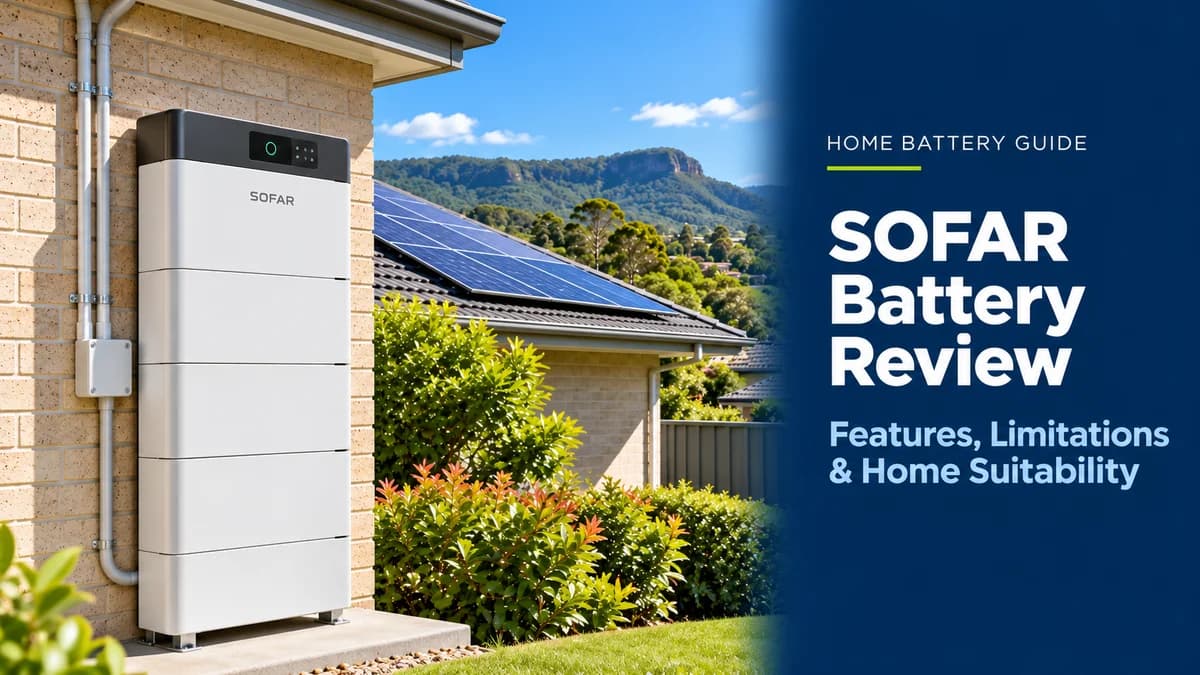
SOFAR Battery Review: Features, Limitations & Home Suitability
Provide Australian homeowners with an objective, evidence-based review of SOFAR residential batteries and hybrid inverters, focusing on verifiable specifications, practical installation considerations, and genuine limitations rather than marketing hype.
SOFAR Battery Review: Features, Limitations & Home Suitability
1. Review Scope & Covered Models
SOFAR Solar (Shenzhen SOFARSOLAR Co., Ltd.) is an established global manufacturer of solar inverters and energy storage systems founded in 2013, with products listed on the Clean Energy Council (CEC) approved product database for Australian grid connections.
This review focuses on the current residential energy storage models actively supplied in Australia:
· Battery Module: SOFAR BTS 5K (5.12 kWh nominal high-voltage LiFePO4 battery pack)
· Battery Distribution Unit: SOFAR BTS 5K-BDU (top-mounted management and control module)
· Single-Phase All-in-One Inverter: SOFAR PowerAll ESI Series (3 kW to 6 kW single-phase hybrid)
· Three-Phase Hybrid Inverter: SOFAR HYD Series (5 kW to 20 kW three-phase hybrid)
· Documentation Examined: SOFAR BTS 5K-BDU Datasheet (Doc ref: OV2024102901), PowerAll Residential ESS Technical Specifications (2025/2026 AU Release), and Australian Warranty Terms.
· Review Last Checked: November 2026.
---
2. Verdict: Where SOFAR Excels and Where It Has Limits
┌──────────────────────────────────────────────┐
│ SOFAR RESIDENTIAL BATTERY: CONDITIONAL VERDICT│
├──────────────────────────────────────────────┤
│ BEST SUITED FOR: │
│ ✔ High-capacity households wanting 15–30 kWh │
│ ✔ Homes needing fast UPS-grade backup (<10ms)│
│ ✔ Future-proofing capacity with mixed-pack │
│ expansion technology │
│ ✔ Three-phase homes needing unbalanced EPS │
├──────────────────────────────────────────────┤
│ PROCEED WITH CAUTION IF: │
│ ✖ Wall space is extremely constrained │
│ ✖ You require single-stack 30kWh tower │
│ (stacks over 4 modules must be split) │
│ ✖ You want a cloud ecosystem with extensive │
│ third-party smart home API integrations │
└──────────────────────────────────────────────┘
The SOFAR BTS 5K system provides exceptional value in high-capacity installations (particularly 20 kWh to 30 kWh). Its integrated pack-level energy optimization solves one of the biggest drawbacks of high-voltage battery stacks: the inability to add new modules several years down the track without degrading existing capacity.
However, prospective buyers must understand physical constraints: a full 30 kWh system comprises six 50 kg battery modules plus the BDU and inverter, totaling over 330 kg. It requires solid concrete floor mounting or split-tower placement, making it less suitable for homes with tight side setbacks or lightweight timber-framed external walls.
---
3. Key Features vs Practical Homeowner Realities
The table below contrasts manufacturer specifications with practical conditions in an Australian residential setting:
Documented Feature | Practical Benefit for Homeowners | Condition or Real-World Limitation |
Modular 5.12 kWh Packs | Expand storage incrementally from 5.12 kWh up to 30.72 kWh (1 to 6 modules). | Stacking height is limited to 3 or 4 modules vertically for structural stability; larger 25–30 kWh systems require two side-by-side towers. |
Pack-Level Energy Optimization | Each battery module contains an internal DC/DC converter, allowing new and old modules to operate together. | While modules can be mixed, expansion is only supported within the same BTS 5K model generation. Cannot be paired with third-party low-voltage batteries. |
<10 ms EPS Switchover | Uninterrupted Power Supply (UPS) speed prevents computers, Wi-Fi routers, and home automation from resetting during an outage. | Only circuits wired into the dedicated EPS backup sub-board receive power during an outage. Non-backed up heavy loads (e.g., standard ovens, ducted A/C) will still lose power. |
IP65 Weatherproof Enclosure | Enclosure is rated for outdoor installation against rain, coastal humidity, and dust. | Ambient operating range is -10°C to +50°C, but sustained direct summer sun on dark brickwork will trigger thermal protection and throttle charging speed. A shaded installation location is strongly recommended. |
Natural Convection Cooling | No mechanical fans on the battery modules, resulting in whisper-quiet operation (<25 dB). | Silent operation makes it ideal near living spaces, but adequate ventilation clearances (minimum 300 mm sides and top) are mandatory per AS/NZS 5139. |
Solarman Cloud Monitoring | Free smartphone app displaying real-time generation, consumption, battery state-of-charge, and grid flow. | Requires stable local 2.4 GHz Wi-Fi connectivity at the inverter location. If the Wi-Fi signal drops, remote reporting pauses (though local battery operation continues). |
---
4. Potential Advantages
1. Active Module Balancing (Long-Term Expandability): In conventional high-voltage battery stacks (such as older BYD or basic modular stacks), modules are wired directly in series. If you add a new module three years later, the older modules drag down the capacity of the new module to match their degraded state. SOFAR's internal module-level DC/DC converter balances voltage independently, allowing genuine post-install expansion without capacity penalty.
2. True Three-Phase Unbalanced Backup (HYD Inverters): Many three-phase hybrid inverters in Australia can only output equal power across all three phases during a blackout. If phase A has a 3 kW load and phase B has 200 W, some inverters trip or cap total output. The SOFAR HYD series supports 100% phase unbalance, delivering full emergency power to the specific phase that actually needs it.
3. Safety Architecture: Utilises Lithium Iron Phosphate (LiFePO4) chemistry, widely recognized as the most thermally stable lithium technology. Incorporates dual electrical and physical isolation across five distinct safety layers (cell, pack, BDU, BMS, and inverter level).
---
5. Limitations & Practical Constraints
· Physical Weight & Footprint: A single BTS 5K module weighs 50 kg. A complete 30 kWh setup (6 modules + BDU + inverter) exceeds 330 kg. This weight cannot simply be hung from standard timber wall studs. It requires floor-standing installation on a concrete foundation or masonry anchor plate compliant with AS/NZS 5139.
· Footprint of Split Towers: Due to ceiling height and stability limits, systems with 5 or 6 modules cannot be stacked into a single 2.5-metre tower. Installers configure them as twin towers (e.g., 3 modules + 3 modules), requiring roughly 1.5 to 1.8 metres of continuous horizontal wall space.
· App User Experience: While the Solarman platform is feature-rich, its user interface can feel more technical and data-heavy compared to consumer-focused apps like Tesla or Enphase. Homeowners who want a very simple dashboard may experience a slight learning curve.
· VPP Availability in Australia: While SOFAR hardware supports remote communication protocols, Virtual Power Plant (VPP) eligibility depends heavily on specific retail energy plan partnerships in Australia (such as Amber Electric or Origin Loop). Check confirmed VPP aggregator support prior to purchase if your investment relies on VPP grid-event revenue.
---
6. Who Should Consider a SOFAR Battery?
Scenario A: High-Consumption Single-Phase Families (6.6 kW Solar + 20–30 kWh Storage)
· Profile: A family home in Western Sydney or the Illawarra using 25+ kWh per day. Ducted air conditioning runs on summer evenings, and the home office operates during the day.
· Suitability: High. The 5 kW hybrid inverter easily captures midday solar generation, and a 20–30 kWh battery stores sufficient power to run cooling and appliances right through the night, eliminating expensive peak-rate grid imports.
Scenario B: Modern 3-Phase Residential Properties (10–13.2 kW Solar + 30 kWh Storage)
· Profile: A large two-storey home with a three-phase connection, pool heat pump, induction cooktop, and future electric vehicle plans.
· Suitability: Excellent. The SOFAR HYD 10 kW three-phase hybrid inverter provides high instantaneous power, charges the battery quickly during solar hours, and maintains emergency power across all three household phases during severe weather blackouts.
Scenario C: Small Home with Limited Space (<10 kWh Requirement)
· Profile: A single-storey terrace or compact suburban lot using under 12 kWh per day, with very narrow side setbacks.
· Suitability: Moderate / Consider Alternatives. The minimum base components (BDU + 1 module = ~5 kWh) take up significant physical presence compared to compact all-in-one wall units. For tight wall spaces under 10 kWh, a dedicated slimline battery like the Fox ESS Energy Cube or Sigenergy unit may be easier to place.
---
7. Warranty Terms & Australian Consumer Protection
In Australia, SOFAR residential storage systems carry a 10-year manufacturer warranty covering materials, workmanship, and retained capacity:
· Coverage: Typically covers battery modules for 10 years or a cumulative energy throughput (whichever occurs first), guaranteeing retained capacity (commonly 60–70% at year 10 under standard temperature conditions).
· Australian Consumer Law (ACL): SOFAR warranties sit alongside statutory consumer guarantees under the ACL. If equipment suffers a major failure, consumers are entitled to a replacement or refund regardless of manufacturer warranty fine print.
· Installer Accountability: Kratos Energy provides a matching 10-year comprehensive installation warranty. If a fault arises, Kratos manages warranty claims directly with the manufacturer on your behalf, so you are not left dealing with an overseas contact centre.
---
8. Summary Comparison: SOFAR vs Mainstream Competitors
· Compared to Tesla Powerwall 3: SOFAR offers a modular approach where you only buy the capacity you need (starting from 5.12 kWh up to 30.72 kWh), whereas Powerwall 3 has a fixed 13.5 kWh unit size. SOFAR systems in high capacities (20–30 kWh) typically offer a lower cost per kilowatt-hour installed.
· Compared to Fox ESS Energy Cube: Both are excellent high-voltage modular systems. Fox ESS modules are slightly lighter (4.74 kWh / ~44.5 kg) with a narrower footprint, making Fox easier to install in narrow side passages. SOFAR offers internal pack-level balancing, giving it a technical edge if you intend to add extra modules years later. [Read our detailed SOFAR vs Fox ESS comparison](/guides/sofar-vs-fox-ess).
---
Frequently Asked Questions
Is SOFAR an approved battery brand in Australia?
What is the round-trip efficiency of a SOFAR battery?
Can SOFAR batteries be installed indoors?
Solar System Packages
Tier 1 panels & CEC accredited installation.
- 475W Tier 1 solar panels
- 5kW power inverter
- 14 × 475W panels
- Single-phase compatible
- 475W Tier 1 solar panels
- 8–10kW power inverter
- 21 × 475W panels
- Battery & EV ready
- 475W Tier 1 solar panels
- 10kW power inverter
- 28 × 475W panels (13.3kW)
- Three-phase compatible