

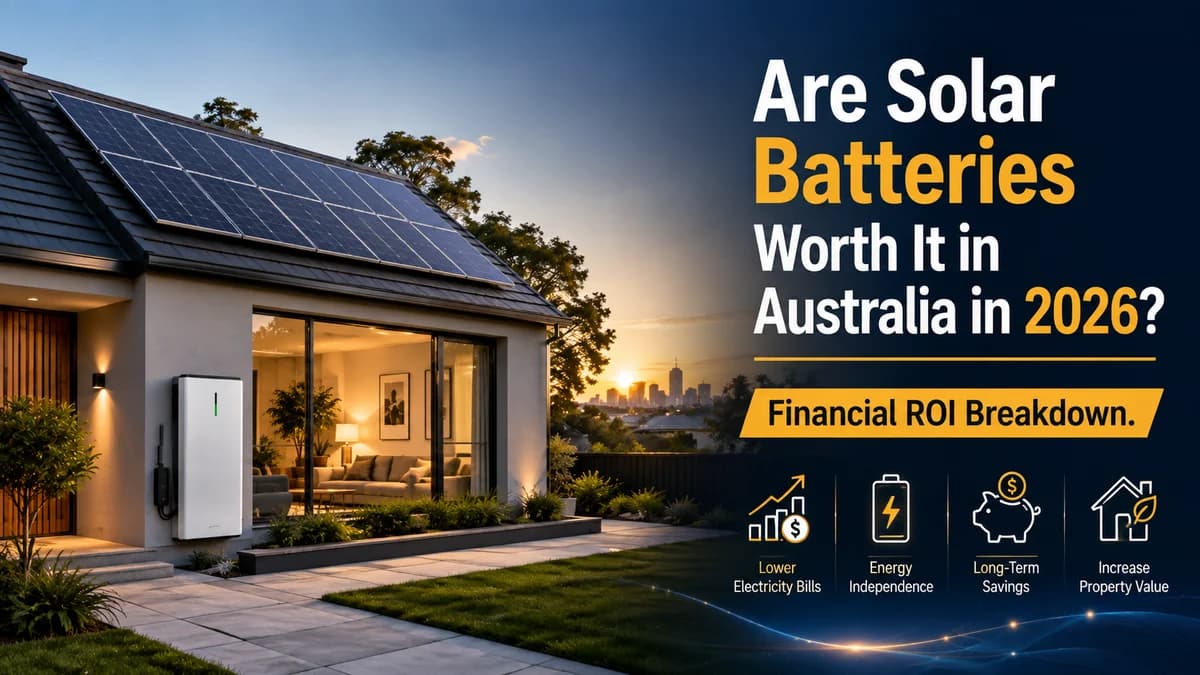
Solar Battery FAQs 2026: Costs, Lifespan, Rebates & Backups
Get clear answers to 15 top solar battery questions in Australia: battery lifespan, blackout backup, VPP participation, cost per kWh, and federal rebate eligibility.
Solar Battery FAQs 2026: 15 Most Critical Questions Answered
Adding a battery storage system to your home solar setup is one of the smartest investments you can make in 2026. However, with rapidly evolving government rebates, falling hardware prices, and complex technical jargon, it is natural to have questions before making a decision.
Below, the SAA-accredited engineering team at Kratos Energy answers the 15 most frequent questions Australian homeowners ask before installing battery storage.
15 Critical Solar Battery Questions Answered
Q1: How long do home solar batteries last in Australia?
Most modern Lithium Iron Phosphate (LFP) batteries last 10 to 15 years and are warrantied for 6,000 to 10,000 full charge and discharge cycles. LFP chemistry offers superior thermal stability compared to older NMC chemistries, making it far better suited to Australian summer heat across NSW, VIC, and the ACT.
Q2: Can a solar battery power my home during a blackout?
Yes, provided your battery system includes an automated backup gateway switch or Emergency Power Supply (EPS) interface. Standard grid-tied inverters automatically turn off during grid outages for lineman safety. With a backup gateway, your system instantly isolates your switchboard ("islanding mode") within milliseconds to keep essential circuits running.
Q3: Can a solar battery run ducted air conditioning?
Yes, but running heavy loads like ducted air conditioning depends on your battery's continuous power output rating (in kW), not just its energy capacity (in kWh). Running a 6kW ducted AC unit requires a battery with at least 7.0kW to 11.5kW of continuous output (such as the Tesla Powerwall 3 or Sigenergy SigenStor).
Q4: What is the difference between kW (Power) and kWh (Capacity)?
kWh (Kilowatt-hours) measures total stored energy capacity (how long your home stays powered). A 10kWh battery holds 10 units of electricity.
kW (Kilowatts) measures instant power output speed (how many appliances can run simultaneously). A 5kW output can run a 2kW kettle and a 3kW oven at the same time.
Q5: How much does a 10kWh battery lower my electricity bills?
A 10kWh battery eliminates up to 80% to 90% of your peak evening electricity purchases from the grid. Storing excess daytime solar to avoid paying 35c–44c/kWh peak evening tariffs yields typical bill savings of $1,500 to $2,200 per year.
Q6: What is the Federal Cheaper Home Batteries Rebate in 2026?
Introduced on July 1, 2025, the Australian Government's Cheaper Home Batteries Program provides an approximate 30% point-of-sale discount on eligible small-scale battery systems up to 28kWh installed by SAA-accredited technicians.
Q7: What is a Virtual Power Plant (VPP) and should I join one?
A Virtual Power Plant (VPP) networks thousands of home batteries via smart software to form a decentralized power station. During severe heatwaves or grid emergencies, the VPP coordinator discharges small bursts of energy to stabilize the grid. In return, homeowners receive upfront sign-on bonuses ($750–$1,500 in NSW) plus premium feed-in tariffs (up to $1.00/kWh during event calls).
Q8: Should I choose an AC-coupled or DC-coupled battery system?
AC-Coupled Batteries: Best for retrofitting a battery to an existing solar panel array that already has a functioning string inverter.
DC-Coupled (Hybrid) Batteries: Best for brand new solar installations or replacing an old inverter. They connect directly to a hybrid inverter, yielding 3% to 5% higher round-trip efficiency.
Q9: Can I add a battery if I already have solar panels installed?
Yes. AC-coupled batteries like the Tesla Powerwall 3 or Enphase IQ battery system connect directly to your main switchboard. They operate alongside any existing solar panels or inverter brand without requiring you to replace your current roof setup.
Q10: How many solar panels do I need to charge a 10kWh battery?
To fully charge a 10kWh battery during winter months while covering daytime household loads, a minimum solar panel capacity of 6.6kW is recommended. An array of 8.8kW to 10kW is optimal for year-round self-sufficiency.
Q11: What happens when my solar battery reaches 100% full charge?
Once your battery reaches 100% capacity, any excess electricity generated by your solar panels is automatically redirected to the electricity grid for a feed-in credit, or diverted to heat pumps and EV chargers.
Q12: Are home solar batteries safe to install indoors or in a garage?
Yes. Modern CEC-approved LFP batteries comply strictly with Australian Safety Standard AS/NZS 5139. They feature integrated temperature sensors, automated fire-suppression mechanisms, and non-hazardous materials suitable for indoor or garage mounting.
Q13: What accreditation is required for battery rebate eligibility?
To qualify for federal and state battery rebates, your system must be designed and installed by a Solar Accreditation Australia (SAA) certified technician, utilize Clean Energy Council (CEC) approved hardware, and be supplied by a New Energy Tech Approved Seller (NETCC) like Kratos Energy.
Q14: How does winter weather impact battery performance?
Cold temperatures slightly reduce chemical charge acceptance speed. Modern premium batteries installed by Kratos Energy (such as Sungrow and Sigenergy) include built-in internal heating elements that automatically regulate cell temperatures during cold winter nights.
Q15: What routine maintenance does a solar battery require?
Virtually zero. Solar batteries are solid-state electronic devices with no internal moving parts. Kratos Energy provides automated 24/7 remote monitoring so our service desk is notified instantly if firmware updates are required.
Solar System Packages
Tier 1 panels & CEC accredited installation.
- Trina 475W or Jinko panels
- 5kW power inverter
- 14 × 475W panels
- Single-phase compatible
- Trina 475W or Jinko panels
- 8–10kW power inverter
- 21 × 475W panels
- Battery & EV ready
- Trina 475W or Jinko panels
- 10kW power inverter
- 27 × 475W panels
- Three-phase compatible