

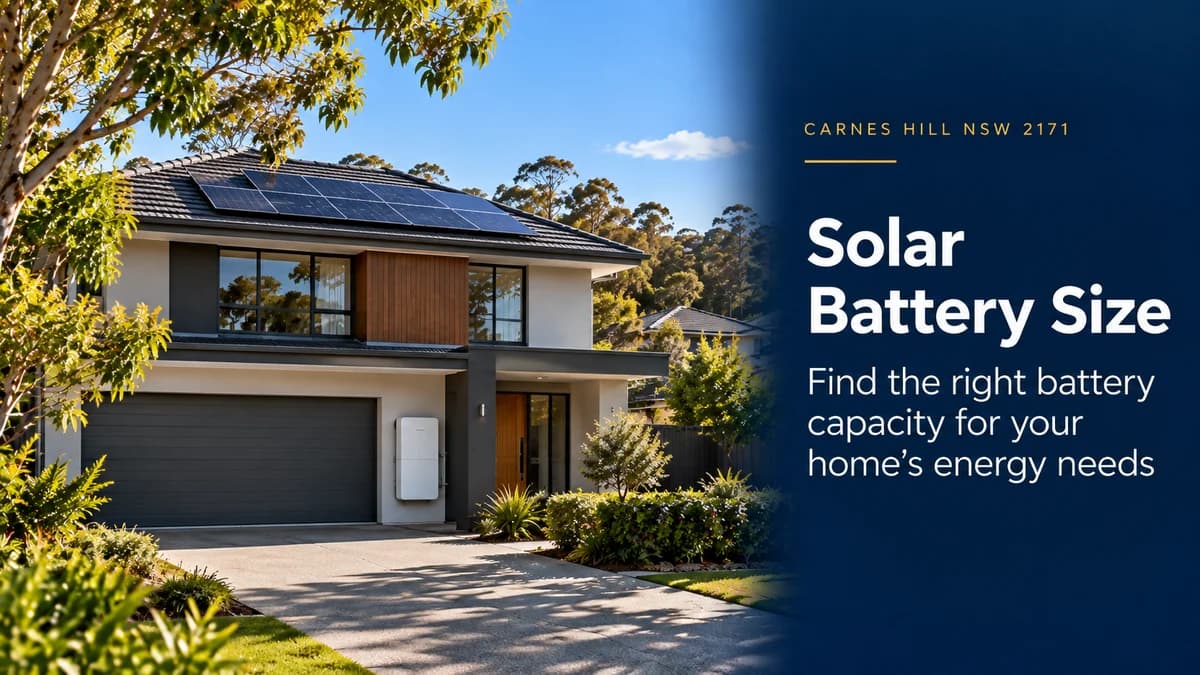
Solar Battery Size Carnes Hill: How Many kWh Do You Need?
Choosing a solar battery in Carnes Hill NSW 2171? Compare 5kWh, 10kWh, 13.5kWh and 20kWh+ batteries based on night usage, solar surplus, backup and 2026 rebates.
Solar Battery Size Carnes Hill: How Many kWh Do You Actually Need?
If you are considering a solar battery in Carnes Hill NSW 2171, choosing the right capacity matters just as much as choosing the battery brand.
A 10kWh battery may be enough for one household, while another may need 13.5kWh, 20kWh or more.
The right solar battery size for a Carnes Hill home mainly depends on:
How much electricity you use after sunset
How much excess solar you generate during the day
Whether you want blackout backup
Future loads such as an EV, pool or electric hot water
Your inverter and electrical configuration
The objective is not to install the biggest battery available. It is to choose enough usable storage to match the way your home actually consumes energy.
For broader information on solar and storage in NSW, see the Kratos Energy NSW Solar Guide.
What Size Solar Battery Do Carnes Hill Homes Need?
As a practical starting point:
Electricity Used After Solar Hours | Battery Capacity to Investigate* |
4–7 kWh/night | 5–8 kWh usable |
7–10 kWh/night | 8–12 kWh usable |
10–14 kWh/night | 12–16 kWh usable |
14–20 kWh/night | 16–24 kWh usable |
20+ kWh/night | 20–30+ kWh usable |
*These are indicative assessment ranges, not fixed recommendations. Solar surplus, efficiency, backup reserve, seasonal generation and battery output also matter. If you want a quicker route for Carnes Hill, this is the link https://kratos-energy.com/solar/nsw/carnes-hill
A useful rule is:
Your battery should be large enough to cover the portion of night-time consumption you want to offset—but small enough to be regularly charged and used.
Why Battery Sizing Matters in Carnes Hill
Carnes Hill has a housing profile that makes individual energy assessment particularly relevant.
According to the 2021 Census, around 97.6% of occupied private dwellings in Carnes Hill are separate houses, approximately 87.1% have four or more bedrooms, and the average household has about 3.8 people.
That does not mean every Carnes Hill household needs a large battery.
However, larger family homes may have significant loads from:
Ducted air conditioning
Pool equipment
Electric cooking
Electric hot water
Multiple refrigerators
Home-office equipment
EV charging
This makes a generic recommendation such as “every home needs a 10kWh battery” unreliable.
Your battery should be sized from actual electricity data.
How to Calculate Your Battery Size
You can estimate a practical starting point in three steps.
Step 1: Measure Your Night-Time Electricity Use
Check your smart-meter, electricity retailer or solar-monitoring app.
Measure how much electricity your home typically consumes from the time solar production drops until the following morning.
For example:
Average night-time consumption = 12kWh
If you want your battery to cover around 80% of that consumption:
12kWh × 80% = 9.6kWh
A battery around 10kWh usable capacity would therefore be worth investigating.
You do not necessarily need enough battery capacity to eliminate every kilowatt-hour purchased from the grid.
Step 2: Check Your Daytime Solar Surplus
A battery needs energy to charge.
Suppose your home uses 10kWh overnight.
Home A
Night use: 10kWh
Excess daytime solar: 12kWh
There may be enough surplus solar to recharge a battery capable of covering most night-time consumption.
Home B
Night use: 10kWh
Excess daytime solar: 4kWh
A 10–13.5kWh battery may regularly remain partly empty unless the home:
Adds more solar
Uses controlled grid charging
Reduces daytime consumption
Changes when appliances operate
This is why battery size should be matched to both night-time demand and solar surplus.
Step 3: Decide What You Want the Battery to Do
Battery sizing changes depending on your goal.
Mostly bill savings
Focus on regularly storing daytime solar and using it at night.
Blackout backup
Allow additional capacity for your essential loads and backup reserve.
Greater energy independence
You may need more capacity, especially if you want to reduce overnight grid use significantly.
Future EV charging
Consider when the vehicle will charge. Daytime solar charging may require less battery capacity than overnight EV charging.
10kWh vs 13.5kWh vs 20kWh Battery
Here is a simpler way to compare common residential capacities.
5–8kWh Battery
Best suited to:
Lower evening electricity use
Smaller overnight loads
Partial grid-offset goals
Essential-load backup
It can be highly effective when regularly charged and discharged rather than leaving unused capacity.
10–13.5kWh Battery
This range can suit households with:
Moderate-to-high night-time consumption
Good daytime solar surplus
Air-conditioning use
Typical family evening loads
Some blackout-backup requirements
For many households, this is the range worth modelling first—but it should still be checked against actual consumption.
16–20kWh Battery
Worth considering when:
Night-time demand is consistently high
A larger solar array produces substantial excess electricity
The home has ducted air conditioning or pool loads
Greater blackout duration is required
Future electricity demand is expected to increase
20kWh+ Battery
Larger storage systems can make sense for:
Very high-energy households
Large solar arrays
Extended backup requirements
Multiple EVs
High overnight consumption
Strategic time-of-use grid charging
But purchasing 30kWh of storage for a household that normally uses only 10kWh overnight may leave a significant portion of the investment under-utilised.
Usable Capacity Matters More Than the Headline Number
When comparing batteries, pay attention to usable capacity, not just nominal capacity.
Nominal capacity
The total energy capacity inside the battery.
Usable capacity
The amount available for normal charging and discharging.
For household sizing, usable capacity is the more meaningful figure.
If you are comparing two battery packages, compare:
usable kWh vs usable kWh
rather than simply comparing the product names.
You can explore Kratos Energy's home battery storage solutions when comparing system options.
kWh vs kW: Don't Confuse Battery Capacity With Power
Two battery specifications matter:
kWh — Capacity
How much energy the battery can store.
kW — Power
How much electricity the battery can deliver at one time.
For example, a battery may contain enough energy to operate your home for several hours but still lack the power output to simultaneously run:
Ducted air conditioning
Induction cooking
Electric oven
Pool pump
EV charger
This is especially important when designing blackout backup.
Before choosing a battery, check both:
Usable capacity (kWh)
Continuous output power (kW)
Carnes Hill Battery Sizing Examples
Example 1: Moderate Family Home
Solar system: 6.6kW
Night use: 6–7kWh
Solar surplus: 8–10kWh
Starting range:
7–10kWh usable
This may provide strong daily utilisation without unnecessarily increasing capacity.
Example 2: Larger Family With Ducted Air Conditioning
Solar system: 10kW
Night use: 10–13kWh
Solar surplus: 12–16kWh
Starting range:
12–16kWh usable
Battery output power should also be checked if air conditioning is expected to operate from the battery.
Example 3: High-Use Home With Pool
Solar system: 10–13kW
Night use: 14–18kWh
Solar surplus: 15–22kWh
Starting range:
16–24kWh usable
However, running the pool pump during daylight hours may reduce battery requirements.
Should You Size a Battery for Blackouts?
If blackout protection matters, battery capacity alone is not enough.
Decide which circuits need backup.
Common essential loads include:
Refrigerator
Lighting
Wi-Fi
Security systems
Selected power outlets
Garage door
Running only essential loads can significantly extend battery backup duration.
Running an entire home—including air conditioning, cooking appliances and pool equipment—requires significantly more battery capacity and power output.
Also remember:
Installing a battery does not automatically provide blackout backup.
The battery, inverter, backup gateway and electrical circuits must be configured for it.
How Backup Reserve Changes Battery Size
Many batteries allow part of their capacity to be reserved for outages.
For example, if you maintain a 20% backup reserve, that portion normally remains unavailable for daily bill savings.
This means a nominally suitable battery could deliver less everyday usable energy than expected.
A higher reserve provides better blackout preparedness.
A lower reserve provides more capacity for daily cycling.
Your installer should configure this around your priorities.
What About Winter?
Battery sizing should not rely only on summer solar production.
During winter:
Solar days are shorter
Cloud cover can reduce generation
Less excess solar may be available
Heating-related electricity demand may increase
A battery that fills easily in summer may not fully recharge every winter day.
For this reason, sizing should consider annual solar production and household consumption, not just ideal sunny-day figures.
Carnes Hill Battery Rebate in 2026
Eligible home batteries can receive support through the Australian Government's Cheaper Home Batteries Program.
For eligible systems installed from 1 May 2026, the battery STC factor is tapered by usable capacity:
Usable Capacity | STC Factor Applied |
First 14kWh | 100% |
Above 14kWh to 28kWh | 60% |
Above 28kWh to 50kWh | 15% |
Eligible batteries can have up to 100kWh usable capacity, but STCs are calculated only on the first 50kWh. The Clean Energy Regulator says the revised settings are designed to provide support equivalent to around a 30% reduction in installation costs across battery sizes.
This makes proper battery sizing even more important.
Do not buy additional capacity simply to receive a larger rebate.
Estimate the current incentive using the Kratos Energy Battery Rebate Calculator.
Does Battery Size Need to Match Solar Size?
No.
There is no fixed rule such as:
6.6kW solar = 10kWh battery
or
10kW solar = 20kWh battery
Solar size measures how much electricity the panels can generate.
Battery capacity measures how much electricity can be stored.
The missing number is solar surplus.
A 10kW solar system on a high-consumption property may export very little electricity.
A 6.6kW system on an efficient household may export substantial energy.
Battery sizing therefore needs generation and consumption data—not a fixed solar-to-battery ratio.
Four Numbers to Check Before Buying a Battery
Before accepting a battery quote for your Carnes Hill home, ask for:
1. Average daily solar generation
How much electricity does your solar system produce?
2. Daytime self-consumption
How much solar do you use directly?
3. Average solar export
How much excess electricity is available for battery charging?
4. Night-time grid consumption
How much electricity do you buy after solar production falls?
These four numbers provide a much stronger foundation for sizing than choosing a standard package.
What Solar Battery Size Is Best for Carnes Hill?
There is no single correct battery size for every home in Carnes Hill NSW 2171.
As an initial guide:
5–8kWh: lower overnight consumption
8–12kWh: moderate family usage
12–16kWh: higher evening demand
16–24kWh: large household or significant loads
20kWh+: high demand, larger solar or greater backup requirements
The final capacity should be based on:
Night-time consumption + solar surplus + backup requirement + future energy use
rather than house size or solar capacity alone.
Frequently Asked Questions
Is a 10kWh battery enough for a Carnes Hill home?
Is 13.5kWh a good solar battery size?
Is a 20kWh battery too large?
How much solar do I need for a 10kWh battery?
Should battery size match my solar system?
Can a battery power my home during a blackout?
Does the 2026 battery rebate apply in Carnes Hill?
Find the Right Battery Size for Your Carnes Hill Home
The best battery is not necessarily the biggest one.
It is the battery your home can regularly charge, discharge and use effectively.
For a Carnes Hill property, Kratos Energy can assess:
Electricity consumption
Night-time grid usage
Solar generation and exports
Existing inverter
Battery compatibility
Backup requirements
EV plans
Future electricity demand
Available battery incentives
Explore our battery storage solutions, calculate your potential 2026 battery rebate, or request a tailored solar and battery assessment.
Choose your battery around your home's actual energy profile—not a generic package.
Solar System Packages
Tier 1 panels & CEC accredited installation.
- Trina 475W or Jinko panels
- 5kW power inverter
- 14 × 475W panels
- Single-phase compatible
- Trina 475W or Jinko panels
- 8–10kW power inverter
- 21 × 475W panels
- Battery & EV ready
- Trina 475W or Jinko panels
- 10kW power inverter
- 27 × 475W panels
- Three-phase compatible