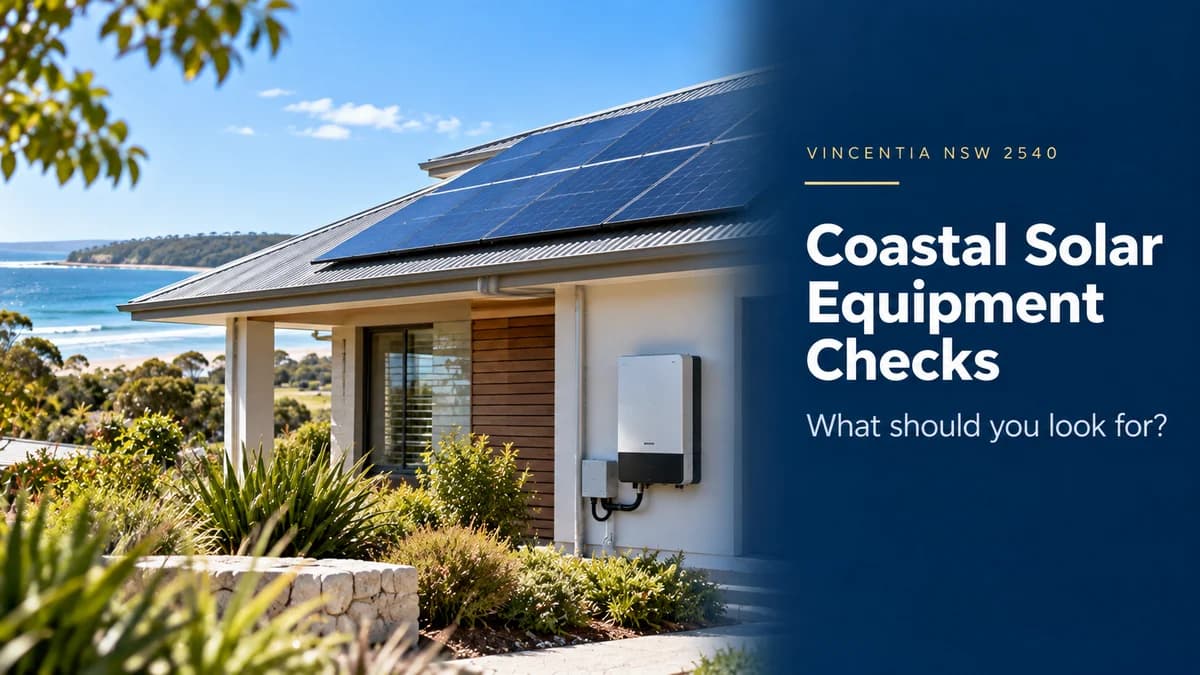
Coastal Solar Panels Vincentia: Equipment Checklist
Installing solar in Vincentia NSW 2540? Learn what to check for coastal corrosion, salt-mist certification, mounting hardware, inverter placement and warranties.
Coastal Solar Equipment Checks in Vincentia: What Should You Look For?
Living close to the coast has obvious advantages, but salt-laden air can create additional demands on rooftop solar equipment.
If you are installing solar in Vincentia NSW 2540, system design should therefore consider more than panel wattage, inverter size and price.
For a coastal property, check whether the solar panels, mounting rails, clamps, fasteners, connectors and equipment installation locations are suitable for the property's actual exposure to salt and corrosion.
The most important question is not simply:
“Is this panel suitable for Australia?”
It is:
“Is this exact equipment configuration suitable for my coastal installation?”
Kratos Energy currently installs solar equipment from manufacturers including Trina Solar and JinkoSolar, together with established mounting systems such as Clenergy. You can review the current equipment range on the Kratos Energy solar products page. (Kratos Energy)
Why Coastal Solar Design Matters in Vincentia
Vincentia is a predominantly detached-home suburb. According to the 2021 Census, approximately 91.5% of occupied private dwellings in Vincentia were separate houses, making rooftop system design particularly relevant to the local housing profile. (Australian Bureau of Statistics)
Because Vincentia sits in the Jervis Bay coastal environment, some properties can experience greater exposure to:
Salt-laden air
Wind-driven moisture
High humidity
Salt deposits on metal components
Corrosive conditions around exposed fixings
However, coastal exposure is property-specific.
A home several kilometres inland and protected by surrounding buildings or vegetation may experience different conditions from a property directly exposed to sea winds.
That is why equipment should be selected according to the actual installation environment.
1. Check the Solar Panel's Salt-Mist Certification
The first specification to look for is:
IEC 61701 — Salt Mist Corrosion Testing
The Clean Energy Council identifies IEC 61701 as an important additional module standard for coastal installations, particularly for properties within approximately 500 metres of the sea. (Clean Energy Council)
This test evaluates how a solar module withstands corrosive salt-mist conditions.
For a coastal installation, ask your installer:
Does the exact panel model have IEC 61701 certification?
Which edition/test method applies?
Is there an official certificate or manufacturer documentation?
Are there additional installation conditions near the coastline?
Do not accept only:
“This brand is coastal rated.”
Certification should relate to the specific module family being proposed.
What Do Kratos' Panel Brands Say About Salt Exposure?
Kratos currently lists Trina Solar and JinkoSolar among the panel manufacturers it installs. (Kratos Energy)
Both manufacturers publish salt-corrosion documentation, but model-specific verification is still essential.
JinkoSolar
JinkoSolar's current installation documentation states that its standard PV modules have passed IEC 61701:2020 salt-spray corrosion testing using Method 6.
Importantly, Jinko also provides an additional installation instruction for modules located approximately 50–500 metres from the seashore, including protection of connectors using dust plugs. (JinkoSolar)
This is exactly why coastal installation manuals matter.
The panel may be certified, but the manufacturer can still specify additional installation measures.
Trina Solar
Trina publishes IEC 61701 salt-mist corrosion certificates for applicable module families, including certificates tested to IEC 61701:2020. (Trina Solar)
Again, confirm that the certificate covers the exact Trina model on your quote.
2. Check the Mounting System — Not Just the Panels
A corrosion-resistant solar panel does not help if the mounting structure deteriorates prematurely.
Your rooftop system also contains:
Aluminium rails
Roof brackets
Panel clamps
Bolts
Nuts
Washers
Roof screws
These components need to be appropriate for the property's corrosion environment.
Kratos currently lists Clenergy and Mibet among its mounting equipment brands. (Kratos Energy)
For any proposed mounting system, ask:
What corrosion category is the hardware designed for?
What materials are used?
Examples can include:
Aluminium
Anodised aluminium
Stainless steel
Coated or galvanised steel
Does the warranty change in severe coastal environments?
This is especially important.
Clenergy's current warranty documentation separates mounting products according to ISO 9223 corrosion categories, and warranty coverage can vary depending on the component material and corrosivity category. For example, stainless-steel and aluminium components can have different conditions from coated steel screws in higher-corrosion environments. (Clenergy)
So do not assume every bracket, screw and rail automatically carries the same coastal warranty.
3. Fasteners Matter More Than They Look
Bolts and screws represent a small part of the system cost, but they can be important in a coastal environment.
Your installer should ensure that:
Fastener materials suit the mounting system
Roof-interface screws meet the manufacturer's specification
Components are suitable for the site's corrosion category
Different metals are installed in a way that limits galvanic corrosion
Australian mounting-system guidance emphasises corrosion-resistant materials and appropriate protection for the installation environment. (SUNLOCK)
This is not an area where installers should substitute whatever hardware happens to be available.
Use the hardware specified by the mounting-system manufacturer.
4. Check the Manufacturer's Distance-from-Coast Conditions
One of the most useful questions for a Vincentia homeowner is:
Does this manufacturer impose additional requirements based on how close my home is to the ocean?
Some manufacturers define special conditions for properties near the coast.
For example, JinkoSolar specifically identifies additional connector protection for installations within approximately 50–500 metres of the seashore. (JinkoSolar)
The exact distance between your property and the shoreline therefore matters.
Your installer should not simply classify every property in postcode 2540 in the same way.
Ask for the actual manufacturer's installation requirements that apply to your location.
5. Check Solar Connectors and Cable Management
Panels and rails usually receive most of the attention, but electrical connections are also exposed to the environment.
A good coastal installation should avoid leaving connectors:
Resting on the roof
Sitting where water can accumulate
Unsupported beneath panels
Unnecessarily exposed to direct weather
Cable routing should follow the panel and equipment manufacturers' installation instructions.
This becomes even more important where a manufacturer specifies additional connector protection for coastal locations.
6. Think Carefully About Inverter Placement
Solar panels must sit on the roof.
The inverter usually does not.
Where practical, the inverter should be installed in a location that respects the manufacturer's environmental and installation requirements while reducing unnecessary exposure.
Potential considerations include:
Direct rain
Direct afternoon sun
Salt-laden wind
Ventilation
Access for maintenance
Manufacturer clearance requirements
Kratos currently installs inverter brands including FoxESS, GoodWe, Sungrow, Sigenergy, ESY Sunhome and Sofar Solar. (Kratos Energy)
Do not assume that because an inverter has a particular IP enclosure rating it is automatically ideal for every marine environment.
The exact inverter installation manual should be checked for environmental restrictions and installation requirements.
if you are weighing up a system for a coastal home, see solar panels in Vincentia for local costs and the rebate for 2540.
Coastal Solar Equipment Checklist for Vincentia
Before accepting a solar proposal, ask the installer to confirm the following:
Component | What to Check |
Solar panels | Exact model and IEC 61701 salt-mist certification |
Panel warranty | Any exclusions for marine/coastal environments |
Mounting rails | Material and corrosion classification |
Clamps & brackets | Coastal suitability |
Bolts & fasteners | Stainless/coated specification required by manufacturer |
Roof screws | Correct corrosion rating for the environment |
Connectors | Manufacturer coastal-protection requirements |
Cables | Secure routing away from standing water |
Inverter | Environmental limitations and installation location |
Warranty | Whether coastal location changes coverage |
Maintenance | Recommended inspection or cleaning intervals |
This is far more useful than asking only whether the panel is “premium” or “Tier 1”.
What About Solar-System Maintenance Near the Coast?
A coastal solar installation should not simply be forgotten for 20 years.
Mounting-system manufacturers can recommend additional inspection in severe environments.
For example, SunLock recommends that systems in severe marine environments be inspected as part of regular roof maintenance and washed with fresh water where appropriate to minimise salt accumulation at interfaces and crevices. (SUNLOCK)
Your maintenance plan may therefore include periodic inspection of:
Rails and clamps
Fasteners
Roof interfaces
Electrical cables
Connectors
Inverter condition
Visible corrosion
Never climb onto a solar roof yourself unless appropriately qualified and equipped.
Does Salt on the Panel Surface Reduce Solar Output?
Salt deposits, dust and other contaminants can reduce the amount of sunlight reaching the solar cells if they accumulate heavily enough.
But panel cleaning should be approached carefully.
Before cleaning:
Follow the module manufacturer's instructions
Avoid harsh chemicals
Avoid abrasive tools
Do not use cleaning methods that could affect the module warranty
For most homeowners, professional inspection is preferable where roof access is difficult or unsafe.
Should You Pay More for Coastal-Compatible Equipment?
Potentially—but focus on documented suitability rather than marketing labels.
A slightly cheaper solar package may become poor value if:
Mounting components are unsuitable for the environment
Warranty exclusions apply close to the ocean
Non-approved replacement fasteners are used
Connectors are installed contrary to manufacturer instructions
For a Vincentia property, it can make more sense to prioritise:
correct materials + documented certifications + correct installation
over simply selecting the lowest upfront quote.
3 Questions Every Vincentia Solar Quote Should Answer
1. What salt-corrosion certification does the exact panel have?
Ask for the certificate or manufacturer's documentation.
2. What corrosion category is the mounting system suitable for?
Ask about rails, brackets and fasteners, not just the main rail.
3. Does my distance from the coastline change the installation method or warranty?
This should be checked against the equipment manufacturers' documentation.
If the installer cannot answer these questions, ask for clarification before signing.
Common Coastal Solar Mistakes
Choosing panels based only on wattage
A high-output panel is not automatically the best panel for a coastal installation.
Checking panels but ignoring mounting hardware
Every exposed metal component matters.
Assuming stainless steel is all the same
Different grades can have different corrosion performance and manufacturer specifications.
Ignoring manufacturer installation instructions
A valid product warranty can depend on correct installation.
Assuming every Vincentia property has identical exposure
A protected inland-facing property and an ocean-exposed property can require different considerations.
Frequently Asked Questions
Are solar panels suitable for coastal homes in Vincentia?
What is IEC 61701?
Are Jinko panels suitable for coastal installations?
Are Trina Solar panels salt-mist tested?
Does the solar mounting system matter near the coast?
Does every Vincentia solar system need special marine equipment?
Choosing Coastal Solar Equipment in Vincentia
For a home in Vincentia NSW 2540, a good solar proposal should assess more than system size and expected generation.
Before installation, verify:
Panel certification → mounting materials → fasteners → connectors → inverter location → coastal warranty conditions.
The strongest system is one where every component—not only the solar module—is suitable for the environment in which it will operate.
Kratos Energy's current residential equipment range includes Tier 1 panels and mounting systems selected for Australian conditions, including coastal applications, but the exact equipment should still be matched to the specific property and manufacturer requirements. (Kratos Energy)
Explore Kratos solar panels and inverters
Explore Kratos residential solar systems
Request a tailored Kratos solar quote
For a coastal solar system, durability starts with the equipment specification—not after corrosion appears.
Solar System Packages
Tier 1 panels & CEC accredited installation.
- Trina 475W or Jinko panels
- 5kW power inverter
- 14 × 475W panels
- Single-phase compatible
- Trina 475W or Jinko panels
- 8–10kW power inverter
- 21 × 475W panels
- Battery & EV ready
- Trina 475W or Jinko panels
- 10kW power inverter
- 27 × 475W panels
- Three-phase compatible