

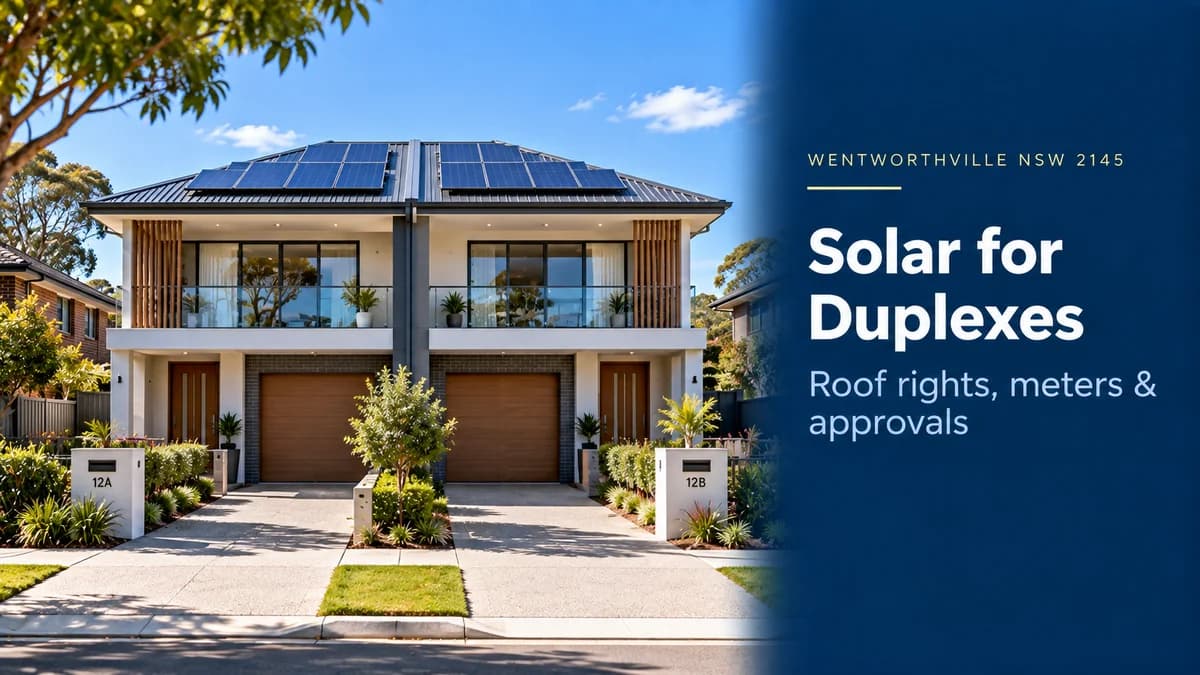
Solar for Duplexes Wentworthville: Roof, Meter & Approval Guide
Planning solar for a duplex in Wentworthville NSW 2145? Learn how title type, roof ownership, separate meters, strata approval and system design affect installation.
Solar for Duplexes in Wentworthville: Roof Rights, Meters and Approvals
Installing solar on a duplex in Wentworthville NSW 2145 can be straightforward—but only after confirming who controls the roof and which electricity meter the system will serve.
Unlike a standard detached house, a duplex may be:
Individually Torrens titled
Part of a two-lot strata scheme
Built around shared walls or common property
Separately metered
Connected through a more complex shared electrical arrangement
These differences affect panel placement, approvals, inverter connection and who benefits from the generated electricity.
Before comparing 6.6kW or 10kW systems, answer three questions:
Who legally controls the roof area?
Does each dwelling have its own electricity meter and supply?
Is neighbour, strata or owners-corporation approval required?
Kratos Energy designs residential systems around roof conditions and actual electricity usage rather than applying the same package to every property. Explore Kratos residential solar systems. (Kratos Energy)
Why Duplex Solar Is Relevant in Wentworthville
Wentworthville has a diverse housing mix.
According to the 2021 Census, around:
37.2% of occupied private dwellings were separate houses
22.3% were semi-detached, row/terrace houses or townhouses
40.0% were flats or apartments
The Census category does not identify duplexes separately, but it shows that attached and multi-dwelling housing represents a significant share of the local housing stock. (Australian Bureau of Statistics)
For a property in Wentworthville 2145, the solar design therefore needs to consider the individual title and electrical configuration rather than assuming every roof operates like a detached home. More details ...
First Check: What Type of Duplex Do You Own?
This is the most important starting point.
Torrens-Titled Duplex
If each dwelling is on its own Torrens title, the solar process may be relatively straightforward where:
The roof section is entirely within your property
Your electrical supply is independent
Panels do not interfere with neighbouring property
No easement, covenant or other title restriction affects the proposed work
However, do not assume that a dividing wall automatically tells you where legal roof rights begin and end.
Check the deposited plan and title documents if there is any uncertainty.
Strata-Titled Duplex
Many NSW duplexes operate under strata arrangements.
NSW Government guidance specifically notes that strata rules apply to properties including many duplexes, and owners should check the strata plan and by-laws before making changes. (NSW Government)
In a strata scheme, the roof may form part of common property, even though it sits directly above your individual dwelling. NSW strata guidance generally identifies roofs and gutters as owners-corporation maintenance responsibilities, subject to the actual strata plan. (NSW Government)
That means installing rooftop solar may require approval before work begins.
Do You Need Your Neighbour's Approval?
It depends on the ownership structure.
Individually owned roof and electrical supply
Formal neighbour approval may not always be necessary, although title restrictions, shared structures or access arrangements still need to be checked.
Strata roof or common property
Approval through the owners corporation may be required.
NSW strata law provides a specific pathway for sustainability infrastructure, which can include changes to common property that reduce energy consumption or greenhouse emissions. Where a sustainability infrastructure resolution is used, the resolution passes when votes against represent less than 50% of the relevant vote by unit entitlement. (NSW Government)
For a two-lot duplex, the practical approval position can depend on:
Unit entitlements
The strata plan
Existing by-laws
Which roof area is affected
Who will own and maintain the solar system
If the roof ownership is unclear, obtain advice from the strata manager, conveyancer or appropriately qualified property professional before committing to installation.
What Should the Solar Approval Request Include?
If owners-corporation approval is required, prepare a clear proposal.
Include:
Proposed panel layout
Number of panels
Inverter location
Cable route
Roof penetrations or mounting method
Installer details
Equipment specifications
Insurance information where required
Who pays for installation
Who owns the equipment
Who maintains and removes it if roof repairs are required
This reduces uncertainty for the other owner or strata committee.
It also makes it easier to establish responsibility if roof maintenance is required later.
Separate Electricity Meters Make Solar Simpler
The next major check is metering.
Many duplexes have a separate electricity meter for each dwelling.
For example:
Dwelling A → Meter A → Electricity account A
Dwelling B → Meter B → Electricity account B
Where this is the arrangement, a solar system installed for Dwelling A would normally be designed around Dwelling A's electrical connection and consumption.
The panels may physically sit close to the neighbouring roof, but the electricity needs to be correctly connected to the intended customer's installation.
What If the Duplex Has a Shared Meter?
A shared electrical arrangement requires more investigation.
If both dwellings receive electricity through one meter or a private metering arrangement, the installer needs to understand:
Main connection point
Existing switchboard
Sub-metering
Which customer pays the retailer
How electricity is allocated between dwellings
Whether separate solar accounting is required
Do not assume solar production can simply be divided 50/50 between two dwellings.
Metering and billing arrangements need to match the electrical design.
If the duplex owners want two independent solar systems, separate metering and connection arrangements may need to be assessed first.
One Large Solar System or Two Smaller Systems?
Both approaches may be possible depending on title, roof area and electrical infrastructure.
Option 1: Independent Solar for Each Duplex
Example:
Dwelling A: 6.6kW solar
Dwelling B: 6.6kW solar
This can work well where each dwelling has:
Independent roof allocation
Separate meter
Separate switchboard
Separate electricity account
Each owner can then size their system according to their own consumption.
Option 2: One Shared Solar System
A shared system may be considered where both dwellings share electrical infrastructure or where the owners corporation installs solar for common benefit.
However, this creates additional questions:
Who owns the system?
How are costs divided?
How is generated electricity allocated?
Who receives export credits?
Who pays maintenance costs?
What happens if one duplex is sold?
These issues should be resolved before installation, ideally in the appropriate ownership or strata documentation.
Roof Space Can Become the Main Constraint
Duplex roofs can be smaller or more segmented than roofs on standalone homes.
Usable solar space may be reduced by:
Roof boundaries
Shared ridgelines
Different orientations
Skylights
Chimneys
Roof vents
Shade from the adjoining dwelling
Trees
Required access and installation clearances
A roof may physically fit 20 panels, but that does not automatically mean one duplex owner has the right to use all of that space.
The solar layout should follow both:
technical suitability + property rights.
Example: A Wentworthville Duplex Solar Layout
Consider a hypothetical duplex with two separately metered dwellings.
Duplex A
Usable north-facing roof: 30 m²
Household consumption: 16kWh/day
Good daytime usage.
Duplex B
Usable west-facing roof: 24 m²
Household consumption: 11kWh/day
Lower daytime usage.
It would not necessarily make sense to install identical systems simply because the homes are attached.
Duplex A may justify a larger system, while Duplex B may achieve better utilisation from a smaller one.
Each system should be designed around:
Available roof area
Roof orientation
Electricity usage
Export conditions
Future battery or EV plans
This example is illustrative only.
Can Panels Cross Onto the Other Duplex Roof?
Do not assume so.
If panels would extend into:
Another lot
Common property
A neighbour's separately owned roof area
the appropriate property rights and approvals need to be established first.
Even where both owners agree informally, documenting the arrangement is sensible because property ownership can change later.
A future purchaser should be able to understand:
Who owns the panels
Which dwelling receives the electricity
Who maintains them
Which roof area they occupy
Planning Approval and Strata Approval Are Different
Another important distinction is between planning permission and property-owner approval.
NSW planning rules allow many rooftop solar systems to be installed as exempt or complying development, provided the relevant standards are satisfied. (Planning Portal NSW)
But even if council development consent is not required, you may still need:
Strata approval
Roof-owner approval
Electricity-network approval
These are separate processes.
So:
“Council approval not required” does not automatically mean “no other approval required.”
Grid Connection Still Needs Approval
NSW Government guidance states that approval from the electricity network owner is required before connecting a solar system to the grid. (NSW Government)
For postcode 2145, confirm the electricity distributor for the specific property from the electricity bill or the Australian Energy Regulator's distributor information rather than assuming based only on suburb name. NSW has separate Ausgrid and Endeavour Energy network areas across metropolitan Sydney and Greater Western Sydney. (Australian Energy Regulator (AER))
Your solar installer should normally manage the connection application as part of the project.
What Solar Size Works for a Wentworthville Duplex?
There is no standard duplex system size.
A useful starting comparison is:
Household Profile | System Worth Investigating* |
Lower electricity use | 6.6kW |
Moderate-to-high use | 6.6kW–10kW |
High daytime use / EV / air-con | 10kW or custom design |
*Subject to available roof space, phase configuration and network requirements.
Kratos currently offers residential systems from 6.6kW through 13kW, plus customised designs. (Kratos Energy)
For a duplex, however, roof allocation may become the limiting factor before electricity consumption does.
Calculate Solar Output for Wentworthville 2145
Kratos Energy's postcode calculator can provide an indicative generation estimate for different solar-system sizes.
Enter:
2145
Calculate solar output for Wentworthville
The calculator provides a location-based estimate, but actual generation will still depend on roof orientation, shade and panel placement. (Kratos Energy)
For duplexes, the final calculation should use only the roof area genuinely available to the relevant dwelling.
What About Adding a Battery?
A battery can be added to a duplex solar system, but the ownership and electrical arrangement must remain clear.
Before adding storage, confirm:
Which dwelling the battery serves
Where the battery can legally be installed
Inverter compatibility
Switchboard configuration
Backup circuits
Any common-property approval required
If the system is individually metered and electrically independent, battery design can be similar to a detached house.
Shared or strata electrical arrangements may require more detailed planning.
Wentworthville Duplex Solar Checklist
Before requesting installation, confirm:
Property
Torrens or strata title?
Who controls the proposed roof area?
Is common property involved?
Are any by-laws or easements relevant?
Approvals
Is neighbour consent required?
Is owners-corporation approval required?
Does the proposal need a sustainability infrastructure resolution or by-law?
Does the project meet NSW planning requirements?
Electricity
Separate or shared meters?
Separate electricity accounts?
Separate switchboards?
Which network distributor serves the connection?
Solar Design
Usable roof area
Orientation
Shade
Panel count
Inverter location
Expected generation
Future battery or EV requirements
Resolve these issues before signing the final installation contract.
Frequently Asked Questions
Can I install solar on one side of a duplex in Wentworthville?
Does my duplex neighbour need to approve my solar?
Is the roof common property in a strata duplex?
Can both duplexes install separate solar systems?
Can two duplexes share one solar system?
Does solar require council approval in NSW?
What postcode should I use for a Wentworthville solar estimate?
Solar for Duplexes in Wentworthville: The Bottom Line
For a Wentworthville NSW 2145 duplex, solar design should begin with ownership and metering—not panel count.
Follow this order:
Confirm title → confirm roof rights → confirm approvals → confirm meter → assess roof → size the solar system.
Where each dwelling is independently titled and metered, solar may be relatively straightforward.
Where roof space or electrical infrastructure is shared, resolve ownership, approval and maintenance responsibilities before installation.
Kratos Energy can then design the system around the roof area and electricity account that the solar installation will actually serve.
Explore Kratos residential solar systems
Calculate solar output for postcode 2145
Request a tailored Kratos solar assessment
For duplex solar, the right design starts by knowing exactly which roof—and which meter—the system belongs to.
Solar System Packages
Tier 1 panels & CEC accredited installation.
- Trina 475W or Jinko panels
- 5kW power inverter
- 14 × 475W panels
- Single-phase compatible
- Trina 475W or Jinko panels
- 8–10kW power inverter
- 21 × 475W panels
- Battery & EV ready
- Trina 475W or Jinko panels
- 10kW power inverter
- 27 × 475W panels
- Three-phase compatible