

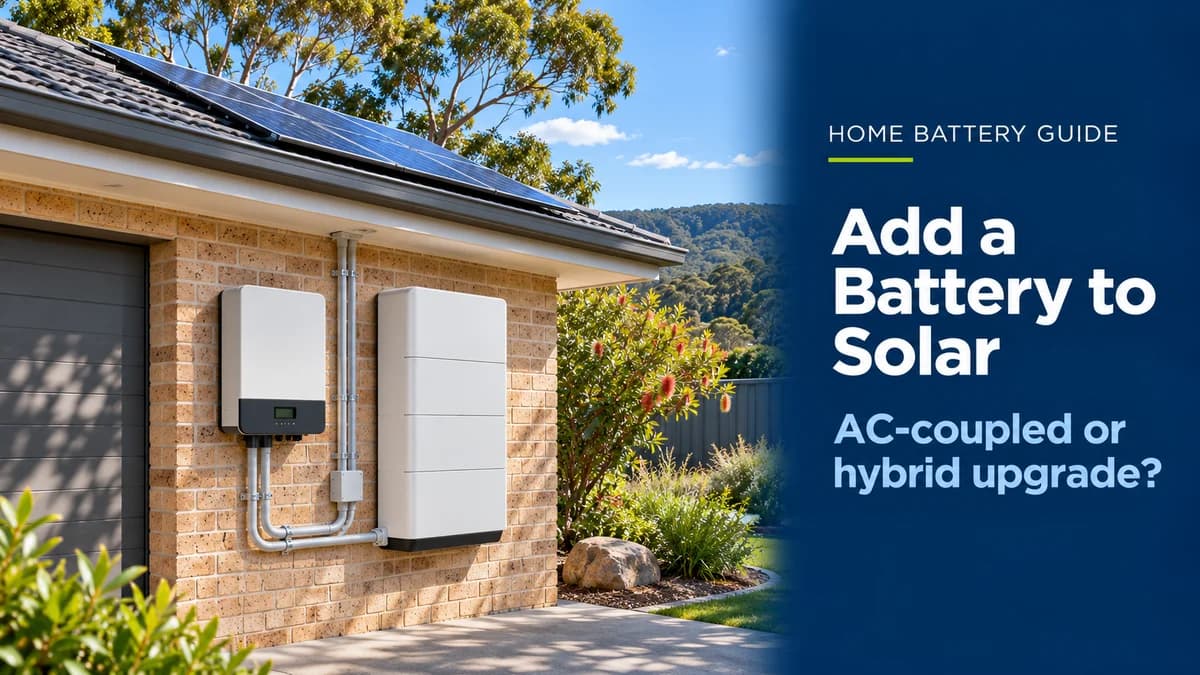
Adding a Battery to Existing Solar: AC-Coupled or Hybrid?
Help Australian homeowners with existing rooftop solar understand how to add battery storage, choose between an AC-coupled retrofit and a DC-coupled hybrid inverter upgrade, assess blackout backup feasibility, and request an accurate compatibility quote.
Adding a Battery to Existing Solar: AC-Coupled or Hybrid?
Many existing solar systems can be upgraded with a battery. The main choice is whether to retain the current solar inverter and add AC-coupled storage, or replace it with a compatible hybrid inverter. Equipment condition, connection requirements and backup goals determine which option makes sense.
Option one: keep the inverter and add AC-coupled storage
Your existing solar inverter continues supplying AC electricity to the home. A separate battery inverter converts surplus AC energy into stored DC energy and converts it back to AC when the household needs it.
This can suit a serviceable inverter with useful life remaining or a microinverter installation. It avoids replacing working equipment solely to add storage. However, the designer must check metering, site controls, connection limits and compatibility, especially if backup is required.
Option two: replace it with a hybrid inverter
A compatible hybrid inverter manages both rooftop solar and battery storage. This can be sensible when the old inverter needs replacement or the household is planning a broader system upgrade.
The installer must check the existing panel strings against the new inverter's voltage, current and input requirements. A replacement is not automatically a plug-in swap. Read our inverter replacement guide for the questions to ask before changing an older inverter.
AC-coupled versus hybrid at a glance
Consideration | AC-coupled addition | Hybrid inverter upgrade |
|---|---|---|
Existing solar inverter | Usually retained. | Usually replaced. |
Solar charging route | Solar DC becomes AC before battery charging. | Compatible panels can charge the battery through a DC path. |
Efficiency | Extra conversion stages may increase losses. | Can avoid an intermediate AC conversion; losses still exist. |
Compatibility | Check system controls and backup interaction. | Check panel strings and approved battery pairing. |
Outage operation | Requires a suitable backup design. | Requires a backup-capable inverter and suitable wiring. |
Best starting point | A sound existing inverter worth retaining. | An inverter due for replacement or a larger redesign. |
Neither method is always cheaper. Compare the complete installed scope and useful life of the equipment you would retain or replace. Our Wollongong battery cost guide explains local cost factors.
Will existing solar work during a blackout?
Ordinary grid-connected solar shuts down when the grid fails. Adding a battery does not automatically change that behaviour.
For an AC-coupled system, the existing solar inverter must be supported within the backup arrangement if it is to keep generating during an outage. Otherwise, the battery may supply selected loads while the solar remains off.
A suitable hybrid system may recharge from solar during an outage, but this depends on the design, sunlight, battery state and operating limits. Ask the installer to describe outage behaviour explicitly, including what happens when the battery reaches its minimum reserve.
What to send for a retrofit assessment
Your suburb and electrical phase, if known.
The solar inverter make, model and approximate installation date.
The existing panel capacity and any available system paperwork.
Electricity bills or interval data showing evening demand and solar exports.
Photos of the proposed battery area and accessible switchboard exterior.
A list of the appliances or circuits you want backed up.
Do not remove electrical covers to take photographs. Our switchboard upgrade guide explains why older boards may require additional work. Use the solar quote checklist to ensure that work is clearly described.
Can an existing solar home receive the battery discount?
The federal program can apply to eligible batteries connected to existing solar as well as new solar. Eligibility is not established by system age alone. The battery, inverter, installer and installation must meet the applicable requirements.
Use our battery rebate calculator for an initial estimate. Ask for the final incentive deduction and installation-date assumptions in writing.
Two example decisions
A recent, serviceable solar system: assess AC-coupled storage first if retaining the inverter offers good value. Then check the proposed backup interaction before choosing equipment.
An older system with an inverter fault: compare a compatible hybrid replacement with repair or replacement plus separate storage. Check panel-string suitability before committing. These are illustrative scenarios, not customer case studies.
Common questions
Will adding a battery affect existing warranties?
Can I charge from the grid?
Do I need new solar panels?
Check your upgrade options
Explore our home battery storage options and use Design My Solar Plan to outline household demand. For an existing-system compatibility assessment, contact Kratos Energy with your inverter details and backup priorities.
Eligibility reference: Clean Energy Regulator solar battery guidance.
Solar System Packages
Tier 1 panels & CEC accredited installation.
- 475W Tier 1 solar panels
- 5kW power inverter
- 14 × 475W panels
- Single-phase compatible
- 475W Tier 1 solar panels
- 8–10kW power inverter
- 21 × 475W panels
- Battery & EV ready
- 475W Tier 1 solar panels
- 10kW power inverter
- 28 × 475W panels (13.3kW)
- Three-phase compatible