

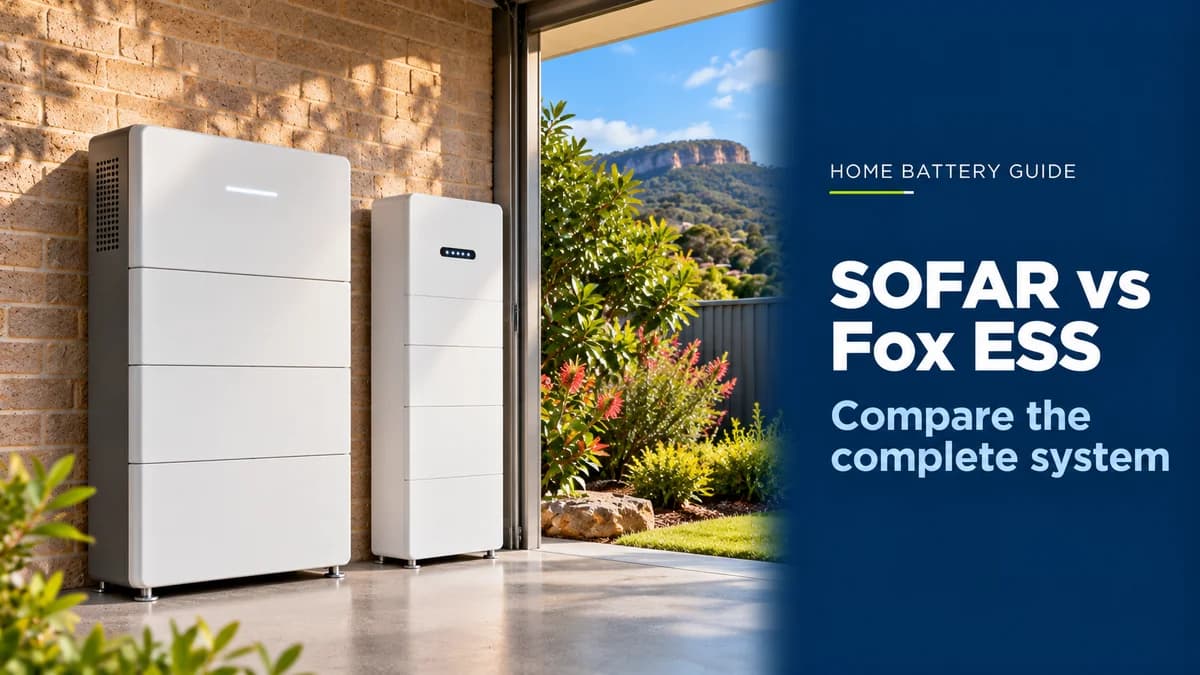
SOFAR vs Fox ESS Batteries: Which System Suits Your Home?
Help Australian homeowners evaluate the key differences between two of Kratos's most popular residential storage systems—SOFAR BTS 5K and Fox ESS Energy Cube (EQ4800 / ECS series)—to select the ideal system for their space, budget, and power requirements.
SOFAR vs Fox ESS Batteries: Which System Suits Your Home?
SOFAR and Fox ESS both offer modular home storage, but the better choice depends on the exact battery and inverter combination. Compare usable energy, output, installation space and support on a like-for-like proposal.
Kratos Energy supplies solar and battery systems. This guide explains purchase considerations; it does not rank long-term reliability from independent testing.
Start with the exact model
This comparison considers SOFAR BTS 5K and Fox ESS EQ4800. “Energy Cube”, “ECS” and “EQ4800” should not be treated as interchangeable specifications. Ask for the model suffix and current Australian documentation.
For example, the Fox ESS EQ4800 V1.3 datasheet lists a two-module system at 9.32 kWh nominal capacity. A proposal describing these modules as 4.74 kWh each does not match that document. SOFAR documentation has also changed across revisions, so usable capacity must be tied to the supplied equipment.
Compare these features
Feature | SOFAR BTS 5K | Fox ESS EQ4800 |
|---|---|---|
System selection | Check the supported BTS and SOFAR inverter combination. | Check the EQ4800 revision and compatible Fox ESS inverter. |
Capacity | Quote nominal and usable energy for the complete configuration. | Quote nominal and usable energy for the complete configuration. |
Expansion | Pack-level optimisation is a manufacturer feature; installation conditions still apply. | Follow the manufacturer's module-matching and expansion requirements. |
Backup | Depends on inverter output, phase limits and backup wiring. | Depends on inverter output, phase limits and backup wiring. |
Space | Assess complete equipment and access clearances. | Assess complete equipment and access clearances. |
Warranty and support | Compare Australian model-specific terms and installer responsibilities. | Compare Australian model-specific terms and installer responsibilities. |
Which suits a home with limited space?
Ask for a scaled layout showing the inverter, battery, control equipment and clearances. Module depth alone does not establish whether a system fits: cables, covers, walkways and access for maintenance can change the result. An outdoor rating also does not remove exposure and placement requirements.
Which suits future expansion?
SOFAR's pack-level optimisation makes expansion worth discussing if your future demand may grow. However, no brand can promise unlimited future compatibility or product availability. Obtain the permitted module count, additional hardware requirements and conditions in writing.
If you expect an electric vehicle, first consider when it will charge. Daytime charging may use rooftop generation directly, while overnight charging creates a different storage requirement. Design My Solar Plan helps organise the household loads for an assessment.
Which provides better blackout backup?
Compare the named inverter and installed backup arrangement. Ask about continuous power, appliance starting loads, phase limits, battery reserve and solar charging during an outage. Do not select a system solely on a transfer-time headline or assume it replaces an equipment-specific UPS.
How should you compare price?
Request matching installation scopes and rebate assumptions. Two packages labelled “30 kWh” may deliver different usable energy or include different backup work. For a simple cost comparison, divide the net installed price by usable kWh, then assess output, warranty and support alongside that number.
Our solar quote checklist helps identify missing items. The Wollongong battery cost guide explains local installation variables, and our home battery storage options provides a starting point for discussing alternatives.
Common questions
Can either battery connect directly to any hybrid inverter?
Does a higher temperature rating mean better performance in heat?
Not by itself. Check derating behaviour and siting requirements, rather than comparing only the maximum operating temperature.
Compare both options for your property
contact Kratos Energy with your electricity use, electrical phase and available installation area to discuss suitable configurations and a comparable quote.
Manufacturer references: SOFAR BTS 5K and Fox ESS EQ4800 V1.3 datasheet.
Solar System Packages
Tier 1 panels & CEC accredited installation.
- 475W Tier 1 solar panels
- 5kW power inverter
- 14 × 475W panels
- Single-phase compatible
- 475W Tier 1 solar panels
- 8–10kW power inverter
- 21 × 475W panels
- Battery & EV ready
- 475W Tier 1 solar panels
- 10kW power inverter
- 28 × 475W panels (13.3kW)
- Three-phase compatible