
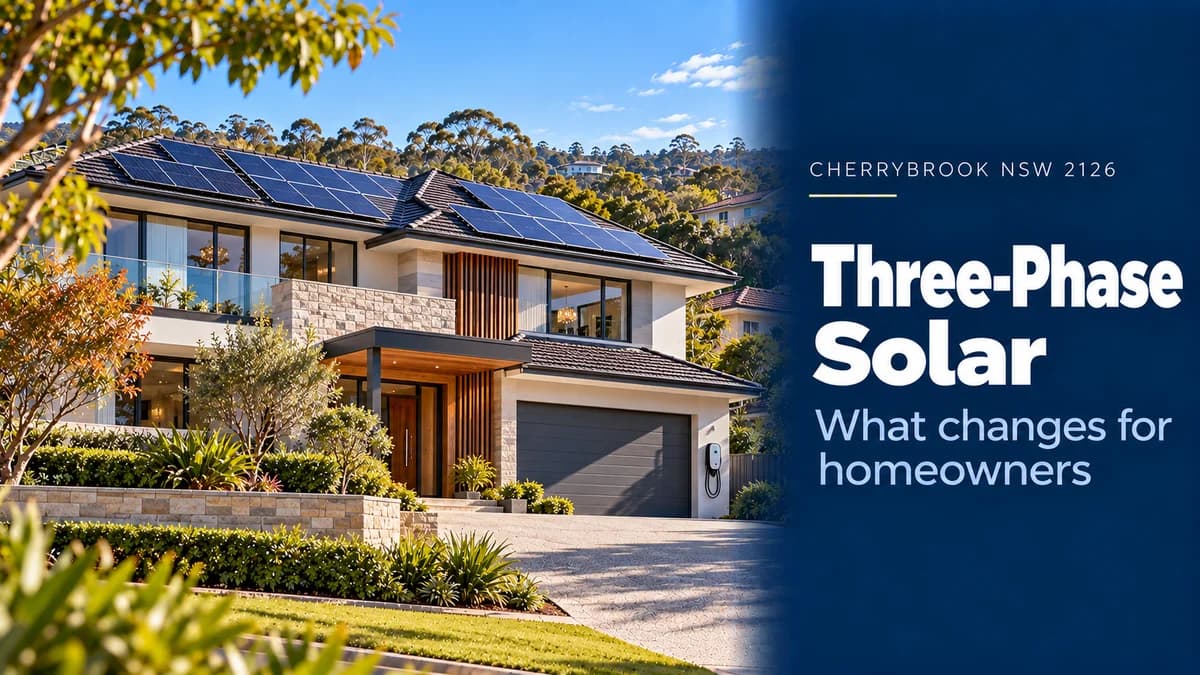
Three-Phase Solar Cherrybrook NSW: 2026 Home Guide
Have three-phase power in Cherrybrook NSW 2126? Learn whether you need a three-phase solar inverter, phase balancing, battery backup and system sizing.
Solar for Three-Phase Cherrybrook Homes: What Changes?
If your Cherrybrook NSW 2126 home has three-phase electricity, you may be wondering whether your rooftop solar system also needs to be three-phase.
For estimated costs and the rebate for 2126, see solar panels in Cherrybrook.
The short answer is:
Not necessarily.
Australian Government guidance states that a property with a three-phase electricity supply can use either a single-phase or three-phase solar inverter, subject to the system design and electricity-network requirements. Energy.gov.au
However, three-phase solar can become particularly relevant when you have:
A larger solar system
High household electricity demand
Ducted air conditioning
Pool equipment
A three-phase EV charger
Battery storage
Whole-home backup requirements
Network export limits applied per phase
The correct choice therefore depends on more than simply identifying three-phase power at the switchboard.
Kratos Energy designs residential systems around roof configuration, energy consumption and future loads rather than using the same inverter arrangement for every property. Explore Kratos residential solar systems. Kratos Energy
Single-Phase vs Three-Phase Power: What's the Difference?
Australian homes generally receive either single-phase or three-phase electricity.
Single-Phase Supply
A single-phase property receives electricity through one active phase.
It is common in homes with moderate electrical demand.
Three-Phase Supply
Three-phase properties receive electricity across three active phases.
This provides greater capacity for larger electrical loads such as:
Large ducted air-conditioning systems
Pool pumps
Workshops
Induction cooking
Large EV chargers
Other high-demand equipment
Energy.gov.au explains that three-phase supply can support more or larger electrical appliances than a single-phase connection. Energy.gov.au
Having three-phase power does not automatically mean your electricity use is three times higher. It means the electrical supply can distribute loads across three phases.
Why Three-Phase Solar Is Relevant in Cherrybrook
Cherrybrook has a housing profile where larger electrical systems can be relevant.
According to the 2021 Census:
81.5% of occupied private dwellings were separate houses
71.8% had four or more bedrooms
Average household size was approximately 3.1 people
The average dwelling had around 3.8 bedrooms. Australian Bureau of Statistics
This does not mean every Cherrybrook property needs a large three-phase solar system.
But larger homes can have loads such as ducted air conditioning, pools, electric hot water, multiple appliances and EV charging that make three-phase system design worth considering.
Do You Need a Three-Phase Solar Inverter?
Not always.
If your home has three-phase supply, there are broadly two options.
Option | How It Works | Often Worth Considering When |
Single-phase inverter | Solar inverter connects to one phase | Smaller systems, moderate loads |
Three-phase inverter | Solar output is distributed across all three phases | Larger systems, higher loads, future electrification |
The Australian Government notes that a three-phase property can use either option. It also states that where electricity networks apply connection or export limits per phase, a three-phase inverter may allow a greater overall system or export capacity. Energy.gov.au
The network approval for your actual address ultimately determines what can be connected.
How Does Solar Work Across Three Phases?
This is where homeowners often become confused.
Imagine a house has:
Phase A: kitchen and lighting
Phase B: air conditioning
Phase C: pool and other circuits
A single-phase solar inverter might physically connect its solar output to Phase A.
That does not automatically mean solar can provide financial benefit only to appliances wired to Phase A.
Energy.gov.au states that on a three-phase property, a single-phase solar system can still provide the same cost-reduction benefits through self-consumption across the three-phase connection. Energy.gov.au
However, the physical power flow, phase loading and network limits still matter from an electrical-design perspective.
This is why installers need to distinguish between:
energy-bill offset
and
physical phase distribution.
What Does “Phase Balancing” Mean?
Phase balancing means distributing electrical demand and generation reasonably across the three phases.
Consider an exaggerated example:
Phase A
2kW household load
Phase B
5kW air-conditioning load
Phase C
1kW household load
Total demand:
8kW
If major appliances are concentrated heavily on one phase, that phase can experience considerably greater demand than the others.
A three-phase solar inverter normally supplies power across all three phases rather than putting its entire output onto one phase.
That can be useful in larger residential installations.
However, the electrician should assess the existing phase arrangement rather than assuming the house is already perfectly balanced.
Single-Phase vs Three-Phase Inverter: Practical Comparison
Feature | Single-Phase Inverter | Three-Phase Inverter |
Suitable on 3-phase property | Yes, subject to approval | Yes |
Physical solar output | One phase | Across three phases |
Typical equipment cost | Usually lower | Usually higher |
Larger-system flexibility | More limited | Generally stronger |
Per-phase export considerations | More important | Output spread across phases |
3-phase battery integration | More limited | Better options with compatible equipment |
Whole-home 3-phase backup | Generally unsuitable alone | Possible with appropriate system |
Future 22kW EV charging | Separate 3-phase load | Can integrate into broader 3-phase design |
There is no reason to select a three-phase inverter purely because the technology sounds more advanced.
It should solve an actual design requirement.
When Does a Three-Phase Inverter Make More Sense?
1. You Want a Larger Solar System
Three-phase supply can provide more flexibility for larger residential arrays, particularly where the electricity distributor applies limits by phase.
This can matter when comparing:
6.6kW → 10kW → 13kW+
systems.
Kratos currently offers residential configurations from 6.6kW through larger 10kW and 13kW systems, including customised designs. Kratos Energy
2. Your Home Has High Daytime Loads
A larger Cherrybrook home might operate:
Ducted air conditioning
Pool equipment
Home-office equipment
Electric hot water
Cooking appliances
If significant consumption occurs during daylight hours, a larger three-phase solar system may allow more solar electricity to be used directly.
3. You Plan to Install a 22kW EV Charger
Home EV chargers commonly come in two broad classes:
7kW — single-phase
and
22kW — three-phase.
Kratos currently lists both 7kW single-phase and 22kW three-phase home-charging options. Explore Kratos EV charging options. Kratos Energy
A 22kW charger can create a substantial three-phase load.
If future EV charging is part of your plan, it makes sense to design the solar, switchboard and charging architecture together.
Three-Phase Solar Does Not Mean Every Phase Uses the Same Amount
A common misconception is:
“If my solar is three-phase, my appliances must use exactly one-third of the electricity on each phase.”
They do not.
The house's actual loads can still vary significantly by phase.
At one moment:
Phase A might operate lights and a refrigerator.
Phase B might run ducted air conditioning.
Phase C might operate pool equipment.
The inverter and electrical system manage generation according to their design, while the smart meter records energy flow at the grid connection.
The installer should therefore review the home's actual electrical configuration instead of simply dividing estimated household consumption by three.
What Happens With Solar Export Limits?
The electricity distributor sets connection and export requirements.
Where limits apply per phase, a three-phase inverter may provide greater flexibility because solar output is distributed across multiple phases. Energy.gov.au specifically highlights this as one reason a three-phase inverter can support larger system sizes. Energy.gov.au
But there is an important local detail for Cherrybrook.
Do Not Assume One Network Distributor for Every Cherrybrook Address
The Cherrybrook area sits close to the boundary between Ausgrid and Endeavour Energy.
Planning infrastructure assessments for the Cherrybrook precinct identify areas supplied by both networks, with the boundary around Castle Hill Road and some exceptions. Planning Portal
So homeowners should not select network limits based only on postcode 2126.
Check your electricity bill or have the installer confirm the distributor for the exact address before designing the system.
This is particularly important when sizing a larger three-phase array.
Three-Phase Solar and Battery Storage
Battery planning introduces another important distinction.
Your home may have:
three-phase grid supply
but:
single-phase battery backup.
That arrangement can work for everyday energy savings.
However, blackout performance needs much closer attention.
The Australian Government explains that a single-phase battery or hybrid-inverter system on a three-phase property may provide blackout backup only to circuits connected to that phase. Energy.gov.au
If whole-home or multi-phase backup is important, the battery system needs to be designed accordingly.
Example: Single-Phase Battery on a Three-Phase Home
Consider this illustrative layout:
Phase A
Refrigerator, lighting, Wi-Fi
Phase B
Ducted air conditioning
Phase C
Pool equipment and other circuits
Suppose a single-phase hybrid battery system provides backup to Phase A.
During normal grid operation, the battery may still help reduce electricity costs.
But during a blackout:
Phase A backup circuits
May remain powered.
Phase B and Phase C circuits
May not receive backup power.
That distinction should be made clear before the battery is purchased.
What If You Want Whole-Home Three-Phase Backup?
Whole-home three-phase backup is possible with suitable system architecture, but it requires more than simply purchasing a large battery.
The installer needs to assess:
Three-phase hybrid inverter capability
Battery compatibility
Continuous output
Surge output
Backup gateway
Phase balancing
Essential vs non-essential loads
Three-phase appliances
High-demand equipment such as:
Ducted air conditioning
Pool pumps
Electric cooking
22kW EV charging
can significantly increase backup-power requirements.
A battery may contain enough kWh of energy but still lack enough kW of output to operate all of those appliances simultaneously.
Kratos' current battery range includes solar-storage and blackout-capable systems, but backup functionality depends on the final system configuration. Explore Kratos battery storage options. Kratos Energy
kWh vs kW Matters Even More With Three-Phase Backup
When comparing batteries:
kWh = stored energy
This determines how much energy is available over time.
kW = power output
This determines how much electrical load can operate at once.
A large Cherrybrook home might have:
30kWh of stored battery energy
but if the inverter can provide only a limited amount of backup power, it cannot necessarily run every high-demand appliance simultaneously.
For three-phase homes, battery quotes should therefore state:
Usable battery capacity
Continuous backup power
Peak/surge output
Number of phases backed up
Which circuits operate during an outage
Should You Choose a Hybrid Inverter?
A hybrid inverter combines solar-inverter and battery-inverter functions and can be useful where battery storage is being installed now or planned later.
Energy.gov.au describes hybrid inverters as a common option for solar-and-battery systems installed together. Energy.gov.au
For a Cherrybrook homeowner, a hybrid inverter may be worth considering if:
Battery storage is likely
Blackout backup matters
The existing system is being replaced
Future household loads will increase
However:
Hybrid does not automatically mean whole-home three-phase backup.
Check the exact model, battery compatibility and backup architecture.
Inverter Approval Matters in 2026
The Clean Energy Council maintains Australia's approved inverter list.
The updated AS/NZS 4777.2:2020 Amendment 2:2024 inverter requirements came into effect on 23 August 2025, and non-compliant inverter models were removed from the approved-product list. Clean Energy Council
When comparing a three-phase inverter, confirm:
Exact model
Current approved status
Single- or three-phase configuration
Number of MPPTs
Battery compatibility
Backup functionality
Manufacturer warranty
Kratos currently lists inverter brands including GoodWe, Sungrow, FoxESS, Sigenergy, ESY Sunhome and Sofar within its solar equipment range. View Kratos solar panels and inverters. Kratos Energy
Example: Choosing Solar for a Three-Phase Cherrybrook Home
Consider a hypothetical household with:
Three-phase supply
Average use: 35kWh/day
Major loads:
Ducted air conditioning
Pool
Home office
Future EV
Available roof: good north and west-facing areas
Option 1 — Smaller Single-Phase Solar
Could remain technically viable depending on system size and network approval.
Suitable where the household wants a relatively modest solar installation and does not require complex backup.
Option 2 — Larger Three-Phase Solar
Could make more sense if the household wants:
Higher solar capacity
Better distribution of solar output
Future 22kW EV charging
Three-phase battery integration
Greater design flexibility
Neither option should be selected solely because the property has three-phase electricity.
The decision should come from:
energy usage + network approval + future loads + backup requirements.
How to Check If Your Home Has Three-Phase Power
The simplest approach is to ask your electrician or solar installer.
You may also see clues at the switchboard.
A three-phase property often has:
Three linked main switches or breakers
A three-phase smart meter
Three active supply conductors
But homeowners should not open meter or switchboard equipment to inspect wiring themselves.
If you are unsure, have a licensed electrician confirm the supply.
Cherrybrook Three-Phase Solar Checklist
Before approving a system, ask:
Existing Supply
Is the property single-phase or three-phase?
Which distributor serves the exact address?
Solar
Proposed panel capacity
Proposed inverter capacity
Single-phase or three-phase inverter
Expected annual generation
Phase Design
How are large loads distributed?
Will phase imbalance be an issue?
Does the network impose per-phase limits?
Future Loads
EV charger
Ducted air conditioning
Pool
Heat-pump hot water
Additional household electrification
Battery
Single- or three-phase battery inverter
Essential-load or whole-home backup
Continuous kW output
Battery usable kWh
Solar recharging during blackout
Compliance
Current inverter approval
Network connection approval
Export setting
Current Australian standards
This is the information that turns “three-phase solar” from a marketing label into a properly engineered system.
Frequently Asked Questions
Do I need a three-phase solar inverter in Cherrybrook?
Is a three-phase inverter better?
Can a single-phase solar system work on a three-phase house?
Is 10kW solar suitable for a three-phase home?
Can I install a battery on a three-phase property?
Is 10kW solar suitable for a three-phase home?
Can I install a battery on a three-phase property?
Will a single-phase battery back up all three phases?
Can I run ducted air conditioning during a blackout?
Which electricity distributor covers Cherrybrook?
Three-Phase Solar in Cherrybrook: The Bottom Line
For a Cherrybrook NSW 2126 home, having three-phase electricity does not automatically mean you must install a three-phase solar inverter.
The correct design should consider:
System size → household loads → phase configuration → network limits → EV plans → battery plans → blackout requirements.
A smaller system may work perfectly with a single-phase inverter.
A larger home with substantial loads, future EV charging or sophisticated battery backup may benefit from a three-phase solar and storage architecture.
The most important step is to design the solar system around the whole electrical profile of the property, rather than treating three-phase power as a simple equipment checkbox.
Explore Kratos residential solar systems
View Kratos solar panels and inverters
Explore Kratos battery storage options
Contact Kratos Energy for a tailored assessment
Three-phase power gives your home more electrical flexibility. The solar system should be designed to make proper use of it.
Solar System Packages
Tier 1 panels & CEC accredited installation.
- Trina 475W or Jinko panels
- 5kW power inverter
- 14 × 475W panels
- Single-phase compatible
- Trina 475W or Jinko panels
- 8–10kW power inverter
- 21 × 475W panels
- Battery & EV ready
- Trina 475W or Jinko panels
- 10kW power inverter
- 27 × 475W panels
- Three-phase compatible