

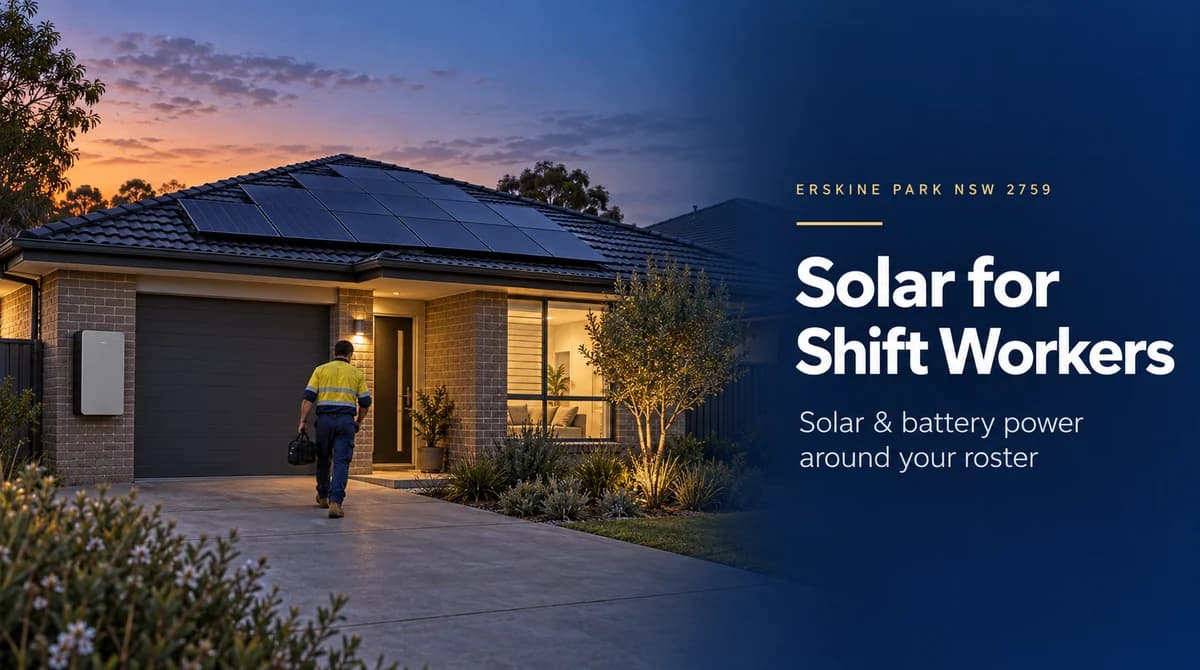
Solar for Shift Workers in Erskine Park
Working shifts in Erskine Park? Compare solar, battery storage and electricity tariffs around your roster, daytime usage and evening energy needs.
Solar for Shift Workers in Erskine Park
Working early mornings, late evenings or rotating shifts changes when your household needs electricity. Your solar and battery system should reflect those hours.
For homeowners in Erskine Park NSW 2759, the key question is how closely solar generation matches household consumption. Someone sleeping at home after a night shift may use daytime solar for cooling. Someone arriving home after sunset may benefit more from stored energy.
Start with your household’s electricity use across a complete roster cycle, then compare solar alone, solar with a battery, and alternative electricity tariffs.
Can Solar Save Money If You Work Shifts?
Yes. Solar can supply appliances operating during daylight hours, including refrigeration, cooling and scheduled hot water. Surplus generation may earn export credits or charge a battery for later use.
However, daytime exports and evening grid purchases are usually priced differently. Exporting 10kWh does not necessarily pay for buying 10kWh back at night. The Australian Government’s guide to solar savings explains how direct consumption, exports and storage affect the bill.
Your work schedule is only part of the picture. Include the electricity used by partners, children and anyone else at home while you are away.
How Different Rosters Affect Solar and Battery Choices
The following are illustrative routines, not assumptions about every Erskine Park household.
Work pattern | Possible household energy pattern | What to investigate |
Early shift: 5am–1pm | Breakfast before sunrise; afternoon cooking, cooling or laundry | Direct afternoon solar use, plus storage for early-morning demand |
Day shift: 7am–5pm | Low daytime consumption; cooking and cooling after work | Daytime appliance scheduling and a battery for evening loads |
Afternoon shift: 2pm–10pm | Morning activity; late-night meals and appliances | Direct morning solar use and the price of electricity after returning home |
Night shift: 10pm–6am | Morning activity and daytime sleep; possible cooling demand | Solar for daytime cooling; storage based on remaining household loads |
Rotating roster | Consumption timing changes between weeks | Modelling across the full roster, including weekends and days off |
Being away at night does not automatically mean you need a battery. If the home’s overnight consumption is low, additional storage may have limited daily use. If you want a quicker route for Erskine Park, this is the link https://kratos-energy.com/solar/nsw/erskine-park
Measure Your Usage Across a Complete Roster
A monthly bill shows total consumption but can hide the timing that determines solar and battery value.
Request smart-meter interval data from your retailer. Ideally, use 12 months to capture seasonal changes, and identify representative days for each shift pattern.
Check:
Daytime consumption: electricity that could be supplied directly by solar.
Consumption outside solar hours: potential demand for stored energy.
Solar exports: surplus generation available for charging an added battery.
Simultaneous appliance demand: the power needed when cooking, cooling or charging an EV together.
Days off: these may differ substantially from working days.
For an existing solar system, combine meter data with inverter monitoring. Grid-import data alone does not show electricity already supplied directly by your panels.
Solar Alone or Solar With a Battery?
When solar alone deserves consideration
Begin by modelling solar without storage if substantial electricity use occurs during daylight hours or can be scheduled then.
For example, a night-shift worker may run bedroom cooling while sleeping during the day. An early-shift worker may be home in time to use afternoon generation for cooking and laundry.
These routines can create useful direct consumption without storing the electricity first.
When a battery deserves closer assessment
Storage is worth modelling when the household regularly exports solar during the day and purchases electricity after generation falls.
It may also support backup or a suitable tariff strategy. However, those benefits should be assessed against the additional installed cost. The Australian Government notes that a battery’s financial value depends on the household’s circumstances; it is not automatically a cost-effective addition. Source: Solar Consumer Guide
Explore Kratos Energy’s home battery storage options once you have identified the loads storage needs to cover.
Worked Example: A Household Away During the Day
Consider an illustrative Erskine Park household with:
Input | Assumption |
Daytime solar surplus available for charging | 10kWh |
Consumption after solar hours | 12kWh |
Battery round-trip efficiency | 90% |
Import rate during displaced consumption | A$0.35/kWh |
Solar feed-in tariff | A$0.05/kWh |
If the system can absorb all 10kWh of surplus solar, it could return approximately 9kWh after the assumed losses.
The simplified daily value is:
Avoided imports: 9 × A$0.35 = A$3.15
Export income forgone: 10 × A$0.05 = A$0.50
Incremental energy-bill saving: A$2.65 for that day
This is an example, not a Kratos quote, current tariff offer or annual savings forecast. It assumes sufficient battery capacity and charging power, with no reserve restricting the cycle. It excludes equipment cost, degradation and other charges.
The same stored energy would have less financial value if it replaced cheaper overnight electricity. That is why the price at the time of consumption matters alongside the number of kilowatt-hours used.
Which Electricity Tariff Suits Shift Workers?
Compare the total annual bill under each available plan.
Tariff type | How it works | What a shift worker should check |
Single rate | One usage rate throughout the day | Whether predictable pricing suits a changing roster |
Time of use | Usage rates vary by time period | The actual rates when arriving home, cooking or charging |
Demand tariff | Includes a charge linked to measured peak demand | Whether several appliances running together create a costly peak |
Controlled load | Separate pricing for eligible connected equipment | Whether eligible hot water or other equipment is on this arrangement |
Peak periods and eligibility differ between plans. Do not assume that late-night electricity is always cheaper.
Use the Australian Energy Regulator’s Energy Made Easy tariff guide and comparison service to check available plans. Include daily supply charges, export credits and any additional fees.
Practical Design Priorities for an Erskine Park Home
Ask for a property-specific design that addresses these four points:
1. Generation timing. Have the installer compare feasible panel layouts against your roster. Roof orientation, shading and seasonal output affect when electricity is available.
2. Appliance scheduling. Where equipment supports it, schedule hot water, pool pumps or EV charging during suitable solar hours. Avoid scheduling everything simultaneously without checking power demand.
3. Battery energy and power. Usable capacity in kWh determines stored energy; output in kW determines the load it can supply at once. Cooking and air conditioning together may require substantial output even if total overnight consumption is modest.
4. Backup requirements. Specify the circuits you want supported and have the installer confirm backup capability, switching equipment and operating limits. Do not assume every battery package provides whole-home backup.
You can start exploring a system through Kratos Energy’s Design Your Solar tool, then provide your roster and usage data for a detailed assessment.
Frequently Asked Questions
Is solar worthwhile if nobody is home during the day?
Do night-shift workers need larger batteries?
What if my roster changes every week?
Can a battery charge from the grid?
What should I provide when requesting a quote?
Plan Solar Around Your Erskine Park Roster
A useful quote should explain how the proposed system performs on early shifts, late shifts and days off. Ask for a comparison of solar alone and solar with storage, showing expected imports, exports and annual costs under clearly stated assumptions.
Request a tailored solar and battery quote from Kratos Energy for your Erskine Park home, and include your work roster so the assessment reflects when your household actually uses electricity.
Solar System Packages
Tier 1 panels & CEC accredited installation.
- Trina 475W or Jinko panels
- 5kW power inverter
- 14 × 475W panels
- Single-phase compatible
- Trina 475W or Jinko panels
- 8–10kW power inverter
- 21 × 475W panels
- Battery & EV ready
- Trina 475W or Jinko panels
- 10kW power inverter
- 27 × 475W panels
- Three-phase compatible