

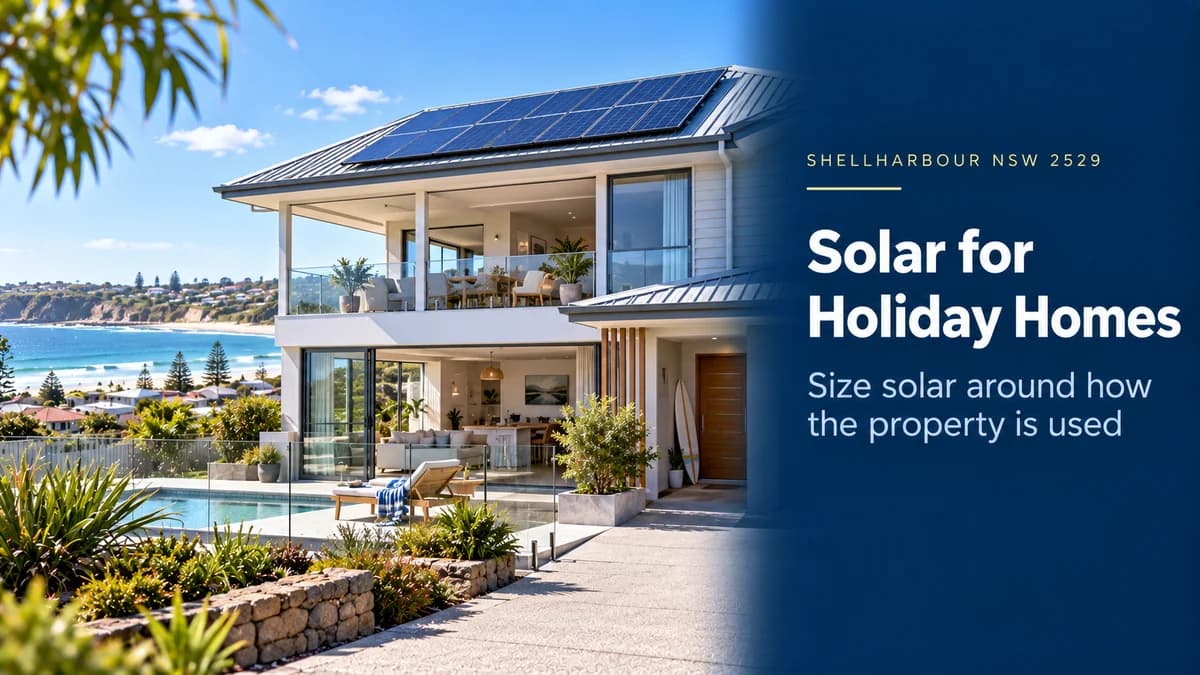
Solar for Holiday Homes Shellharbour: 2026 Guide
Own a holiday home in Shellharbour NSW 2529? Learn how occupancy, solar self-consumption, pools, hot water, batteries and remote monitoring affect system sizing and savings.
Solar for Shellharbour Holiday Homes: How Should You Size the System?
Solar can work well for a holiday home in Shellharbour NSW 2529, but the system should not be designed exactly like solar for a permanently occupied family home.
The key difference is occupancy.
A full-time household may use electricity every day while the solar panels are generating. A holiday property might instead be:
Empty during the week
Occupied mainly on weekends
Used heavily during school holidays
Rented to guests
Running pool pumps, refrigeration or hot water even when vacant
These different usage patterns can significantly affect solar self-consumption, exports and payback.
The right question is therefore not:
“What solar size fits the roof?”
It is:
“When does this property use electricity, and how much of its solar generation can actually be used on site?”
Kratos Energy designs residential systems around household usage, roof conditions and future energy requirements. Explore Kratos residential solar options.
Why Holiday-Home Solar Needs a Different Approach
Solar generally creates the greatest financial benefit when the electricity generated is used directly in the property.
The Australian Government explains that self-consuming rooftop solar usually provides greater savings than exporting the same electricity to the grid because self-consumption avoids purchasing electricity at the retail tariff. (Energy Australia)
This matters for holiday properties.
If a Shellharbour home is empty for five days every week, a large solar system could generate substantial electricity while very little is being consumed.
That electricity may then be exported instead.
A home that is frequently occupied—or has substantial daytime loads such as pool filtration—can make much better use of the same solar array.
Shellharbour Solar: Local Housing Context
According to the 2021 Census, around 68.4% of occupied private dwellings in the Shellharbour suburb were separate houses, with another 14.8% semi-detached or townhouse-style dwellings. (Australian Bureau of Statistics)
The Census also recorded 7.6% of private dwellings as unoccupied on Census night. That figure should not be interpreted as the percentage of holiday homes, but it reinforces why actual occupancy needs to be established before modelling solar for an individual property. (Australian Bureau of Statistics)
For a property in Shellharbour 2529, the solar assessment should therefore start with its real usage pattern rather than assuming full-time occupancy.
Three Common Holiday-Home Usage Profiles
The following examples are hypothetical planning profiles, not measured Shellharbour customer results.
Profile 1: Weekend-Only Holiday Home
Imagine the property is usually occupied from:
Friday afternoon → Sunday evening
and remains mostly empty during the week.
Typical vacant-period loads might include:
Refrigerator
Wi-Fi
Security equipment
Pool filtration
Standby appliances
Solar implication
A large proportion of weekday solar generation could be exported.
A smaller, well-matched solar system may therefore provide stronger utilisation than automatically installing the largest array the roof can accommodate.
What to investigate
6.6kW solar may be a useful starting point for modelling, depending on roof conditions and actual loads.
Profile 2: Frequently Rented Holiday Property
Now consider a property listed for short-term accommodation and occupied regularly throughout the week.
Typical loads could include:
Air conditioning
Cooking
Hot water
Laundry
Pool equipment
Refrigeration
Entertainment systems
Solar implication
Higher daytime occupancy can materially increase solar self-consumption.
A larger system such as 10kW may therefore be worth comparing if the electricity data supports it.
The important factor is not that the property is a holiday rental.
It is that the property has regular daytime electricity demand.
Profile 3: Owner-Occupied Part of the Year
Some holiday homes are occupied heavily during:
Summer
School holidays
Long weekends
but remain lightly used for the rest of the year.
This creates seasonal electricity demand.
Solar implication
System sizing should use at least 12 months of electricity data where possible.
Designing the system around one high-usage summer bill could result in excessive exports during the quieter months. More Details ...
Holiday-Home Solar Comparison
Property Pattern | Solar Design Priority |
Weekend use only | Avoid excessive weekday exports |
Frequent short-term rental | Match solar to guest daytime consumption |
Pool property | Schedule filtration during solar hours |
Seasonal owner use | Model annual rather than peak consumption |
Remote/unattended property | Strong monitoring capability |
Battery considered | Check actual daytime surplus and night usage |
There is no universal “holiday-home solar size”.
The right system depends on how the property actually operates.
Start With the Electricity Data
Before choosing 6.6kW, 10kW or another system size, review:
Annual electricity consumption
How many kWh does the property use over 12 months?
Occupied-day consumption
How much electricity is used when guests or owners are present?
Vacant-day consumption
How much electricity is still consumed when nobody is staying?
Daytime usage
How much electricity can solar directly supply?
Seasonal peaks
Does summer air conditioning or pool equipment significantly increase demand?
Smart-meter interval data is particularly useful because it shows when electricity is being used rather than only total quarterly consumption.
Pool Pumps Can Be Ideal Solar Loads
Many coastal holiday properties include pools.
Pool filtration is particularly relevant to solar because it can often be scheduled during daylight hours.
For example, suppose a pump uses:
1kW for 6 hours
Daily consumption would be approximately:
6kWh
If it operates between late morning and afternoon, rooftop solar may directly supply much of that electricity.
This is better than:
running the pool overnight → exporting solar during the day → buying grid electricity later
Where practical, controllable loads should be shifted into the solar-production window.
Endeavour Energy also encourages customers with solar to use appliances during the day when rooftop generation is available. (Endeavour Energy)
Hot Water Can Also Improve Self-Consumption
Electric or heat-pump hot-water systems can potentially be scheduled to operate while solar generation is strong.
For a lightly occupied holiday home, this can create a productive daytime load.
Instead of heating water overnight, the system may be configured—where equipment and tariffs allow—to operate during the solar-production period.
The exact strategy depends on:
Hot-water system type
Electricity tariff
Guest occupancy
Tank capacity
Control equipment
The goal is to shift flexible consumption into the hours when solar is available.
Air Conditioning Changes the Calculation
Shellharbour holiday properties may experience high air-conditioning use during warm-weather occupancy.
If guests regularly use cooling during sunny afternoons, this can increase solar self-consumption significantly.
For example:
solar generation + afternoon cooling demand
can align well.
But if most cooling occurs after sunset, the benefit is different.
This is another reason to examine interval electricity data rather than only the total bill.
Should a Holiday Home Install a Battery?
Possibly—but a battery should not be added automatically.
A battery generally makes more sense when the property:
Produces substantial excess solar during the day
Uses significant electricity after sunset
Has regular occupancy
Requires blackout resilience
Can make use of stored energy consistently
For a property vacant much of the week, a large battery might regularly have little night-time demand to serve.
In that case, the battery's available capacity may be under-utilised.
Example
Weekday solar surplus:
12kWh
Vacant-property night consumption:
2kWh
A large battery may fill during the day but discharge very little overnight.
Battery storage may still offer backup or tariff benefits, but the economics should be modelled separately.
Battery Storage May Make More Sense for Frequently Occupied Rentals
Consider instead a short-stay property with guests present most nights.
Daytime excess solar can be stored and later used for:
Evening air conditioning
Cooking
Lighting
Television
Hot water
Overnight appliances
This creates a stronger daily charge-and-discharge cycle.
If battery storage is being considered, first calculate:
daytime surplus + evening demand + occupancy frequency
before selecting capacity.
Remote Solar Monitoring Is Particularly Useful
For a holiday property, remote monitoring can be more valuable than it is for an owner-occupied home.
Modern inverter monitoring can help owners check:
Current generation
Daily solar production
Fault alerts
Grid export
System status
Battery systems may additionally show:
State of charge
Charging/discharging
Grid usage
Backup status
This is useful when the property is several hours away or managed remotely.
A system fault should ideally be identified from the monitoring platform rather than discovered during the next visit.
What About Appliances While the Property Is Vacant?
Even an empty holiday home may have continuous loads.
Typical examples include:
Refrigerator
Freezer
Security system
Internet router
Pool pump
Hot-water system
Smart-home equipment
Outdoor lighting
Measure these loads before assuming the property consumes almost no electricity when vacant.
A steady base load can improve weekday solar self-consumption.
6.6kW or 10kW Solar for a Shellharbour Holiday Home?
There is no automatic winner.
6.6kW May Suit the Property When:
Occupancy is occasional
Weekday consumption is low
Roof space is limited
Pool and appliance loads are moderate
The objective is to offset the property's core electricity consumption
10kW May Be Worth Comparing When:
The property is frequently rented
Daytime electricity demand is high
There is a pool
Air conditioning is regularly used
An EV charger is planned
Battery storage may be added
There is sufficient productive roof space
The final decision should be based on annual consumption and occupancy—not simply property size.
Estimate Solar Output for Shellharbour 2529
Kratos Energy provides a postcode-based calculator that estimates potential generation for different system sizes.
For a Shellharbour property, enter:
2529
Calculate solar output for postcode 2529
This provides a useful generation benchmark.
Your final design still needs to consider:
Roof orientation
Shading
Roof pitch
System losses
Actual occupancy
Shellharbour Is Within the Endeavour Energy Network
Endeavour Energy's network covers the Illawarra and South Coast, including Shellharbour. (Endeavour Energy)
Solar installations must therefore meet the applicable connection requirements.
Endeavour Energy states that the installer normally designs the system and submits the grid-connection application on the customer's behalf. (Endeavour Energy)
This is relevant for holiday homes because installing an unnecessarily oversized system purely to export additional electricity may be affected by network export conditions.
The system should first be designed around how much electricity the property can use productively.
Solar Payback for Holiday Homes Can Differ From Full-Time Homes
Two identical 10kW solar systems can have different financial outcomes.
Full-Time Home
High daily self-consumption.
Weekend Holiday Home
High weekday exports.
The second property may generate the same amount of solar electricity but receive less financial value from each exported kilowatt-hour than it would from direct self-consumption.
The Australian Government specifically notes that households generally save the most by using the solar electricity themselves. (Energy Australia)
This makes occupancy modelling central to holiday-home payback.
Example: Two Hypothetical Shellharbour Properties
Property A — Weekend Use
Solar generation:
30kWh/day
Weekday property consumption:
6kWh/day
Potential weekday surplus:
~24kWh/day
Much of the system's weekday production may be exported.
Property B — Frequent Holiday Rental
Solar generation:
30kWh/day
Daytime household + pool consumption:
18kWh/day
Potential daytime surplus:
~12kWh/day
The second property directly uses far more solar.
Even though both systems produce the same amount of electricity, their financial outcomes can differ significantly.
These figures are illustrative only and are included to demonstrate the effect of occupancy and self-consumption.
Holiday-Home Solar Checklist
Before choosing solar for a Shellharbour holiday property, check:
Occupancy
How many days per year is the property occupied?
Weekends only or regular rentals?
Seasonal or year-round use?
Electricity
Annual kWh consumption
Vacant-day consumption
Occupied-day consumption
Daytime vs evening loads
Flexible Loads
Pool filtration
Hot water
Laundry
EV charging
Air conditioning
Roof
Available area
Orientation
Shade
Coastal exposure
System
Solar size
Inverter monitoring
Battery compatibility
Remote fault alerts
Economics
Self-consumption
Expected exports
Current electricity tariff
Feed-in tariff
Network connection conditions
A strong proposal should address these factors rather than recommend a system purely from the property's quarterly bill.
Frequently Asked Questions
Is solar worth installing on a Shellharbour holiday home?
What solar size is best for a holiday home?
Does solar still work when nobody is at the property?
Should a holiday home have a battery?
Can pool pumps run from solar?
Can I monitor my solar system remotely?
What electricity network covers Shellharbour?
Solar for Shellharbour Holiday Homes: The Bottom Line
For a Shellharbour NSW 2529 holiday property, the best solar system should reflect how the property is actually used.
Start with:
Occupancy → daytime loads → annual consumption → solar generation → self-consumption → exports.
A weekend-only property may benefit from a smaller system that avoids excessive exports.
A frequently occupied holiday rental with air conditioning, hot water and pool equipment may make much better use of a larger array.
Battery storage should then be assessed separately using the property's actual evening demand.
Explore Kratos residential solar systems
Calculate solar output for postcode 2529
Estimate your solar savings and payback
Request a tailored Kratos solar assessment
For a holiday home, the best solar system is not the one that generates the most electricity—it is the one that matches when the property actually uses it.
Solar System Packages
Tier 1 panels & CEC accredited installation.
- Trina 475W or Jinko panels
- 5kW power inverter
- 14 × 475W panels
- Single-phase compatible
- Trina 475W or Jinko panels
- 8–10kW power inverter
- 21 × 475W panels
- Battery & EV ready
- Trina 475W or Jinko panels
- 10kW power inverter
- 27 × 475W panels
- Three-phase compatible