

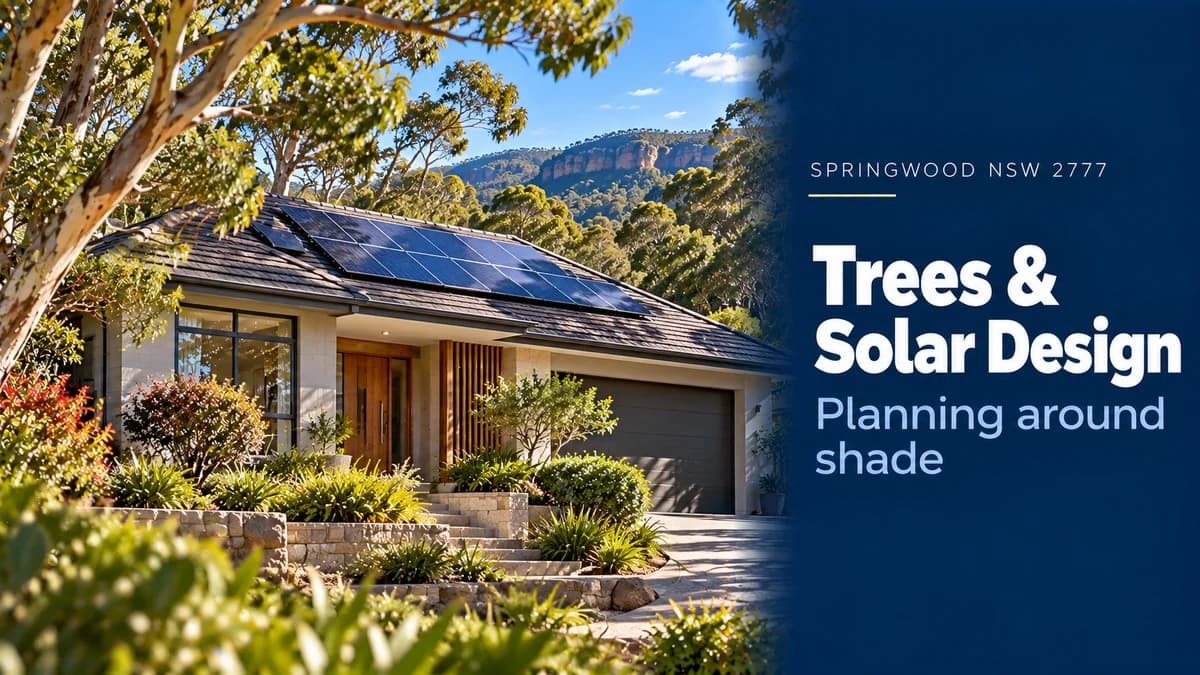
Solar Shading Springwood NSW: Trees & Solar Design Guide
Planning solar in Springwood NSW 2777? Learn how tree shade affects solar output, winter shading, panel layout, MPPTs, optimisers and system sizing.
Trees and Solar Design in Springwood: How to Plan Around Shade
If you are considering rooftop solar in Springwood NSW 2777, trees around the property do not automatically make your home unsuitable for solar.
What matters is where the shade falls, when it occurs and how long it remains on the productive areas of your roof.
For local costs, the rebate for 2777 and what we check on a Springwood roof, see solar panels in Springwood.
A small amount of early-morning shade can have a very different impact from a tree shadow covering several panels around midday.
For this reason, a Springwood solar assessment should consider:
Roof orientation
Existing tree shade
Morning vs afternoon shade
Summer vs winter shadows
Panel placement
Future vegetation growth
Inverter and string design
Expected generation after shading losses
The goal is not simply to install the maximum number of panels.
It is to use the best-performing roof areas first.
Kratos Energy designs residential solar around roof layout and household energy use rather than applying one standard panel arrangement to every property. Explore Kratos residential solar systems. Kratos Energy
Does Tree Shade Stop Solar Panels From Working?
No.
Solar panels can still produce electricity under partial shade, but output decreases as the available sunlight falls.
The Australian Government notes that shading performance depends on:
The height and position of the obstruction
Time of day
Season
Length of time the panels remain shaded. Energy.gov.au
This means the question should not be:
“Are there trees near my house?”
Instead ask:
“How much productive sunlight does each roof section receive across the year?”
That is what a proper shade assessment should answer.
Why Shade Assessment Matters in Springwood
Springwood is predominantly a detached-house suburb.
According to the 2021 Census, 82% of occupied private dwellings in Springwood were separate houses. Australian Bureau of Statistics
Detached homes can provide useful rooftop area for solar, but each property has a different relationship with surrounding vegetation, neighbouring buildings and roof geometry.
Two homes on the same street could therefore require very different solar layouts.
Home A
Clear north-facing roof with some late-afternoon tree shade.
Home B
Multiple roof sections with morning and midday shade.
Home C
Good western roof but a heavily shaded northern section.
The best solar design for each property would be different.
Not All Shade Has the Same Impact
Early-Morning Shade
Shade shortly after sunrise may reduce some morning generation but leave the strongest parts of the solar day unaffected.
Midday Shade
Persistent shade around the middle of the day can have a larger impact because this is often when solar production is strongest.
Late-Afternoon Shade
A north-facing array may still achieve substantial daily generation before becoming shaded later in the afternoon.
Seasonal Shade
A roof can behave very differently in June than in December.
The Australian Government specifically notes that shading can increase in winter, early morning and late afternoon because the sun sits lower in the sky. Energy.gov.au
For Springwood solar design, this means a one-time glance at the roof is not enough.
Summer Shade vs Winter Shade
Consider a tree located north-west of the roof.
During summer:
The sun travels higher across the sky
The shadow may remain relatively short
Panels might receive strong sunlight for most of the day
During winter:
The sun is lower
The same tree may cast a longer shadow
More panels may be affected for longer
This is why good modelling considers the annual sun path, rather than designing only around summer conditions.
Future vegetation growth should also be considered. Energy.gov.au recommends accounting for trees that may create additional shade as they grow. Energy.gov.au
Start With the Best Roof Area
If some roof sections are substantially better than others, they should normally be prioritised.
Consider an illustrative Springwood roof:
Roof Area | Solar Conditions | Design Priority |
North | Mostly clear | High |
West | Some late shade | Medium–High |
East | Morning tree shade | Medium |
South-west | Significant shade | Low |
Instead of filling every available roof face, the designer might achieve a stronger result by using fewer panels on the productive areas.
A well-positioned 8kW array can sometimes be more useful than forcing a nominal 10kW array into significantly shaded roof areas.
System capacity should follow productive roof space, not panel count alone.
How Shade Can Affect a String Solar System
In a traditional string-inverter design, panels are connected together electrically.
Panels within the same string operate as part of a group.
Modern panels contain bypass diodes and modern inverters use Maximum Power Point Tracking, but uneven shade can still influence system behaviour.
Good design therefore considers:
Which panels experience similar sunlight
Which roof faces have different orientations
Which panels experience recurring shade
How strings are connected to the inverter
Panels with very different solar conditions should not simply be grouped together without proper electrical design.
Multiple MPPTs Can Help With Different Roof Conditions
Modern solar inverters commonly contain multiple Maximum Power Point Trackers (MPPTs).
This allows separate panel groups to operate under different conditions.
For example:
MPPT 1
North-facing panels with minimal shade
MPPT 2
West-facing panels with afternoon shade
Separating these arrays can allow the inverter to manage their different operating characteristics more effectively.
This can be particularly useful where a Springwood home's roof has:
Multiple orientations
Different pitches
Partial tree shade
Separate roof sections
The exact number of MPPTs varies by inverter.
Kratos lists the panel and inverter equipment currently used across its residential systems on its Solar Panels & Inverters page. Kratos Energy
Are Power Optimisers Useful for Tree Shade?
Power optimisers can be useful where shade affects individual panels differently.
Rather than relying entirely on one group of panels operating together, optimisers allow more panel-level management.
They may be worth investigating where:
One tree shades only part of the array
Shadows move across different panels
Roof geometry is complex
Panels face multiple directions
Panel-level monitoring is desirable
However, an optimiser does not create sunlight.
If a panel remains heavily shaded for much of the day, electronics cannot make it perform like an unshaded panel.
The priority should still be:
Avoid unnecessary shade first, then use appropriate technology to manage the shade that cannot reasonably be avoided.
What About Microinverters?
Microinverters perform the DC-to-AC conversion at individual panels.
This allows each panel to operate more independently.
They can be useful for complex roofs with:
Irregular shading
Several orientations
Multiple small arrays
Panel-level performance differences
But they also add equipment and cost.
A roof with only minor late-afternoon shade may not need panel-level electronics across every module.
Technology should be selected after the shade pattern is understood, not before.
Should You Install More Panels to Compensate for Shade?
Sometimes—but not automatically.
Imagine you need approximately 8kW of useful solar capacity.
Installing extra panels on moderately productive roof areas could increase annual generation.
But placing large numbers of panels under persistent heavy shade may simply add cost without enough additional energy production.
A good proposal should show:
Panel count → shade losses → expected annual kWh
rather than selling the system purely on its nameplate capacity.
For example:
10kW installed
does not necessarily mean:
10kW worth of useful performance
if several panels spend substantial periods in shade.
Use Generation Estimates After Shade Losses
When comparing Springwood solar quotes, ask for the expected annual generation after shading is modelled.
Do not compare only:
6.6kW vs 10kW
Compare:
expected annual kWh vs expected annual kWh
after considering:
Orientation
Tilt
Shade
Inverter losses
System design
Kratos Energy's Solar Output Calculator provides a useful postcode-based starting estimate. Enter:
2777
But Kratos' calculator correctly notes that actual production varies with roof orientation and shading. Kratos Energy
So treat postcode output as a baseline, not a site-specific guarantee.
Example: Two Solar Layouts on the Same Roof
Consider a hypothetical Springwood property.
Layout A — Maximum Panel Count
22 panels installed across all available roof areas.
Several panels experience substantial winter shade.
Installed size:
Approximately 10kW
Advantage:
Greater headline capacity.
Risk:
Some panels may contribute relatively little during shaded periods.
Layout B — Productive Roof First
18 panels installed only across the strongest north and west roof areas.
Installed size:
Approximately 8kW
Advantage:
Higher-quality solar exposure per panel.
Which is better?
You cannot tell from kW capacity alone.
Compare the shade-adjusted annual generation and cost of both designs.
Trees Can Also Reduce Household Cooling Demand
Trees do not only create solar shade.
Depending on their location, they can also shade walls, windows and outdoor areas, potentially reducing summer heat gain.
This is another reason tree management should not be treated as a simple solar-production calculation.
A system designer should first investigate whether solar panels can be arranged around existing vegetation while still delivering useful performance.
Do Not Assume Trees Can Be Removed for Solar
This is particularly important in the Blue Mountains.
Tree and vegetation work can be subject to local and NSW planning controls. Blue Mountains City Council maintains a formal tree-removal application process, and NSW planning guidance makes clear that where vegetation requires a permit or approval, that approval needs to be obtained before clearing occurs. BMCC
So this article does not recommend removing, pruning or modifying vegetation to improve solar output.
If vegetation work is being considered for any reason, homeowners should first determine what permissions and professional advice apply to their specific property.
Energy.gov.au similarly recommends using a qualified arborist or landscaper for tree work and checking whether council or government permission is required. Energy.gov.au
Solar should be designed around the lawful and practical roof conditions available.
What Should a Springwood Shade Assessment Show?
Before accepting a solar proposal, ask for the following.
Panel Layout
Where will each panel be installed?
Shade Sources
Which trees, buildings or roof structures affect the system?
Time of Day
Is shade mostly morning, midday or afternoon?
Seasonal Effect
How does the shadow pattern change between summer and winter?
Shade-Adjusted Generation
How many kWh is the completed system expected to generate annually?
Inverter Design
How will different roof areas be separated between MPPTs or strings?
Equipment Choice
Are optimisers or microinverters actually justified?
Future Conditions
Could vegetation growth or future structures materially change solar access?
This makes it much easier to compare two quotes that propose different layouts.
Springwood Solar Design Checklist
Before deciding on system size, assess:
Roof
North, east and west areas
Available productive area
Pitch and geometry
Chimneys and vents
Shade
Trees
Buildings
Morning shadows
Afternoon shadows
Winter shadows
System
Panel count
MPPT configuration
Inverter capacity
Estimated annual production
Monitoring
Household
Daytime electricity use
Future EV
Air conditioning
Heat-pump hot water
Battery plans
The strongest design balances solar access with household electricity demand.
Springwood and the Electricity Network
Springwood is within the Blue Mountains, which is served by Endeavour Energy's electricity distribution network. Endeavour Energy
This means roof and shading conditions are not the only considerations.
The installer should also confirm:
Inverter capacity
Single- or three-phase supply
Connection requirements
Approved export settings
before finalising the solar design.
A roof may physically support a certain system size, while the electrical connection still needs to satisfy the applicable network requirements.
Frequently Asked Questions
Can I install solar if my Springwood roof has tree shade?
How much does shade reduce solar-panel output?
Is morning shade a major problem?
Is winter tree shade worse?
Do optimisers fix solar-panel shade?
Are microinverters better for shaded roofs?
Should I remove a tree to install solar?
Which electricity network covers Springwood?
Trees and Solar Design in Springwood: The Bottom Line
For a Springwood NSW 2777 home, trees should be treated as a solar-design factor, not automatically as a barrier to installation.
The right process is:
Map the shade → compare roof areas → model seasonal losses → design strings correctly → choose equipment → estimate annual generation.
A good installer should be able to explain why each panel is being placed where it is.
And where shade is significant, the quote should show its effect on expected output rather than hiding it behind the system's headline kW rating.
Explore Kratos residential solar systems
View Kratos solar panels and inverters
Estimate solar generation for postcode 2777
Contact Kratos Energy for a site-specific assessment
For a shaded Springwood roof, the best solar system is not necessarily the one with the most panels—it is the one that makes the smartest use of the sunlight the property actually receives.
Solar System Packages
Tier 1 panels & CEC accredited installation.
- Trina 475W or Jinko panels
- 5kW power inverter
- 14 × 475W panels
- Single-phase compatible
- Trina 475W or Jinko panels
- 8–10kW power inverter
- 21 × 475W panels
- Battery & EV ready
- Trina 475W or Jinko panels
- 10kW power inverter
- 27 × 475W panels
- Three-phase compatible