
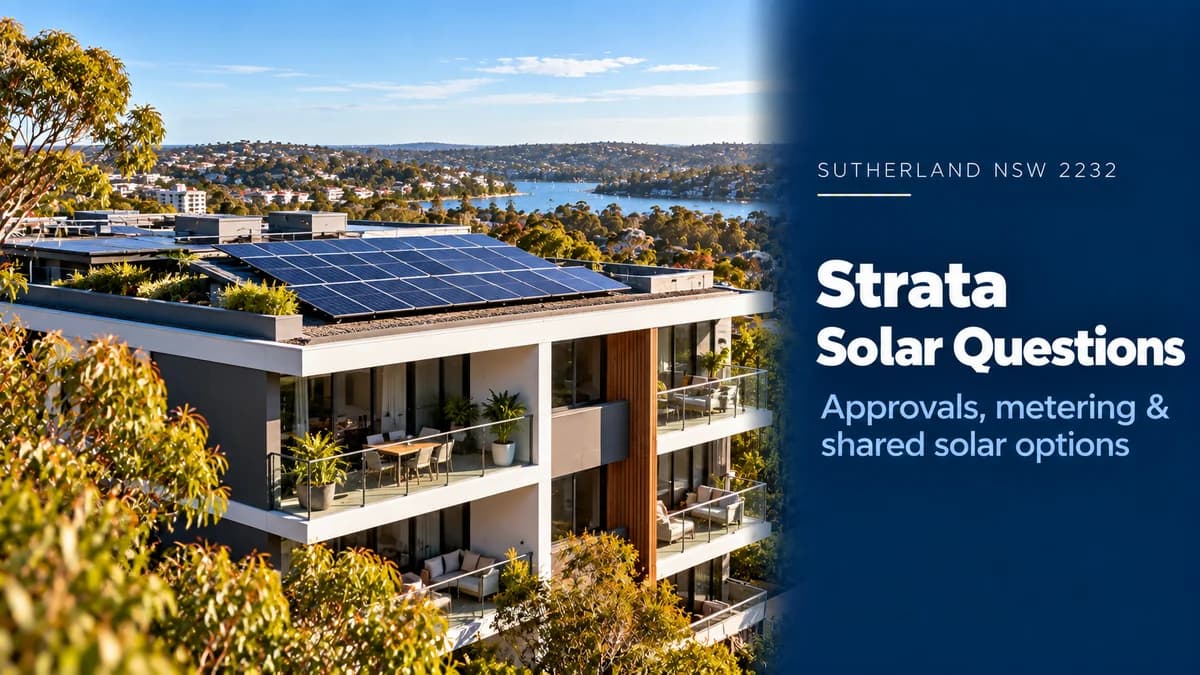
Strata Solar Sutherland NSW: Approval & Metering Guide
Can your Sutherland NSW strata install solar? Learn about owners corporation approval, shared solar, metering, roof space, costs and NSW strata grants.
Strata Solar in Sutherland: Questions Owners Corporations Should Ask First
Installing solar on a strata property in Sutherland NSW 2232 is possible, but it is more complex than installing solar on a standalone house.
For estimated costs and the rebate for 2232, see solar panels in Sutherland.
The biggest questions are usually not about panel brands.
They are about:
Who owns the roof? Who approves the installation? Which electricity meters receive the solar? How are costs and savings shared?
For an apartment building, townhouse complex or other strata-managed property, a useful solar assessment should examine:
Available common-property roof space
Owners corporation approval
Electricity metering
Common-area electricity consumption
Individual lot consumption
Roof and switchboard condition
Solar-sharing options
Network connection requirements
Installation and maintenance responsibility
How costs and benefits will be divided
The right system could range from relatively simple common-area solar to a shared system distributing electricity across multiple apartments.
Kratos Energy designs solar around actual roof conditions and electricity usage rather than applying one standard system to every property. Explore Kratos residential solar systems
Why Strata Solar Matters in Sutherland
Solar for apartments is particularly relevant in Sutherland because the suburb has a very different housing mix from many outer-Sydney residential areas.
The 2021 Census recorded approximately 66.7% of occupied private dwellings in Sutherland as flats or apartments, while only 19.3% were separate houses. Australian Bureau of Statistics
That creates a large group of households that cannot simply decide to install rooftop panels independently.
In many strata buildings, the roof, electrical infrastructure and common areas involve shared ownership and collective decision-making.
That does not prevent solar.
It simply means the system has to be designed around the building, not just one household.
Can a Strata Building Install Solar in NSW?
Yes.
NSW strata law specifically provides a pathway for sustainability infrastructure, which can include changes to common property designed to reduce energy consumption or greenhouse emissions.
For a sustainability infrastructure resolution to pass, votes against the proposal must represent less than 50% of the relevant votes by unit entitlement. This threshold is different from an ordinary special resolution, where no more than 25% can vote against. NSW Government
Before approving the proposal, the owners corporation must consider matters including:
Installation and ongoing costs
Who will own the system
Who will install and maintain it
Whether the infrastructure will benefit all or only some lots. Legislation NSW
This is why a useful solar proposal should provide more than system size and price.
Owners need enough information to make a properly informed strata decision.
Is the Roof Common Property?
Often, yes—but check the actual strata plan.
NSW Government guidance says roofs and gutters are generally maintained by the owners corporation, while also advising owners to check their strata plan and by-laws where the boundary or responsibility is unclear. NSW Government
This distinction matters because rooftop solar may involve:
Panel mounting
Roof penetrations
Cabling
Inverters
Electrical equipment
Access for future maintenance
If the proposed installation alters common property, it normally needs to be handled through the appropriate owners corporation process.
Do not assume that the section of roof directly above an apartment automatically belongs exclusively to that apartment owner.
The Three Main Ways Strata Solar Can Work
There is no single technical arrangement suitable for every Sutherland apartment building.
Solar Arrangement | How It Works | Often Suitable For |
Common-area solar | Solar offsets shared building electricity | Buildings with lifts, lighting, pumps or other common loads |
Individual lot systems | Separate solar allocation goes to participating apartment meters | Buildings with enough roof space and suitable metering |
Shared solar system | One array distributes generation across multiple lots | Schemes wanting wider resident participation |
Current NSW shared-solar grant rules recognise several technical approaches, including individual connections, existing embedded-network allocation and solar gateway/splitter systems. NSW Climate and Energy Action
The correct model depends heavily on the building's existing electrical infrastructure.
Option 1: Solar for Common Areas
This is often the simplest strata solar model.
One rooftop system supplies electricity used by the owners corporation for common-property loads.
Examples might include:
Hallway lighting
Garage lighting
Lifts
Pumps
Ventilation
Security systems
Shared facilities
Imagine a building consuming:
50kWh/day in common-area electricity
with substantial consumption during daylight hours.
A solar system can directly offset some of that grid demand without needing to allocate generation separately to every apartment.
Advantage
The metering and benefit-sharing can be simpler because the owners corporation pays the common-area electricity bill.
Limitation
Residents may not see a direct reduction on their individual apartment electricity accounts.
Instead, the financial benefit flows through reduced owners-corporation electricity expenditure.
Option 2: Separate Solar for Individual Apartments
Another approach is to allocate solar directly to individual residential meters.
This can work where the electrical design, available roof space and metering arrangement allow it.
But roof allocation quickly becomes an issue.
Consider a building with:
20 apartments
but only enough productive roof area for:
40 solar panels.
The owners corporation then needs to determine:
Which lots participate
How roof space is allocated
How costs are divided
Who owns the panels
What happens when an apartment is sold
Who pays for future maintenance
Technical feasibility is only part of the decision.
The ownership arrangement also needs to remain workable over the life of the solar system.
Option 3: Shared Solar Across Multiple Apartments
Shared solar can allow one rooftop array to provide generation across multiple residential lots.
Current NSW guidance recognises approaches including a solar gateway or splitter system that distributes solar energy between participating apartments. NSW Climate and Energy Action
Ausgrid also has specific connection requirements for apartment systems using an Inverter Power Sharing Device (IPSD). These installations can require participating electricity-account holders to consent, and individual meter upgrades may be needed depending on the existing setup. Ausgrid
For this reason, shared solar should be assessed as a complete electrical and metering project—not simply as panels on the roof.
Why Metering Is One of the First Things to Check
Before recommending system size, establish how the building is currently metered.
A strata property may have:
Individual retail meters
Each apartment has its own electricity retailer account, with another meter for common-area electricity.
Embedded network
The building has one main connection and electricity is distributed internally to individual premises.
NSW describes an embedded network as a private energy network where one main connection supplies multiple premises, a structure commonly found in apartment buildings and strata schemes. NSW Climate and Energy Action
Hybrid arrangements
Some buildings have more complicated legacy electrical infrastructure.
The solar-sharing technology that works for one building may therefore be inappropriate for another.
If the Building Has an Embedded Network
An embedded network can potentially make shared-energy allocation possible, but it adds contractual and regulatory considerations.
Before designing solar, establish:
Who operates the embedded network
How individual apartments are currently billed
Whether a third-party electricity agreement exists
How solar savings would be allocated
Whether the existing agreement limits solar sharing
Current NSW apartment-solar grant rules specifically require schemes with relevant third-party embedded-network arrangements to confirm that the contract will not prevent residents from receiving the intended solar benefit. NSW Climate and Energy Action
Do not assume that installing panels automatically changes how residents are billed.
What Should Be Assessed Before the Strata Vote?
A strong proposal should give owners enough detail to understand both the technical system and the financial arrangement.
Before voting, assess these five areas:
Roof
How much productive common-property roof space is available?
Check orientation, shade, roof condition, skylights and rooftop equipment.
Electricity
How much power do the common areas and apartments actually consume?
Smart-meter or interval data is considerably more useful than guessing from building size.
Metering
Will solar supply common areas, individual lots or both?
Financial Model
Show:
system cost → annual generation → self-consumption → estimated annual savings → payback
without promising guaranteed savings.
Responsibility
Clearly establish:
ownership → maintenance → warranty → insurance → future roof access.
That makes the owners corporation's decision much more transparent.
Do Strata Schemes Need a New By-Law?
Potentially.
The exact requirement depends on how the project changes common property, how ownership is structured and who is responsible for the equipment.
NSW's sustainability infrastructure framework allows a sustainability infrastructure resolution to address financing, alterations to common property and changes to by-laws required for installing or using the infrastructure. NSW Government
Your strata manager should help determine the motions and documentation required for the specific scheme.
For more complex arrangements, obtaining appropriate strata or legal advice can be worthwhile before the final vote.
Can a Strata By-Law Simply Ban Solar?
NSW strata law has become more supportive of sustainability projects.
Changes applying from 1 July 2025 prohibit strata by-laws from blocking sustainability infrastructure purely because it negatively affects the external appearance of common property or a lot, except in certain heritage circumstances. Owners corporations must also consider sustainability at each AGM. NSW Government
This does not mean any resident can independently install solar wherever they choose.
Common-property approvals and technical requirements still apply.
But appearance alone can no longer necessarily be used as a blanket reason to prohibit suitable sustainability infrastructure.
Does the Electricity Network Also Need to Approve the System?
Yes.
Strata approval and electricity-network approval are different things.
NSW Government guidance states that approval from the electricity network owner must be obtained before a grid-connected solar system is connected. NSW Government
For multi-tenanted properties, network assessment can become more involved because multiple electricity connections may share upstream electrical infrastructure.
Ausgrid notes that adding generation to one tenancy can affect common upstream infrastructure and recommends identifying multi-tenanted sites before a connection application is submitted. Ausgrid
The solar installer should manage the appropriate connection process as part of the project.
How Much Solar Can a Sutherland Apartment Building Install?
There is no standard answer.
The system size should be based on:
usable roof area + building load + resident load + metering arrangement + network approval.
For example, a large apartment roof may physically support a substantial array.
But if the system only supplies a small common-area electricity load, installing the maximum number of panels may create excessive exports.
Conversely, if solar can be shared effectively among individual apartments, a larger system may become far more useful.
The objective should be to maximise productive onsite use, rather than simply maximise panel count.
For a basic location-based generation benchmark, postcode 2232 can be entered into the Kratos Solar Output Calculator. Estimate solar generation for Sutherland 2232 Kratos Energy
What About NSW's Solar for Apartment Residents Grant?
This is particularly relevant in 2026.
As of 28 September 2026, the NSW Solar for Apartment Residents program is open and is scheduled to close at 5 PM on 4 December 2026, or earlier if available funding is fully allocated. NSW Climate and Energy Action
For the standard program, eligible projects can receive funding covering up to 50% of eligible shared-solar costs, capped at $150,000 per project. Eligible buildings generally include Class 2 apartment buildings and certain strata-managed attached dwellings with common-property rooftop space. NSW Climate and Energy Action
The program is aimed at medium-density schemes; current eligibility generally targets buildings with 3 to 55 residential lots, with additional guidance available for certain larger buildings. NSW Climate and Energy Action
Importantly, individual apartment owners cannot apply independently. Applications need to come through the owners corporation or an authorised representative, and a sustainability infrastructure resolution is required before the full application stage. NSW Climate and Energy Action
Because this is a time-limited 2026 program, eligibility and funding availability should be checked again immediately before an application is prepared.
A Practical Sutherland Strata Solar Example
Consider a hypothetical 20-unit apartment building.
The property has:
Large common roof
Separate retail meters for each apartment
One common-area electricity meter
Strong daytime common-area usage
The owners corporation could compare:
Approach | Main Benefit | Main Challenge |
Common-area solar | Simpler design and savings allocation | Residents do not receive direct individual solar |
Individual allocation | Direct benefit to participating apartments | Roof allocation and metering complexity |
Shared solar | Broader resident benefit | More sophisticated metering and system design |
The right answer should come from a feasibility assessment.
It should not be decided solely by whichever option has the lowest initial quote.
What Should Owners Ask a Solar Company?
Before taking a proposal to a strata meeting, make sure the quote answers:
How much usable roof area is available?
How much electricity does the building use during solar hours?
Who will receive the solar electricity?
What metering changes are required?
What network approval is required?
Who owns and maintains the system?
What are the estimated annual savings and payback assumptions?
For a shared project, the solar contractor should also explain how system performance will be monitored and how residents or the owners corporation will see the benefit.
Frequently Asked Questions
Can apartments install solar in Sutherland?
Does every apartment owner need to agree?
Can one apartment owner install panels on the strata roof?
Can rooftop solar reduce strata levies?
Can solar be shared between apartments?
Does a strata building need special metering for shared solar?
Is there currently a NSW apartment solar grant?
Strata Solar in Sutherland: The Bottom Line
For a Sutherland NSW 2232 strata building, the first step is not choosing panels.
It is establishing:
Roof ownership → electricity usage → metering → benefit sharing → owners corporation approval → network connection.
A simple building may only need solar for common-area loads.
Another property may benefit from solar distributed directly to individual apartments.
A larger scheme may require shared-solar technology and more detailed metering design.
And with the NSW Solar for Apartment Residents program currently available, eligible owners corporations have an additional reason to investigate feasibility before the present funding window closes. NSW Climate and Energy Action
Explore Kratos residential solar solutions
Estimate solar output for postcode 2232
Contact Kratos Energy for a site-specific assessment
For strata solar, the strongest proposal is not simply the one with the most panels. It is the one that clearly explains who pays, who benefits and how the electricity will actually be shared.
Solar System Packages
Tier 1 panels & CEC accredited installation.
- Trina 475W or Jinko panels
- 5kW power inverter
- 14 × 475W panels
- Single-phase compatible
- Trina 475W or Jinko panels
- 8–10kW power inverter
- 21 × 475W panels
- Battery & EV ready
- Trina 475W or Jinko panels
- 10kW power inverter
- 27 × 475W panels
- Three-phase compatible