

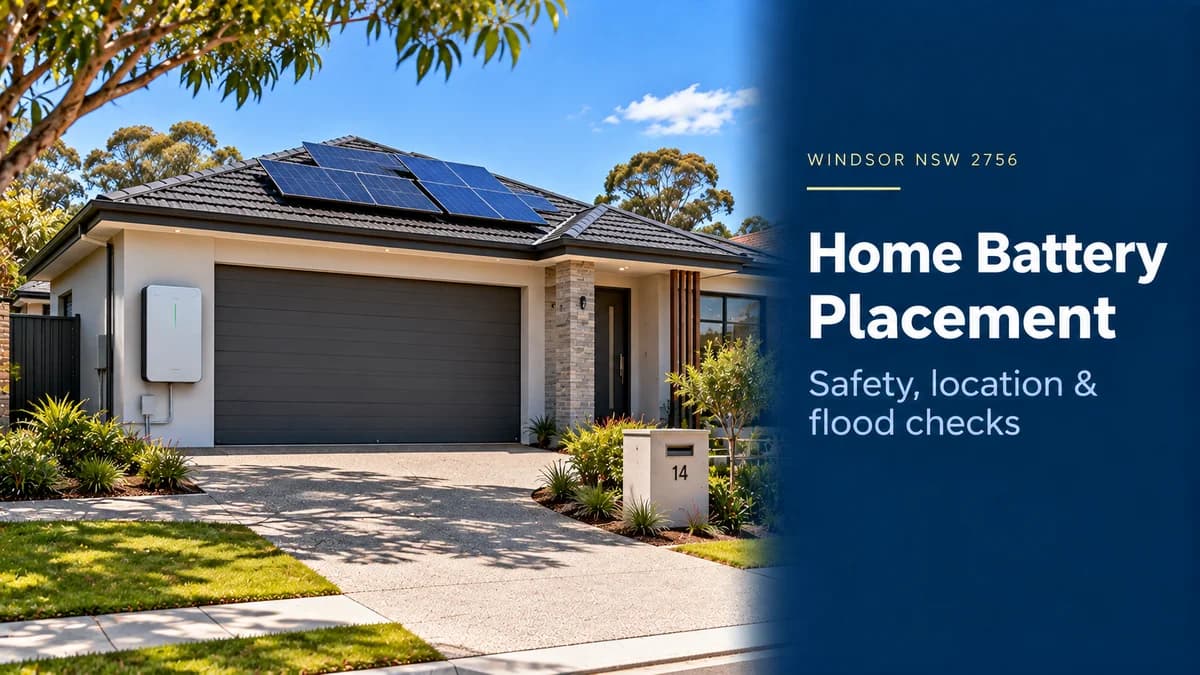
Home Battery Placement Windsor NSW: 2026 Safety Guide
Installing a home battery in Windsor NSW 2756? Learn where batteries can be installed, garage and outdoor placement, flood exposure, access, clearances and 2026 NSW safety rules.
Battery Placement Checks for Windsor Homes: Where Should Your Battery Go?
When planning a solar battery for a home in Windsor NSW 2756, battery capacity and brand are only part of the decision.
Where the battery is installed matters just as much.
The location needs to satisfy current Australian electrical and battery standards while accounting for:
Doors and windows
Habitable rooms
Vehicle impact
Ventilation
Direct sun and weather
Access for servicing
Flood exposure
Manufacturer requirements
Emergency access
This is particularly important in Windsor because flood exposure can vary significantly from one property to another. Battery placement should therefore use property-specific information rather than assuming that every home in postcode 2756 has the same level of risk.
Kratos Energy installs residential battery systems designed around the property, existing solar and household energy requirements. Explore Kratos battery storage solutions. (Kratos Energy)
Where Can a Home Battery Be Installed?
Common residential battery locations include:
Potential Location | Main Checks |
Exterior wall | Weather, sunlight, openings, wall construction |
Garage wall | Vehicle impact, fire separation, doors/windows |
Freestanding outside | Stable base, weather protection, access |
Utility area | Ventilation, restricted-location rules |
Beside switchboard/inverter | Compliance, clearances and service access |
There is no universal location that is best for every Windsor property.
Energy.gov.au confirms that specific rules apply to battery locations, including restrictions involving wall construction and proximity to habitable spaces, doors and windows. Installation should be completed by an appropriately licensed and accredited battery installer. (Energy Australia)
1. Check the Current 2026 Battery Installation Rules
Home batteries in NSW must comply with applicable Australian Standards, including AS/NZS 5139, which governs battery-system safety.
Importantly, NSW requirements were updated recently.
Building Commission NSW states that Amendment 1 to AS/NZS 5139:2019 became mandatory, introducing changes and clarifications relating to battery:
Location
Clearances
Safe egress
Windows
Ventilation
Installation diagrams
The NSW Government specifically advises electricians to use the amended requirements when selecting battery locations. (NSW Government)
For homeowners, this means:
Do not rely on an old online battery-placement diagram when planning a 2026 installation.
The accredited installer should assess the proposed location against the current standard and the exact battery manufacturer's instructions.
2. Keep Batteries Away From Habitable Rooms Where Required
Bedrooms, living rooms and similar occupied areas create additional battery-placement considerations.
Australian residential guidance states that batteries cannot simply be installed anywhere inside the house. The installation method can depend on what is located behind the battery wall and whether appropriate non-combustible construction or protection is required. (Your Home)
Before installation, ask:
What room is behind this wall?
Is the wall construction suitable?
Does additional fire-resistant protection need to be installed?
Does the battery manufacturer's manual impose extra requirements?
A convenient wall is not necessarily a compliant wall.
3. Is the Garage a Good Battery Location?
A garage can be a practical battery location, but it needs proper assessment.
Potential benefits include:
Protection from direct weather
Easier connection to electrical equipment
Convenient access for maintenance
Reduced exposure to direct sunlight
However, a garage can also introduce risks.
Vehicle impact
A battery installed near a parking area may require protection from cars or other mechanical impact.
Doors and exits
The location needs to comply with current clearance and safe-egress requirements.
What is behind the wall?
If a habitable room is on the opposite side, additional fire-protection requirements may apply.
NSW battery guidance recommends selecting a location with safety as the priority and notes that batteries installed in garages may require protection such as a bollard where vehicle impact is possible. (NSW Climate and Energy Action)
4. What About an Outdoor Battery?
Many modern home batteries are designed for outdoor installation, subject to the manufacturer's environmental specifications.
An outdoor position may work well when it provides:
Suitable weather protection
Limited direct solar heat
Good ventilation
Safe maintenance access
Protection from physical impact
Suitable drainage
Appropriate flood exposure
However, an outdoor rating does not mean the battery should be placed anywhere outside.
YourHome advises that batteries should be protected from direct sunlight, mechanical damage and water ingress, while also avoiding excessive temperature extremes. (Your Home)
The selected battery's installation manual should always be checked.
5. Flood Exposure Is an Important Windsor-Specific Check
Flood exposure deserves particular attention when selecting a battery location around Windsor.
The NSW SES identifies Windsor as part of the Richmond/Windsor floodplain within the Hawkesbury-Nepean Valley. However, flood conditions vary across individual streets and properties. (NSW SES)
That distinction is important.
This article should not be interpreted as saying that every Windsor home will flood or that every property has the same flood level.
NSW SES specifically says its mapping provides suburb-level information and recommends contacting the relevant local council for property- or street-level flood information. (NSW SES)
Before choosing a battery position, ask:
Is this part of the property subject to documented flood exposure?
What property-specific flood information is available?
Could water reach the proposed battery or electrical equipment?
Is a higher installation position or alternative wall available?
Could the battery obstruct an evacuation or access route?
NSW's battery guidance explicitly recommends considering flooding risk when selecting the installation location. (NSW Climate and Energy Action)
Why Floodwater and Batteries Should Not Mix
Water ingress can damage batteries and associated electrical equipment.
Fire and Rescue NSW advises that a battery affected by water ingress or flooding should not simply be restarted. The system should remain unused and be assessed by the manufacturer or an appropriately qualified technician. (Fire and Rescue NSW)
For a property where flood exposure is identified, it is better to address battery location during the design stage than after installation.
A potentially safer position might involve:
A higher external location
An alternative wall
A suitable elevated installation arrangement
Another part of the property outside the identified exposure area
The correct solution must be determined by the installer using site-specific flood and electrical information.
6. Consider Heat and Direct Sunlight
Batteries operate within specified temperature limits.
Installing a battery where it receives intense direct afternoon sun can increase operating temperature and may affect performance.
When assessing an exterior wall, consider:
North/west afternoon exposure
Shade throughout summer
Manufacturer temperature limits
Ventilation around the enclosure
Nearby heat-producing equipment
This does not mean every battery needs its own shelter.
Any weather protection must still preserve the ventilation and service clearances specified by the manufacturer. More Details...
7. Do Not Block Battery Ventilation
A battery should not be surrounded by stored household items.
NSW battery guidance recommends regularly ensuring that nothing interferes with ventilation, including objects or vegetation accumulating around the unit. (NSW Climate and Energy Action)
Avoid placing:
Boxes
Garden equipment
Fuel containers
Chemicals
Leaves
Furniture
directly against the battery.
The system also needs enough access for inspection and future servicing.
8. Keep Fuel and Chemicals Away
A garage or shed may contain:
Petrol
Paint
Gas bottles
Pool chemicals
Cleaning chemicals
Garden equipment
These should form part of the site assessment.
The NSW Government specifically recommends considering fuels and chemicals stored nearby when choosing battery location. (NSW Climate and Energy Action)
If the most convenient battery wall is beside stored combustible materials, another location may be safer.
9. Consider the Inverter and Switchboard Location
Battery placement is also influenced by the rest of the electrical system.
The installer may need to consider:
Existing solar inverter
Main switchboard
Meter
Cable route
Backup gateway
Battery inverter
Emergency isolation
Three-phase or single-phase supply
Placing equipment reasonably close together can sometimes simplify wiring, but compliance and safety should take priority over minimising cable length.
The installation should be designed as one complete electrical system.
10. Plan for Blackout Backup Before Choosing the Location
If you want the battery to keep selected circuits running during a blackout, tell the installer before the final location is chosen.
Backup may require:
Additional switching equipment
Backup gateway
Separate essential-load circuits
Additional switchboard work
The battery location should allow these components to be integrated cleanly and safely.
Kratos Energy's battery range includes backup-capable systems for suitable installations. View Kratos home battery options. (Kratos Energy)
Windsor Battery Placement: Three Example Scenarios
These examples are illustrative only.
Scenario 1 — Clear External Garage Wall
The wall:
Is shaded for much of the day
Has good maintenance access
Is away from stored fuel
Is protected from vehicle impact
Has no identified property-specific flood issue
Potential outcome
This could be a strong candidate, subject to the current standard, wall construction and manufacturer's requirements.
Scenario 2 — Battery Beside the Driveway
The position is convenient but a vehicle could reverse into the unit.
Potential issue
Mechanical protection may be required, or another position may be preferable.
Scenario 3 — Low External Wall in an Area With Identified Flood Exposure
The property-level flood assessment indicates that the proposed area could be affected by water.
Potential outcome
The installer should evaluate another location or an appropriately engineered alternative rather than simply mounting the battery at the most convenient height.
Battery Placement Checklist for Windsor Homeowners
Before approving the installation location, confirm:
Safety
Current AS/NZS 5139 requirements checked
Licensed/accredited battery installer
Suitable wall or mounting structure
Required clearances confirmed
Safe emergency access
Environment
Direct sunlight assessed
Rain and weather exposure considered
Adequate ventilation
Water ingress risk considered
Property-specific flood information reviewed where relevant
Physical Protection
Vehicle impact risk
Garden equipment
Children/public access
Stored fuels and chemicals
Electrical Design
Switchboard location
Inverter location
Cable route
Backup equipment
Single/three-phase configuration
Maintenance
Technician can reach the equipment
Battery labels remain visible
Shutdown procedure accessible
No permanent obstruction around equipment
What Documentation Should You Receive?
NSW Government guidance states that after installation homeowners should receive documentation including:
Installed equipment details
Shutdown and isolation instructions
System connection diagrams
Equipment handbooks
Certificate of Compliance for Electrical Work
Clear battery signage is also required to assist occupants and emergency services. (NSW Government)
Keep these documents somewhere accessible.
If you sell the home later, they also help the next owner understand the battery system.
Does the 2026 Battery Rebate Affect Placement?
The rebate does not remove the safety requirements.
An eligible battery still needs to be properly installed by appropriately qualified professionals and meet relevant program requirements.
You can estimate current federal battery support using the Kratos Battery Rebate Calculator. (Kratos Energy)
For Windsor, enter postcode:
2756
The rebate may reduce the upfront cost, but the installation location should always be chosen around safety, compliance and the property itself.
Frequently Asked Questions
Where is the best place to install a home battery in Windsor?
Can a solar battery be installed inside a garage?
Can a battery be installed outside?
Can a battery be installed beside a bedroom wall?
Should flood risk affect battery location in Windsor?
What happens if a battery is flooded?
Do battery-placement requirements change over time?
Choosing a Battery Location for Your Windsor Home
For a Windsor NSW 2756 property, good battery placement should balance:
Compliance + safety + flood exposure + weather protection + electrical design + service access.
Do not choose the location simply because it is:
Closest to the solar inverter
Hidden from view
Cheapest for the installer
The same place a neighbour installed theirs
Every property is different.
For Windsor homes in particular, any relevant flood information should be checked at the property level before the final battery position is approved.
Explore Kratos battery storage solutions
Estimate your 2026 battery rebate
Request a tailored Kratos battery assessment
The best battery location is not simply where the equipment fits—it is where the system can operate safely for the long term.
Solar System Packages
Tier 1 panels & CEC accredited installation.
- Trina 475W or Jinko panels
- 5kW power inverter
- 14 × 475W panels
- Single-phase compatible
- Trina 475W or Jinko panels
- 8–10kW power inverter
- 21 × 475W panels
- Battery & EV ready
- Trina 475W or Jinko panels
- 10kW power inverter
- 27 × 475W panels
- Three-phase compatible