

Putting more roofs to work
5 August 2026
The Albanese Government is helping businesses, farms and community organisations cut energy costs and strengthen Australia’s energy security by slashing
the cost of installing medium-sized solar systems by around 20 per cent.
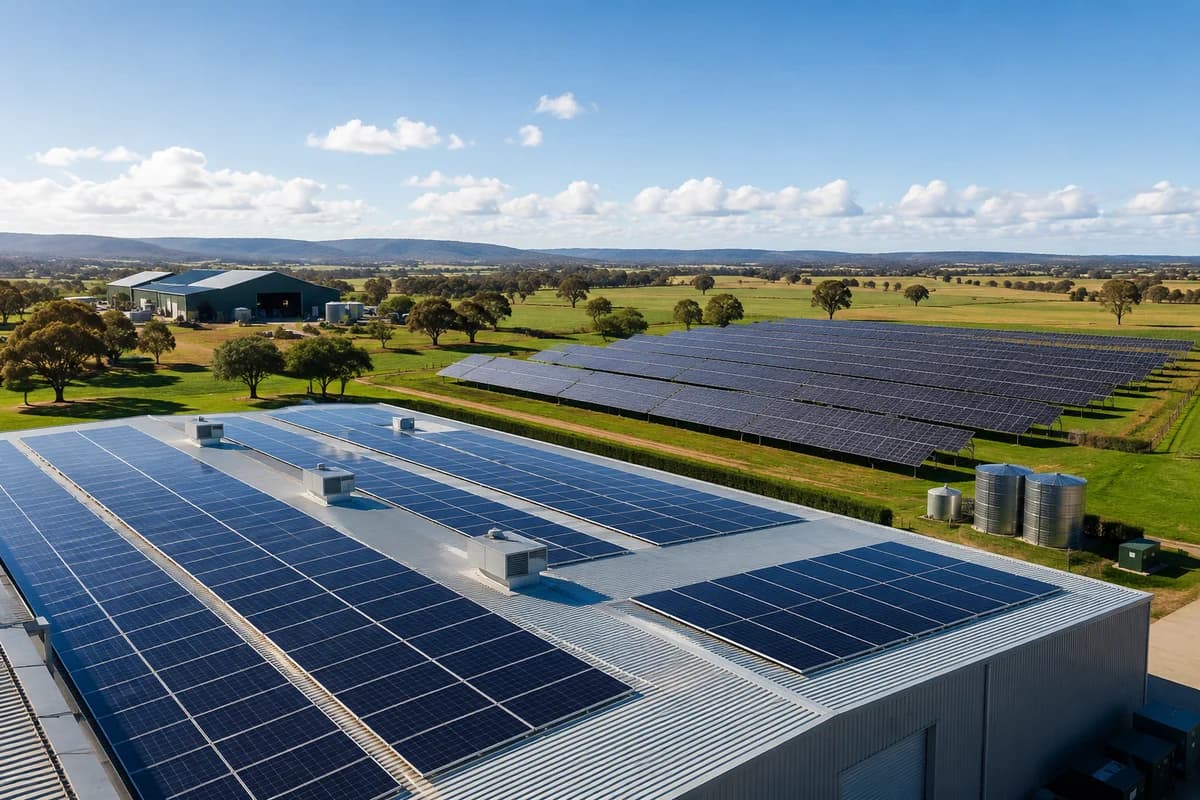
The Small-scale Renewable Energy Scheme (SRES) will be expanded from 100 kW to 1 MW, allowing businesses, farms and community facilities to install solar
systems up to ten times larger, better matching their energy needs and unlocking the potential of large commercial rooftops.
According to the Institute for Energy Economics and Financial Analysis, while Australia’s residential solar is sitting at 22 gigawatts, businesses have only
installed around 5.6 gigawatts, with most of this being rooftop solar systems below 100 kW in size.
This reform will unlock more rooftop solar for the missing middle – helping more businesses take up solar and shield their energy bills from volatile global
energy markets. Lower energy costs will improve productivity and competitiveness across manufacturing, agriculture, retail, transport and logistics, with
benefits flowing through to households using those goods and services.
And more energy generated where it’s used is good for the grid too – reducing the need for expensive networks and smoothing out demand peaks for all
energy users.
It means more regional and remote areas will have access to clean, reliable and affordable solar energy – with community groups, schools, hospitals, farms
and businesses able to secure the discount.
We will also improve network connection processes for mid-scale solar projects through targeted rule change requests and enhancements to the existing
framework.
Minister for Climate Change and Energy Chris Bowen said the expansion would help businesses and communities realise the same benefits from solar that
millions of Australian households already are.
“We're putting more rooftops to work and helping businesses, farms and community organisations cut energy costs by slashing the cost of installing mediumsized solar systems by around 20 per cent.
“One in three Australian homes have rooftop solar, but larger energy users have been locked out because the existing solar rebate only supports systems up
to 100 kW.
“We're fixing that by expanding support to systems up to 1 MW, unlocking the potential of commercial rooftops and helping businesses cut power bills, invest
in growth and create jobs.
“This will help manufacturers, farmers, retailers, logistics centres, schools, hospitals and community organisations reduce energy costs – and it uses an
existing, proven scheme meaning no new bureaucracy or red tape.”
“More rooftop solar means lower energy costs, a stronger economy and faster progress towards an energy system powered by Australian renewable energy.”
The expanded SRES is expected to commence from 1 October 2026, subject to the necessary regulations being in place.
BACKGROUND – POLICY DETAIL
The discount will be delivered through expanding the existing Small-scale Renewable Energy Scheme (SRES) – the successful and safe program that has been
providing discounts for solar upgrades since 2011 and more than 490,0000 Cheaper Home Batteries program installation since 2025.
The expansion of the SRES is expected to be budget neutral and will add to Australia’s renewable energy, which is putting downward pressure on wholesale
prices, with those prices down 47% in the most recent quarter.
Each installation generates certificates which are then traded on the open market. The SRES is administered by the Clean Energy Regulator. The federal
scheme is separate from state-run rebates.
The SRES has always had a small compliance cost for retailers and that is designed to continue to reduce each year to 2030.
The incremental compliance costs from adding these types of systems is expected to be very small, in the order of $1 to $2 a year.
Expanding the SRES to include solar installations up to 1 MW in size will lower the upfront installation costs for commercial, industrial and agricultural buildings
by around 20 per cent.
Based on a mid-scale solar PV system installations the estimated discount is about $68,000 off a 250 kW system - enough to support a reasonably large
commercial operation or $136,000 off a 500 kW system, which could power a small manufacturing site.
A 250kW solar PV installation on a medium sized enterprise, like a retailer, could produce around 345 MWhs of electricity a year, saving around $50,000 of
electricity costs each year.
A large 850kW solar PV installation, which would be more suited to an industrial energy user, could produce around 1,173 MWhs of electricity a year, saving
around $175,000 of electricity costs each year.
Solar System Packages
Tier 1 panels & CEC accredited installation.
- Trina 475W or Jinko panels
- 5kW power inverter
- 14 × 475W panels
- Single-phase compatible
- Trina 475W or Jinko panels
- 8–10kW power inverter
- 21 × 475W panels
- Battery & EV ready
- Trina 475W or Jinko panels
- 10kW power inverter
- 27 × 475W panels
- Three-phase compatible