

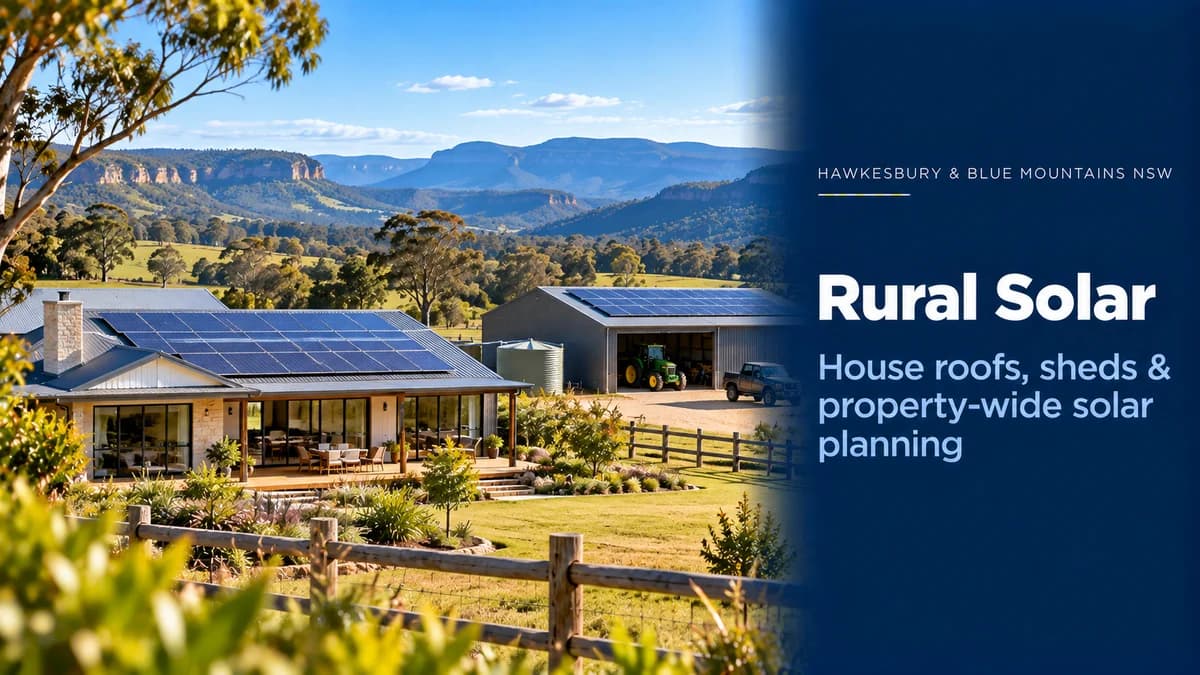
Rural Solar Hawkesbury & Blue Mountains: Property Guide
Planning solar on an acreage property in Hawkesbury or the Blue Mountains? Learn about shed roofs, long cable runs, supply capacity, access, batteries and rural solar design.
Rural Solar in Hawkesbury and the Blue Mountains: What Should Be Assessed First?
Installing solar on an acreage or rural property in the Hawkesbury or Blue Mountains can involve very different design decisions from installing panels on a suburban home.
The property may have:
A large house roof
One or more sheds
Long distances between buildings
Private power poles
Long underground cable runs
Pumps or workshop equipment
Three-phase machinery
Significant tree shade
Difficult vehicle access
Different electricity loads across the property
See solar in the Hawkesbury and Blue Mountains for the region, or the local pages for Windsor and Springwood.
That creates opportunities for larger and more flexible solar layouts—but it also means the system should be designed around the whole property, not just whichever roof has the most available space.
The key questions are:
Where is the electricity actually used? Where is the main switchboard? Which building has the best solar exposure? How far will power need to travel? And can the existing supply support the proposed system?
Kratos Energy designs customised solar systems around roof orientation, electricity consumption and property requirements rather than applying one fixed residential package to every site. (kratos-energy.com)
Explore Kratos residential solar systems
Rural Solar: Quick Property Checklist
What to Check | Why It Matters |
House roof | May be closest to switchboard and household loads |
Shed roof | Can provide larger, less shaded solar area |
Roof structure | Must safely support installation |
Main switchboard | Determines where the system connects |
Cable distance | Affects design, voltage rise and installation cost |
Existing supply | Single-phase, three-phase and available capacity matter |
Private poles/cables | Common on larger rural properties |
Shade | Trees and terrain can materially reduce output |
Vehicle access | Installation teams need safe equipment access |
Pumps/workshops | Can create valuable daytime solar loads |
Battery location | Needs compliant, accessible installation space |
Network approval | Determines inverter/export conditions |
The goal is to decide where solar provides the strongest combination of:
generation + electrical practicality + useful onsite consumption.
Why Rural Properties Need a Different Solar Assessment
In a typical suburban installation:
Roof → inverter → switchboard
may all be located within a relatively small area.
On a rural property, the layout might instead look like:
Solar shed → 50 metres of cable → secondary switchboard → house → main switchboard → grid connection
or:
House solar → workshop → water pump → battery → grid
Those distances and multiple buildings matter.
The Australian Government recommends agreeing on inverter location, electrical infrastructure and any required switchboard work before installation. It notes that inverters are normally positioned relatively close to the switchboard and that some properties require upgrades to wiring, meter boards or electrical infrastructure before solar can be connected. (energy.gov.au)
1. House Roof or Shed Roof?
One of the first rural solar decisions is where the panels should go.
The house is not automatically the best location.
A large rural shed can sometimes provide:
More usable roof area
Less complex roof geometry
Fewer vents and skylights
Better orientation
Less shading
Easier panel layout
But a good shed roof does not automatically mean it is the best electrical location.
The distance from the shed to the switchboard still matters.
Example: House Roof vs Shed Roof
Consider a hypothetical Hawkesbury acreage property.
House
8kW of usable roof space
Some afternoon tree shade
Main switchboard nearby
Machinery Shed
15kW+ of usable roof space
Excellent northern exposure
Minimal shade
65 metres from main switchboard
Which should be used?
You cannot decide from roof size alone.
The installer needs to compare:
expected generation + structural suitability + cable route + electrical losses + cost + household load profile.
In some cases, the shed may still be clearly better.
In others, the additional electrical infrastructure required to connect a distant shed may change the economics.
2. Check the Shed Structure Before Installing Panels
A large shed roof can look ideal for solar but still needs to be assessed for installation safety and structural suitability.
Safe Work Australia says a rooftop solar inspection should consider:
Structural integrity
Roof material
Roof condition
Height and pitch
Skylights and voids
Safe worker access
Equipment access. (safeworkaustralia.gov.au)
This is particularly relevant to:
Older farm sheds
Corrugated metal roofs
Buildings with corrosion
Sheds containing brittle materials
Buildings with limited safe roof access
Do not assume a shed can support solar simply because it has a large roof.
3. Long Cable Runs Need Proper Design
Cable distance matters much more on rural properties.
A solar array may be installed on a shed tens of metres from the property's main point of supply.
Longer electrical runs can create:
Additional cable cost
Trenching requirements
Voltage-rise issues
Larger cable-size requirements
More complex installation routes
The Clean Energy Council's technical guidance specifically requires designers to consider voltage rise between the inverter and the property's point of supply, including existing cabling between multiple switchboards. (cleanenergycouncil.org.au)
Endeavour Energy also warns that where voltage-rise requirements are not met, installation cabling may need to be upgraded. (endeavourenergy.com.au)
For acreage solar, cable routing should therefore be planned before the final system price is agreed.
Why Voltage Rise Matters
When solar generates strongly, the inverter pushes electricity toward the property's switchboard and grid connection.
If electrical resistance across a long cable causes excessive voltage rise, the inverter may encounter operating problems.
This can potentially result in:
Reduced generation
Inverter voltage warnings
Disconnection during high solar output
A larger cable may help manage this, but that increases project cost.
This is why a distant shed should not be selected purely because it has the best-looking roof.
The electrical distance back to the point of supply matters too.
4. Underground Cable Runs Need to Be Identified Early
Rural properties often require cables between detached buildings.
Where underground electrical work is required, the installation method and cable selection need to satisfy the applicable electrical standards.
Clean Energy Council guidance notes that underground PV cabling requires cables suitable for the underground application rather than simply using ordinary above-ground PV cable. (cleanenergycouncil.org.au)
The quote should clearly establish whether it includes:
Trenching
Underground conduit
Cable
Excavation
Reinstatement
Electrical protection
before work begins.
Otherwise, an apparently simple shed installation can develop unexpected additional costs.
5. Check the Existing Electricity Supply
Before selecting a 10kW, 13kW or larger system, confirm how electricity reaches the property.
The supply might be:
Single-Phase
Common for ordinary homes but may limit some larger electrical equipment or inverter configurations.
Three-Phase
Provides greater capacity for larger loads and can provide more flexibility for bigger solar systems.
Rural Supply With Private Infrastructure
Some acreage properties have:
Private poles
Long overhead conductors
Underground private mains
Endeavour Energy explains that on rural properties, the network connection point may be located at the first private pole inside the property. (endeavourenergy.com.au)
That can make the property's internal electrical infrastructure an important part of solar design.
Hawkesbury and Blue Mountains Are Within Endeavour Energy's Network
Both the Hawkesbury and Blue Mountains local government areas sit within Endeavour Energy's distribution network. (endeavourenergy.com.au)
This matters because the network connection agreement determines:
Permitted inverter capacity
Export arrangement
Technical requirements
Metering requirements
The Australian Government notes that the network connection agreement can limit both inverter size and the amount of electricity a system may export. (energy.gov.au)
So acreage and roof size alone do not determine how large a grid-connected solar system can be.
Flexible Exports Are Also Changing
Endeavour Energy states that from November 2026, flexible exports are expected to become the default connection option for eligible new and upgraded solar systems.
Eligible customers may be able to export up to:
10kW per phase most of the time
with the network dynamically adjusting the export level when necessary.
A fixed-export option is also available, with different export constraints. (endeavourenergy.com.au)
Because these requirements are changing, the installer should use the current connection rules at the time the application is submitted.
Do not design a rural system from an old export-limit assumption.
6. Rural Loads Can Make Larger Solar Systems Useful
Acreage homes can consume electricity very differently from suburban properties.
Possible loads include:
Bore pumps
Irrigation pumps
Workshop machinery
Sheds
Pool equipment
Electric fencing equipment
Heat-pump hot water
Ducted air conditioning
EV charging
Farm refrigeration
These loads may create significant daytime demand, which can improve solar self-consumption.
Consider a property using:
4kW of pumping and workshop load during the middle of the day.
That electricity can potentially be supplied directly from solar rather than purchased from the grid.
The system should therefore be sized around actual property demand, not household occupants alone.
7. Pump Loads Should Be Included in the Assessment
Water management is particularly relevant to many rural properties.
Solar may interact with:
Bore pumps
Tank pumps
Irrigation
Pool pumps
Dam pumping
If those loads can run during daylight hours, they can create useful self-consumption.
For example:
Pump:
2.5kW
Operating time:
4 hours/day
Daily electricity consumption:
10kWh
If much of this operates during strong solar production, rooftop solar can potentially offset a substantial part of that demand.
This is why the installer should ask about all buildings and equipment on the property, not simply review the household electricity appliances.
8. Workshop and Shed Equipment Can Change the System Size
A workshop might operate:
Welders
Compressors
Power tools
Ventilation
Machinery
Refrigeration
These can create much larger loads than the house itself.
The installer should establish:
Equipment power requirements
Single- or three-phase operation
When machinery operates
Maximum simultaneous demand
A rural property occupied by two people can still justify substantially more solar than an ordinary two-person suburban home if the workshop consumes significant electricity.
9. Shade Can Be More Complex in the Blue Mountains
Rural and bushland properties may have considerable tree cover.
The Australian Government notes that solar output is affected by both the position of shading objects and by the time of day and season. (energy.gov.au)
This can be especially important where:
Tall trees surround the home
The property sits below a ridge
Winter sun is limited
A shed and house experience different shading patterns
A shed located farther from the home may actually provide the stronger solar site if it receives better year-round sunlight.
Do not choose a roof from satellite imagery alone.
House vs Shed: Example Comparison
Consider a hypothetical Blue Mountains acreage home.
Feature | House | Shed |
Solar capacity | 6.6kW | 13kW |
Morning shade | Moderate | Minimal |
Winter shade | High | Low |
Switchboard distance | 5m | 50m |
Roof condition | Good | Good |
Access | Moderate | Excellent |
The shed provides much better solar access.
But the electrical connection costs more.
The final design should compare:
additional generation value vs additional connection cost.
This produces a much stronger decision than simply choosing the nearest roof.
10. Property Access Affects Installation
Installation logistics deserve more attention on rural properties.
Before installation day, consider:
Driveway width
Gate access
Steep driveways
Low tree branches
Soft ground
Distance from parking area to building
Equipment delivery
Safe ladder/scaffold access
Australian Government guidance recommends checking site access, roof condition and equipment positioning before installation to avoid last-minute design changes or delays. (energy.gov.au)
For difficult rural properties, providing photos or access details during the site assessment can help avoid surprises.
11. Private Poles and Powerlines Should Be Identified
Acreage properties can contain electrical infrastructure that suburban homeowners rarely need to consider.
Endeavour Energy says private property assets can include:
Power poles
Overhead lines
Underground cables
Crossarms
Associated electrical equipment. (endeavourenergy.com.au)
Before solar installation, establish where the network responsibility ends and the property's electrical infrastructure begins.
That can affect:
Solar connection design
Cabling
Required upgrades
Project cost
12. Should You Install a Battery?
A battery can be particularly relevant to rural properties—but only when it solves a real problem.
Possible reasons include:
High evening electricity demand
Significant daytime solar exports
Frequent or disruptive outages
Critical water pumps
Refrigeration
Communications equipment
Security systems
Australian Government guidance explains that appropriately configured battery systems can provide backup during grid outages, although some systems back up only selected circuits rather than the whole property. (energy.gov.au)
For a rural property, backup circuits might include:
Fridge/freezer
Water pump
Lighting
Wi-Fi
Selected outlets
rather than attempting to operate every workshop or high-power appliance during a blackout.
Explore Kratos battery storage options
Battery Capacity vs Backup Power
These are different specifications.
kWh
Tells you how much energy the battery stores.
kW
Tells you how much electrical load it can operate at once.
Suppose a rural property has a large water pump.
A battery might contain:
20kWh
of stored energy.
But if the battery inverter cannot provide the pump's required starting or continuous power, that pump may still not operate during an outage.
For rural backup design, ask:
Which circuits are backed up?
What continuous power is available?
What surge power is available?
Can solar recharge the battery during an outage?
13. Grid-Connected Does Not Mean You Need an Off-Grid System
Large rural properties are sometimes assumed to require off-grid solar.
That is not necessarily true.
If the property already has a suitable grid connection, a conventional grid-connected or hybrid solar-and-battery system may be the more practical option.
A full off-grid system has very different requirements because it must be designed to supply the property through:
Poor weather
Winter
Extended low-solar periods
High-load events
often using much larger battery capacity and sometimes generator support.
If a property has no existing grid connection, off-grid design should be treated as a specialist project and confirmed with the provider before relying on standard residential solar pricing.
14. Planning Rules May Matter When New Sheds Are Involved
Installing solar on an existing suitable shed is different from constructing a new shed specifically for solar.
NSW Planning says detached rural outbuildings such as farm buildings and sheds may qualify as exempt or complying development when the relevant standards are met, but requirements vary according to zoning, building characteristics and site constraints. (planning.nsw.gov.au)
Additional restrictions can apply on land affected by:
Bushfire
Flooding
Heritage
Environmental constraints
So do not assume a new solar shed can automatically be built without approval.
Check the applicable planning pathway for the property first.
Worked Example: Hawkesbury Acreage Solar
Consider an illustrative rural property.
Property
5-acre acreage home
Electricity consumption
32kWh/day
Major loads
House
Pool
Bore pump
Workshop
Future EV
Roof options
House:
6.6kW practical capacity
Shed:
13kW practical capacity
Shed distance
45 metres from the main switchboard
Solar strategy
Instead of immediately choosing 13kW because the shed is larger, the installer should assess:
Shed structural suitability
Annual shading
Cable route
Voltage rise
Existing switchboard
Supply phase
Network connection
Daytime loads
Future EV demand
If the electrical work is practical, the shed could provide significantly better solar generation.
If the connection cost is unusually high, a house-based or split-array design may deserve comparison.
This is the type of analysis that rural solar requires.
What Should You Give the Installer?
For a useful rural-property solar quote, prepare:
Electricity Information
12 months of bills
Smart-meter data where available
Existing solar information
Property Layout
House location
Shed locations
Main switchboard
Meter
Private power poles
Approximate building distances
Roof Information
Roof material
Roof age
Shed condition
Shade
Photos
Major Loads
Pumps
Pool
Workshop
Machinery
Hot water
Heating/cooling
EV plans
Access
Driveway condition
Gate width
Steep areas
Difficult building access
Providing this information early makes a rural quote far more accurate.
Rural Solar Design Checklist
Before accepting the proposal, confirm:
Panels
Which building?
Expected annual output?
Shade modelled?
Electrical
Cable distance?
Cable upgrade included?
Main switchboard suitable?
Single- or three-phase?
Network
Endeavour Energy connection approved?
Export arrangement?
Inverter capacity?
Property
Roof condition?
Private poles or cabling?
Installation access?
Battery
Necessary or optional?
Backup circuits?
Continuous backup power?
Cost
Trenching included?
Switchboard work included?
Additional electrical infrastructure clearly itemised?
A rural quote should not leave major site-work costs hidden behind a generic “standard installation” assumption.
Frequently Asked Questions
Can I install solar on a shed in the Hawkesbury?
Is a shed better than the house for solar?
Does a long distance between the shed and house matter?
Can rural properties install 10kW or 13kW solar?
Which electricity network covers Hawkesbury and the Blue Mountains?
Is a battery useful on acreage?
Can a battery run a rural water pump during a blackout?
Do I need off-grid solar because my property is rural?
Rural Solar in Hawkesbury and the Blue Mountains: The Bottom Line
For rural solar in Hawkesbury and the Blue Mountains, the best roof is not automatically the house—and the largest shed is not automatically the best answer.
The correct process is:
Map the property → identify loads → assess roofs → measure cable distances → inspect supply capacity → check network approval → design the system.
Rural solar should account for the entire property.
That means:
sheds + house + pumps + workshop + private power infrastructure + future loads + access.
Where a shed has strong solar exposure, it can provide an excellent installation location.
But long cable runs, structural condition and connection costs need to be included before deciding.
And where battery backup is important, design the backup around the actual circuits and equipment the property needs during an outage.
Explore Kratos residential solar systems
View Kratos solar panels and inverters
Estimate solar generation by postcode
Contact Kratos Energy for a property-specific assessment
For rural properties, good solar design is not only about how many panels fit—it is about how the entire property's buildings, loads and electrical infrastructure work together.
Solar System Packages
Tier 1 panels & CEC accredited installation.
- Trina 475W or Jinko panels
- 5kW power inverter
- 14 × 475W panels
- Single-phase compatible
- Trina 475W or Jinko panels
- 8–10kW power inverter
- 21 × 475W panels
- Battery & EV ready
- Trina 475W or Jinko panels
- 10kW power inverter
- 27 × 475W panels
- Three-phase compatible