

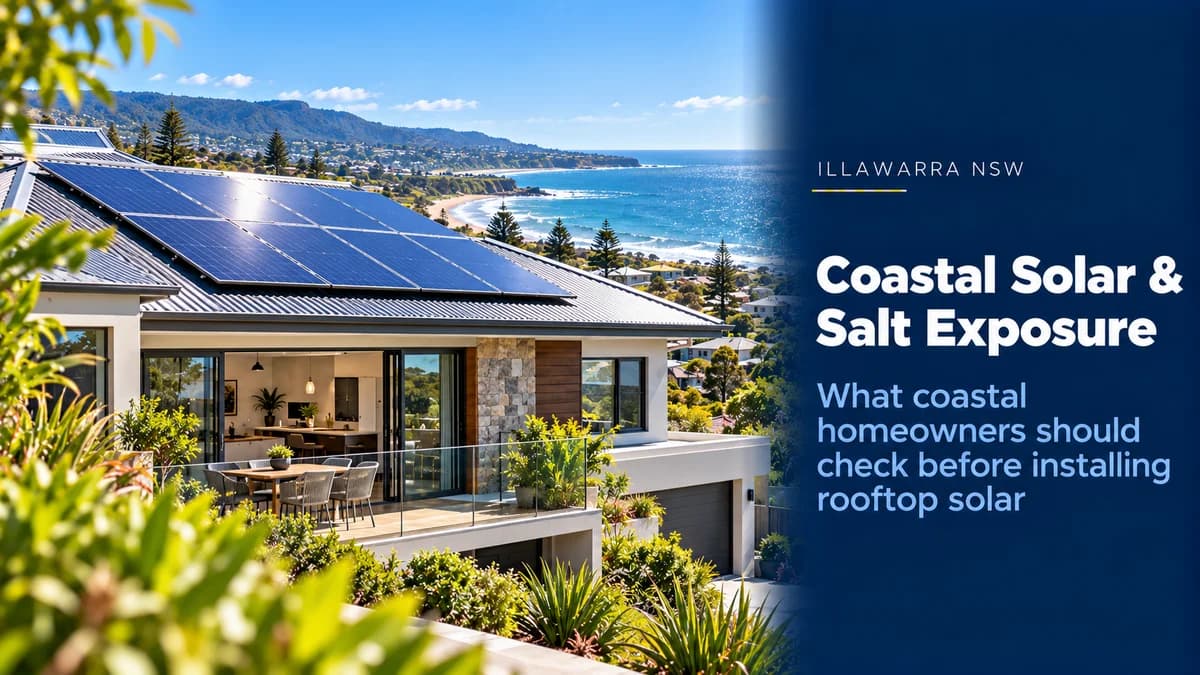
Coastal Solar Illawarra: Salt & Corrosion Guide
Installing solar in the Illawarra? Learn how salt exposure affects panels, inverters and mounting hardware, plus what to check before choosing coastal solar equipment.
Solar and Salt Exposure in the Illawarra: What Coastal Homeowners Should Check
Living near the coast does not mean rooftop solar is unsuitable.
But for homes across the Illawarra, particularly properties exposed to sea breeze and salt-laden air, the system should be designed with corrosion resistance in mind.
The important question is not simply:
“How close is my house to the ocean?”
It is:
“How much salt exposure does this particular roof and equipment location receive?”
See solar in the Illawarra for the whole region, or the local pages for Dapto, Horsley, Shellharbour and Shell Cove.
A property close to the shoreline in Wollongong or Shellharbour may face different conditions from a more sheltered site further inland, even within the same postcode.
A proper coastal solar assessment should consider:
Distance from the coast
Direct sea-breeze exposure
Roof orientation
Local terrain
Panel corrosion certification
Inverter location
Mounting materials
Roof material
Equipment warranty conditions
Ongoing inspection and maintenance
Kratos Energy currently installs Trina and Jinko Tier-1 panels across its residential packages and designs systems around individual roof conditions. (kratos-energy.com)
Explore Kratos residential solar systems
Why Salt Exposure Matters for Solar Equipment
Coastal air contains salt particles carried inland by wind.
Over time, salt can contribute to corrosion of exposed metals and coatings.
A rooftop solar system contains several components that may be affected by environmental exposure:
Panel frames
Mounting rails
Fasteners
Electrical connectors
Cable-management components
Inverter housing
Switchgear
Roof attachment points
The level of risk depends heavily on the actual site.
For example:
Home A
Several kilometres inland and protected by surrounding terrain.
Home B
500 metres from the coastline with regular sea breeze.
Home C
On an exposed coastal ridge receiving direct marine air.
All three may be located in the Illawarra, but they should not automatically receive the same solar design.
How Close to the Coast Is Considered a Higher-Risk Site?
There is no universal distance that applies to every solar product.
However, the Clean Energy Council says IEC 61701 salt-mist corrosion resistance is particularly important for solar modules installed in coastal locations, especially within around 500 metres of the sea. (cleanenergycouncil.org.au)
Some equipment manufacturers use broader definitions.
For example, a current GoodWe inverter manual advises that equipment is more susceptible to corrosion in salt areas and describes these as locations within 1,000 metres of the coast or locations affected by sea breeze, while noting that weather and terrain can change actual exposure. (goodwe.com.au)
That difference is important.
A house 1.5km inland may still experience strong marine exposure if it sits directly in the path of prevailing coastal winds.
So:
Distance is a useful screening tool, but actual exposure should determine the design.
What Is IEC 61701?
When comparing coastal solar panels, one of the most useful specifications to look for is:
IEC 61701
IEC describes IEC 61701 as the international standard for salt-mist corrosion testing of photovoltaic modules.
The testing is designed to evaluate how PV modules respond to wet environments containing high concentrations of dissolved salts such as sodium chloride. (iec.ch)
This does not mean:
“A panel with IEC 61701 can never corrode.”
It means the module has undergone defined salt-mist testing intended to demonstrate resistance under specified conditions.
For coastal projects, ask for the certificate for the exact panel model being quoted, not simply a statement that the manufacturer makes coastal-rated products.
Why the Exact Panel Model Matters
Two panels from the same manufacturer do not necessarily have identical certifications or materials.
Kratos currently lists Trina and Jinko panels in its residential systems. (kratos-energy.com)
Both manufacturers publish salt-resistance information for suitable product ranges, but the exact model should still be checked.
Trina Solar and Salt-Mist Exposure
Trina's Vertex module installation guidance states that its PV modules have undergone salt-spray corrosion testing in accordance with IEC 61701.
However, the same guidance also warns that marine environments can still create corrosion risks.
For installations approximately 50–500 metres from the shoreline, Trina specifically notes that connections between the module frame and mounting structure require additional consideration and that suitable corrosion-resistant materials or protective approaches may be needed. (trinasolar.com)
This illustrates an important principle:
Certification does not replace proper installation design.
The module, mounting system and roof attachment method all need to work together.
Jinko Solar and Coastal Applications
Jinko's current product documentation includes specific Salt Mist certificates within its Tiger Neo product resources. (jinkosolar.com)
Jinko also states that it has enhanced product solutions for more corrosive coastal environments, including changes to frame protection and encapsulation for higher salt-mist resistance. (jinkosolar.com)
Again, this does not mean every Jinko panel should automatically be treated as identical.
Before installation, confirm:
Exact module number
Current IEC 61701 documentation
Manufacturer installation instructions
Any coastal-location restrictions
Applicable warranty requirements
Coastal Solar Panel Checklist
For an Illawarra coastal property, the panel specification should answer:
Question | What to Check |
Salt-mist testing | IEC 61701 |
Exact model | Certificate matches quoted module |
Frame | Corrosion-resistant construction |
Warranty | Coastal use is not excluded |
Installation manual | Marine-environment requirements |
Mounting interface | Compatible materials and fixings |
This is more useful than relying solely on a “Tier 1” label.
Tier 1 primarily refers to manufacturer bankability and market position—not coastal corrosion performance.
The Inverter Needs Coastal Consideration Too
Panels are only one part of the system.
An inverter can remain on the property for many years and may be installed:
Outside
Beside the garage
Near a switchboard
Under an eave
On an exposed external wall
For a coastal Illawarra home, inverter location can significantly affect environmental exposure.
A wall protected from direct salt-laden wind may be preferable to one directly facing the ocean, subject to the manufacturer's ventilation and clearance requirements.
What Should You Check on the Inverter?
Look at:
IP Rating
This relates to protection against dust and water ingress.
Anti-Corrosion Rating
Some manufacturers publish additional corrosion classifications.
Manufacturer Coastal Restrictions
Read the installation manual for salt-area requirements.
Installation Location
Shelter, airflow and direct sea-breeze exposure should all be considered.
These specifications are not interchangeable.
An inverter having a high IP rating does not automatically mean it has unrestricted marine-environment approval.
Example: Sungrow Anti-Corrosion Rating
Sungrow lists several current Australian inverter models with C5 anti-corrosion protection.
For example, its SG5.0–10RT residential three-phase range specifies:
High anti-corrosion rating at C5
along with outdoor environmental protection. (sungrowpower.com)
Sungrow's commercial SG36/40/50CX-P2 range similarly lists:
IP66 + C5 anti-corrosion. (sungrowpower.com)
That type of specification can be useful for exposed sites.
However, C5 inverter corrosion protection and IEC 61701 module testing are different standards addressing different equipment.
Do not compare them as though they are the same rating.
Example: GoodWe Coastal Installation Guidance
GoodWe provides a different type of coastal guidance.
Its current inverter instructions specifically tell installers to consult the manufacturer before outdoor installation in salt-exposed areas and identify regions within 1km of the coast or affected by sea breeze as potentially corrosive environments. (goodwe.com.au)
This demonstrates why the system installer should read the manual for the exact inverter, not assume that all outdoor-rated units can be installed in the same location.
Mounting Hardware Matters Just as Much
Solar panels may have strong corrosion resistance while the mounting system becomes the weak point.
A rooftop installation includes:
Rails
Roof hooks
Clamps
Bolts
Screws
Brackets
These pieces connect different metals together.
Where incompatible metals are placed together in a wet, salty environment, corrosion risk can increase.
A coastal solar installer should therefore use mounting components appropriate to:
the roof type + panel frame + coastal exposure.
Manufacturer instructions may specify materials such as:
Aluminium
Stainless steel
Protective coatings
for high-corrosion environments.
Do not assume ordinary fixings are automatically suitable simply because the solar panels themselves are coastal tested.
Roof Material Should Also Be Considered
Illawarra homes can have:
Concrete tiles
Terracotta tiles
Colorbond or metal roofs
Older metal roofing
Salt exposure affects the entire rooftop environment, not just the solar hardware.
Before installation, inspect:
Existing corrosion
Roof screws
Flashings
Gutters
Roof condition
Existing coatings
A solar system should not be mounted over roofing that already requires significant repair.
If corrosion is visible before installation, resolve the underlying roof issue before adding equipment designed to remain in place for decades.
Coastal Solar Does Not Mean “Wash the Panels Constantly”
Salt deposits can accumulate on exposed surfaces, but this does not mean homeowners should regularly climb onto the roof to hose the panels.
The Australian Government says rooftop solar generally requires relatively little maintenance and recommends that panel cleaning and electrical inspection be carried out by qualified professionals where needed. (energy.gov.au)
A suitable maintenance plan may include:
Monitoring generation
Checking for unexpected performance decline
Professional inspections
Professional cleaning where deposits become significant
Examination of mounting hardware and electrical components
The correct frequency depends on the installation environment and equipment manufacturer's guidance.
What Should You Monitor After Installation?
For coastal systems, monitoring is particularly useful because some issues develop gradually.
Check:
Daily Generation
Is production broadly consistent with weather and season?
Longer-Term Trend
Has output changed significantly compared with similar periods?
Inverter Alerts
Are any recurring faults appearing?
Physical Condition
During professional servicing, is corrosion visible around fixings, connectors or enclosures?
A decline in output does not automatically mean salt corrosion is the cause.
Other possibilities include:
Shading
Inverter fault
Wiring issue
Panel damage
Dirt or debris
Diagnosis should come before replacement.
How Often Should a Coastal Solar System Be Serviced?
There is no single service interval that applies to every Illawarra property.
Australian Government guidance says solar owners should follow the maintenance schedule supplied by the manufacturer or installer and suggests professional servicing could occur approximately every two years for a typical system. (energy.gov.au)
For a more exposed coastal site, the installer may recommend closer attention based on:
Salt exposure
Equipment instructions
Roof condition
Previous corrosion observations
The important point is to follow the actual manufacturer's maintenance and warranty requirements rather than inventing a generic coastal cleaning schedule.
Illawarra Coastal Exposure Is Not Uniform
The Illawarra contains a mixture of:
Immediate coastal suburbs
Harbour and industrial coastal zones
Elevated escarpment areas
Inland residential areas
A property in Thirroul, Wollongong, Port Kembla or coastal Shellharbour can face very different exposure from a more sheltered home further inland around Dapto or the foothills.
Even within one suburb, local terrain can change how much marine air reaches the roof.
That is why Kratos' system design should assess the actual property rather than label the entire Illawarra as one salt-corrosion zone.
Kratos is based at the University of Wollongong's Innovation Campus in North Wollongong, while servicing NSW residential and commercial solar projects. (kratos-energy.com)
Example: Three Illawarra Properties
These are illustrative scenarios.
Property A — Near the Coast
Distance:
~300 metres from shoreline
Direct sea-breeze exposure.
Design priorities
Verify IEC 61701 panel certification
Review manufacturer coastal requirements
Check corrosion-resistant mounting
Carefully select inverter location
Confirm warranty conditions
Property B — Approximately 1km Inland
Protected partly by neighbouring buildings but still exposed to marine winds.
Design priorities
Do not assume distance alone removes the risk.
Review:
Sea-breeze exposure
Inverter manufacturer guidance
Roof condition
Mounting components
This is particularly relevant because some inverter manufacturers classify salt exposure by both distance and wind conditions.
Property C — Further Inland and Sheltered
No obvious direct marine exposure.
Design priorities
A standard high-quality system may be appropriate, subject to normal site assessment.
There is no reason to specify specialised coastal equipment unnecessarily if the site does not require it.
Should You Pay More for “Marine-Grade” Solar?
Only where the specification provides a real technical benefit.
The phrase “marine-grade” can be used loosely in marketing.
Instead of relying on that phrase, ask for evidence.
For panels
Ask for:
IEC 61701 certificate for the exact model
For inverter
Ask for:
IP rating + corrosion classification + coastal installation requirements
For mounting
Ask:
What materials are used in rails, clamps and fasteners?
For warranty
Ask:
Does coastal installation affect warranty coverage?
Technical documentation is more useful than a marketing label.
Coastal Solar Quote Checklist
Before accepting an Illawarra solar quote, confirm:
Site
Approximate distance to coast
Direct sea-breeze exposure
Roof orientation
Roof condition
Panels
Exact manufacturer
Exact model
IEC 61701 status
Manufacturer coastal guidance
Inverter
Exact model
IP rating
Anti-corrosion specification
Installation location
Coastal restrictions
Mounting
Rail material
Fastener material
Roof compatibility
Corrosion protection
Warranty
Panel product warranty
Inverter warranty
Workmanship warranty
Coastal exclusions or conditions
Maintenance
Monitoring setup
Recommended inspection schedule
Who provides servicing
If the quote simply says:
“Coastal rated”
without identifying the actual product evidence, ask for more detail.
Frequently Asked Questions
Can I install solar near the ocean in the Illawarra?
What is IEC 61701?
Do I need salt-mist certified panels?
Are Trina solar panels suitable for coastal areas?
Are Jinko panels salt-mist tested?
Does the inverter need special coastal protection?
Is being 1km from the ocean enough to avoid corrosion concerns?
Should I clean salt from my panels myself?
Coastal Solar in the Illawarra: The Bottom Line
For coastal solar in the Illawarra, salt exposure should be treated as an engineering and product-selection issue—not a reason to avoid rooftop solar.
Use this order:
Assess exposure → confirm panel certification → check inverter requirements → select compatible mounting materials → confirm warranty → monitor and maintain the system.
For homes close to the coast, IEC 61701 panel testing becomes particularly important.
For inverters, the exact corrosion rating and manufacturer's installation instructions matter.
For mounting systems, suitable materials and correct installation are just as important as panel quality.
And most importantly:
Do not treat every Illawarra roof as identical.
A system in an exposed coastal location may require different equipment or installation decisions from a sheltered property only a few kilometres away.
View the solar panels and inverters Kratos installs
Explore Kratos residential solar systems
Contact Kratos Energy for a site-specific assessment
For coastal solar, durability does not come from one “marine-grade” label. It comes from choosing the right panel, inverter, mounting system and installation approach for the actual site.
Solar System Packages
Tier 1 panels & CEC accredited installation.
- Trina 475W or Jinko panels
- 5kW power inverter
- 14 × 475W panels
- Single-phase compatible
- Trina 475W or Jinko panels
- 8–10kW power inverter
- 21 × 475W panels
- Battery & EV ready
- Trina 475W or Jinko panels
- 10kW power inverter
- 27 × 475W panels
- Three-phase compatible