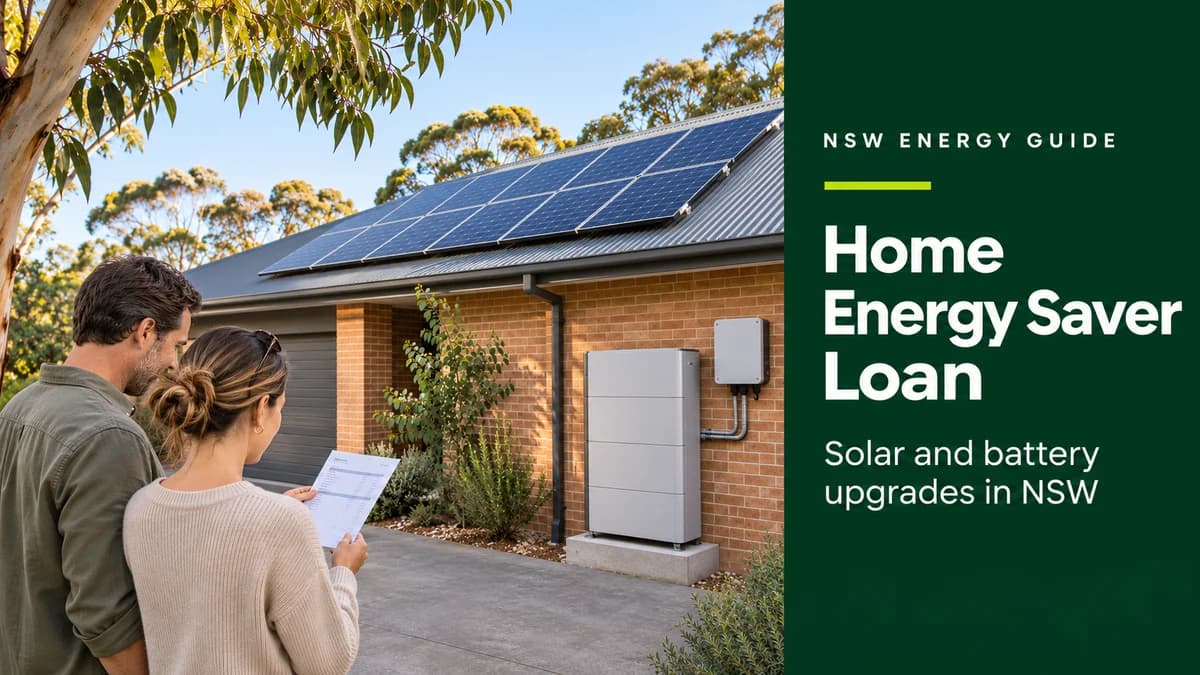
NSW Home Energy Saver Loan for Solar & Batteries | Kratos Energy
Planning rooftop solar or adding a battery to an existing system? See who qualifies for the NSW Home Energy Saver loan and which discounts can reduce the amount you borrow.
NSW Home Energy Saver loan for solar and batteries
If you own a home in NSW and your household’s combined taxable income is $150,000 a year or less, you may be eligible to borrow $2,000 to $15,000 at 0% interest through Brighte. Repayment terms extend to 10 years. You can use the loan for approved upgrades, including rooftop solar, a solar-and-battery system, or a battery for your existing solar panels. Brighte assesses each application. Check the NSW Government’s loan criteria. NSW Climate and Energy Action
Who can apply?
You may qualify for the Home Energy Saver loan by Brighte if you meet all of the following conditions. energy.nsw.gov.au
You own the NSW property where the upgrade will be installed. Both owner-occupiers and landlords can apply.
You are an Australian citizen or permanent resident.
The property owners listed on the rates notice have a combined taxable income of $150,000 a year or less.
The property is outside social and community housing and is not used for short-stay rental accommodation.
Your upgrade meets the program requirements, you use an approved supplier, and you meet Brighte’s credit criteria.
The $15,000 cap applies per property. If you are a landlord, you also need to confirm your tenant’s consent to the work. energy.nsw.gov.au
What does the loan cost?
Brighte loan feature | Amount or term |
|---|---|
Amount you can borrow | $2,000–$15,000 |
Interest rate | 0% |
Repayment term | Up to 10 years |
Establishment, weekly account-keeping and introducer fees | $0 each |
Late payment fee | $4.99 may apply to a missed repayment, capped at $49.90 a year |
Your supplier may require a deposit. Ask for an itemised quote that shows the deposit, any incentives and the balance you would borrow. View Brighte’s loan details. brighte.com.au
Home Energy Saver loans are funded by the NSW Government and delivered by Brighte. All applications are subject to Brighte’s credit approval criteria. Late payment fees, Terms and Conditions apply. Australian Credit Licence Number 508217.
Which upgrades can you finance?
If you are installing solar for the first time, you can seek finance for an approved rooftop system with or without a battery. If you already have panels, you can seek finance for an eligible battery installation. Other options through Brighte include eligible Level 2 EV chargers, heat-pump water heaters, reverse-cycle air conditioners, induction cooktops, double glazing and insulation. Availability depends on the product and approved suppliers servicing your area. brighte.com.au
For a battery retrofit, start by checking how much electricity you use after sunset and whether the battery will work with your existing inverter. Explore home battery options from Kratos Energy.
Can you combine the NSW loan with the federal battery discount?
Yes, if your installation meets both programs’ rules. The federal Cheaper Home Batteries Program can reduce the purchase price of an eligible battery connected to new or existing solar panels. The NSW loan can then finance the eligible amount left to pay. Ask your supplier to show the federal discount as a separate line on your quote so you can see exactly how much you would borrow. DCCEEW
The Australian Government describes the battery discount as around 30% across a range of systems. Your actual discount depends on the installation date, the battery’s usable capacity and the value of its small-scale technology certificates (STCs). Eligible batteries range from 5 to 100 kWh in nominal capacity. Only the first 50 kWh of usable capacity can earn certificates. DCCEEW
Portion of usable battery capacity | Share of the applicable STC factor from 1 May 2026 |
|---|---|
First 14 kWh | 100% |
Portion above 14 kWh and up to 28 kWh | 60% |
Portion above 28 kWh and up to 50 kWh | 15% |
For example, with a 24 kWh usable battery, the first 14 kWh earns certificates at the full factor and the remaining 10 kWh at 60% of that factor. These percentages determine the number of certificates. The installer’s quote shows what those certificates are worth in dollars. Read the federal battery program rules. DCCEEW
Is there a separate NSW discount?
Yes. Some households can receive a Home Energy Saver discount of up to $4,000 towards eligible upgrades at their principal residence. One eligibility pathway is a qualifying concession card. Another is combined gross household income of up to $80,000 a year, with an Australian citizen or permanent resident applying. Eligible renters can also apply with their landlord’s permission. NSW Climate and Energy Action
If you want both the NSW discount and the loan for the same purchase, apply for the discount first through Creditex. The federal Household Energy Upgrades Fund is another option for households comparing finance. It offers discounted loan products through participating lenders, each with its own terms. Check the NSW discount or explore federal finance options. NSW Climate and Energy Action
Who is eligible for the NSW Home Energy Saver loan?
How much can I borrow through Brighte, and are there any fees?
Can I use the loan to add a battery to my existing solar panels?
Can I combine the NSW loan with the federal battery discount?
Will the federal program take 30% off my battery quote?
Can I get the separate NSW discount of up to $4,000 as well?
How do I apply for the Home Energy Saver loan by Brighte?
Plan your solar or battery upgrade
Have a recent electricity bill handy? Use it to explore a system sized to your household, then ask for an itemised quote showing the equipment, installation cost and any available incentives. If you plan to use the Home Energy Saver loan by Brighte, check the supplier’s program approval before committing to the installation. Design my solar plan · Ask Kratos Energy for a solar or battery quote.
Solar System Packages
Tier 1 panels & CEC accredited installation.
- 475W Tier 1 solar panels
- 5kW power inverter
- 14 × 475W panels
- Single-phase compatible
- 475W Tier 1 solar panels
- 8–10kW power inverter
- 21 × 475W panels
- Battery & EV ready
- 475W Tier 1 solar panels
- 10kW power inverter
- 28 × 475W panels (13.3kW)
- Three-phase compatible