Solar, batteries and EV chargers for Kirrawee, Sutherland, Loftus, Kareela, Grays Point and Woronora — the whole 2232 postcode. Solar has no moving parts and makes no noise, which is its great virtue and its one genuine drawback: a system producing half of what it should looks exactly like one producing all of it. This page is about the first year of owning one, and the three checks that catch almost everything.
6.6kW systems starting from $7,410 (battery prices start from $4,290)
A production figure to check against — about 27 kWh a day for 6.6kW
A monitoring walkthrough at switch-on, not just a login handed over
Postcode 2232 sits in Zone 3 (rating 1.382), which sets your rebate
≈27 kWh
What a 6.6kW system averages per day across the year, at 4.1 kWh per kW
Network approval
We lodge your grid-connection application and confirm your export limit
Sutherland Shire Council
Most rooftop solar on houses here needs no council approval
Solar prices in Kirrawee
What solar costs in Kirrawee
These are estimated starting prices, not fixed quotes. Each package starts from the figure shown for a straightforward installation and already has the federal STC discount for postcode 2232 taken off. What your home actually costs depends on your roof, switchboard and connection — we confirm it in writing after a free assessment.
Anything that applies to your home is itemised in your written quote before you commit to it.
Prices start from the figures above, fully installed net payable after the federal STC rebate and including GST for metro areas (regional areas subject to freight and travel costs; T&Cs apply). Checked October 2026. STC figures use postcode 2232, 2026 deeming and an assumed $38 per certificate — the discount you receive depends on the certificate market on your installation date. Savings are modelled on typical usage and tariffs and are not a guarantee.
The first year
Your system is working. How would you know?
This is the question nobody is asked at switch-on, and the answer for most households is that they would not. Solar fails quietly: no noise, no leak, no smell. A string that has dropped out, a shaded panel dragging a row down, an inverter that restarts every afternoon — all of them look identical from the driveway, and all of them show up immediately in data you already have.
About 27 kWh a day
What a 6.6kW system averages across a year at 4.1 kWh per kW. It is an annual average rather than a daily target, so summer runs well above and winter well below — but if clear days are nowhere near it, there is something to chase.
A clean arc, not a jagged one
On a clear day production should climb smoothly to a midday peak and taper. Cloud puts spikes and dips in, which is ordinary. A notch at the same time every day is shade, a flat top is usually the inverter at its limit and expected, and a curve that stops partway through the afternoon is a fault.
Three numbers, once a month
Daily production against comparable days before it. The share you use rather than export, which is the figure you can actually change. And the inverter's status or error log, which most apps will show you and which reports faults before a bill does.
Compare this June with last June, never with December
Seasonal variation is large enough to hide a real fault and dramatic enough to invent one. A midwinter day can produce around a third of what the same system makes in midsummer, so a household that panics in July and relaxes in January has learned nothing either time. Comparing like with like is the whole discipline, and it is why the first year is mostly about building a baseline — after which the second year reads itself. If your system is older and you have never looked, or the monitoring login left with the installer, that is fixable: most inverters of the last decade can be connected to a portal, and an accredited installer can commission it and test the system in the same visit. We do that on systems we did not install, and it is the quickest way to find out whether the years you were not watching cost you anything.
Network rules change and every connection is approved on its own merits — we confirm the limit that applies to your address in writing before install day.
What is actually worth maintaining
Watching the numbers is most of the job, which is fortunate, because there is very little else to do. Be sceptical of anyone selling an annual panel clean on a Sydney roof. The three things that genuinely warrant attention are the monitoring, the electrical side — isolators, connectors and mounting hardware — and the inverter, which is the component that actually stops. Our Kings Langley page sets out what is worth paying for and what is not.
Home batteries attract two separate incentives. The federal Cheaper Home Batteries Program takes an estimated $3,402 off a 13.5 kWh battery, and NSW’s NSW VPP connection incentive (battery via federal program) can add more on top. Battery prices start from $4,290 fully installed after rebates (incl. GST for metro areas; regional areas subject to freight and travel costs). Already have solar? We check your inverter first — some systems take a battery as they are, others need a hybrid inverter.
≈ $3,402
Estimated federal rebate on 13.5 kWh of usable storage
+ NSW
NSW virtual power plant (VPP) incentive when you connect an eligible battery to a VPP, on top of the federal Cheaper Home Batteries discount. The NSW upfront battery discount ended for installs from 1 July 2025.
Size your solar for it now. Our 10kW package comes pre-wired for a battery and an EV charger, so adding one later is a small job rather than a rebuild.
We review your roof, shading, switchboard and a recent bill, and tell you what a system of the size we are proposing should produce — so you have a number to check against later.
Step 2
Written quote
A quote naming the panel and inverter models, the system size, the total price and what is excluded.
Step 3
Network approval
We lodge your grid-connection application and confirm any export limit before install day.
Step 4
Installation
Accredited electricians install, test and commission the system, then clean up. You are told who is coming.
Step 5
Switch-on and the walkthrough
Your retailer updates the meter and we set up monitoring — then we show you how to read it, what a good day looks like and what would make us want a phone call. Five minutes here saves a year of wondering.
Our work
Solar systems we have installed
Every install below is a real Kratos job, with the suburb and month it was completed. As we finish work around Kirrawee, those projects will appear here too.
South AustraliaNov 2026
Kratos Energy’s 5 MW Solar Project in South Australia
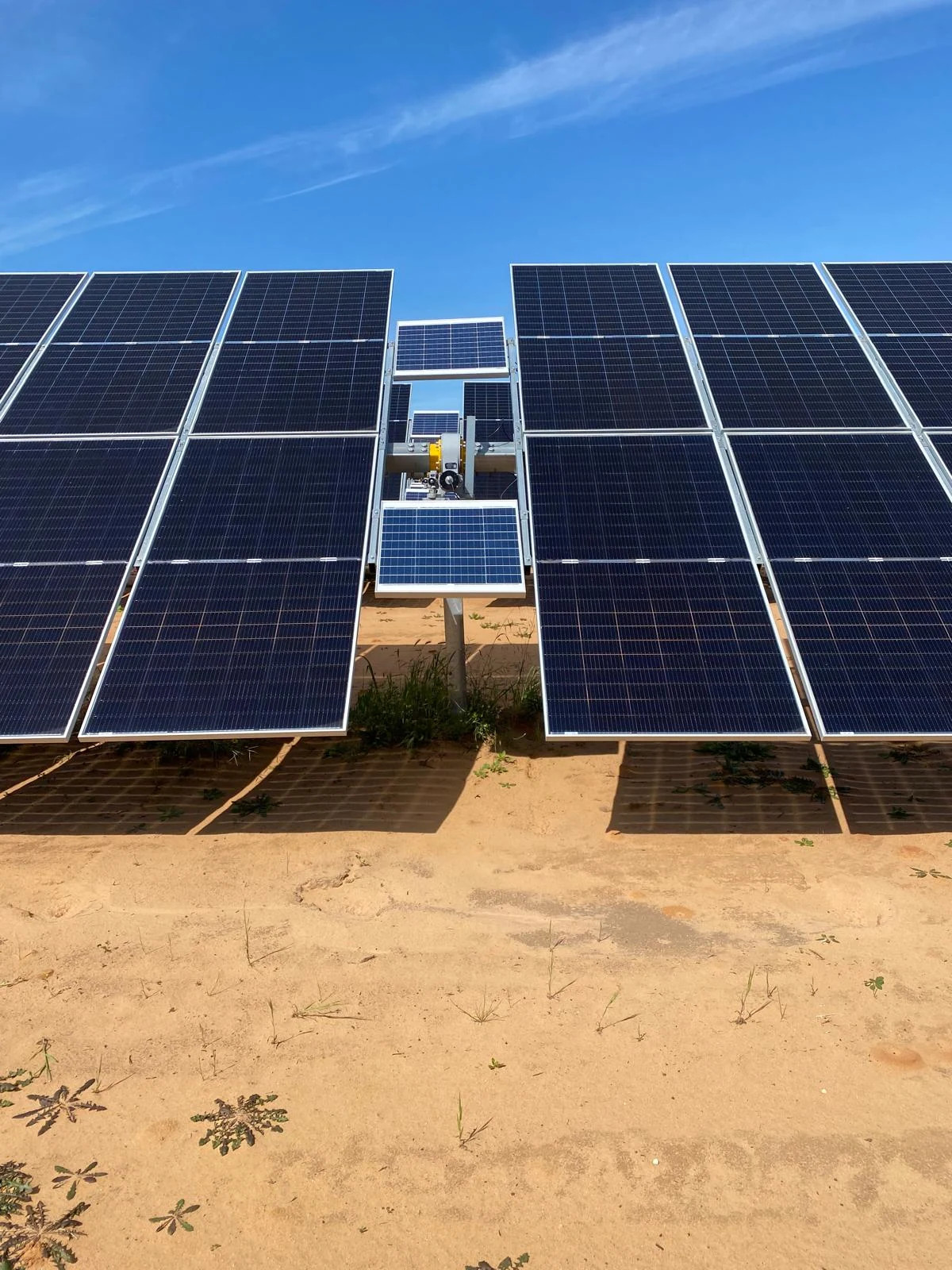
Kratos Energy’s 5 MW solar project in South Australia showcases renewable energy infrastructure at scale. Featuring ground-mounted solar arrays and dedicated electrical infrastructure, the project forms part of our commitment to developing large-scale solar opportunities across Australia.
The project photographs offer a closer look at the installation—from rows of solar panels to the supporting structures, cabling and electrical equipment behind the system.
Project at a Glance
Project detail
Overview
Location
South Australia
Capacity
5 MW
Project category
Large-scale solar
Installation type
Ground-mounted solar photovoltaic system
Featured infrastructure
Solar arrays, mounting structures, electrical equipment and control panels
A Closer Look at the Solar Installation
The site features rows of elevated solar panels arranged across open land, with access routes between sections of the installation. Ground-mounted systems allow the array layout to be planned around the site’s terrain, available space and maintenance requirements.
The photographs also show the underside of the arrays, including structural supports and cable routing. These less-visible components are an essential part of a solar installation, alongside the panels themselves.
Dedicated electrical enclosures and control equipment highlight the infrastructure required to support a project of this scale. Together, the images provide a practical view of the engineering involved in a large-scale solar site.
Large-Scale Solar Expertise
A solar farm requires coordination across site assessment, engineering, equipment selection, construction and network requirements.
Kratos Energy’s large-scale solar services cover solar farm development, engineering and construction support, grid connection coordination, and operational support. We work with landowners, investors and commercial partners to assess opportunities and progress renewable energy projects.
Explore our project portfolio to discover more of our solar and battery installations.
Discuss Your Next Solar Project
Have land suitable for solar development, a commercial energy requirement or a renewable energy project in mind?
Contact Kratos Energy to discuss your site, objectives and potential next steps.
Call 1300 089 547
“I am very happy to recommend Kratos Energy to anyone planning to install a solar panel and battery system at home. I found their pricing fair and affordable, and the service both before and on installation day was excellent. Thank you, Nessar and Wei.”
Robyn Brookfield · Google review
“Friendly and professional throughout the entire process. The contractors were trustworthy and kept us well informed from beginning to end.”
As an estimate, a 6.6kW system starts from $7,410, a 10kW system starts from $10,300 and a 13.2kW system starts from $11,250 (with battery prices starting from $4,290), with the STC discount for postcode 2232 already taken off (incl. GST for metro areas; regional areas subject to freight and travel costs). Those are starting estimates for a straightforward install, not a fixed price. The housing here is mixed enough that a switchboard upgrade is the most common addition, and it should be in the quote rather than discovered on the day.
What solar rebate can I get in Kirrawee (2232)?
Kirrawee is in STC Zone 3, rating 1.382. In 2026 a 6.6kW system creates 45 certificates, worth roughly $1,710 off the price, and a 10kW system 69 certificates, roughly $2,622. It is a discount applied at the point of sale, not a grant you apply for afterwards.
How do I know my system is actually working?
You look, and most people never do — which matters because the failure mode of solar is silence rather than noise. Nothing bangs, nothing leaks, and a system producing half what it should looks exactly like one producing all of it. The number to hold onto is what your system should make on an average day: at 4.1 kWh per kW, a 6.6kW system averages roughly 27 kWh across the year. That is an annual average rather than a daily target — summer runs well above it and winter well below — but if your monitoring is nowhere near it on clear days, something is worth chasing.
What should a normal day look like on the monitoring?
A smooth arc. Production starts after sunrise, climbs to a peak around the middle of the day and tapers off — and on a clear day the curve should be clean rather than jagged. Cloud puts sharp spikes and dips into it, which is normal. What is not normal is a flat top on a clear day, a notch at the same time every day, or a curve that simply stops partway through the afternoon. Those three shapes each mean something specific, and all three are worth a call.
What do those shapes actually mean?
A flat top usually means the inverter has reached its limit, which is expected on a well-designed system for a few hours and not a fault. A notch at the same time each day is almost always shade — a tree, an aerial, a neighbour's new addition — and it will drift through the year with the sun. A system that stops partway through the afternoon, or produces nothing at all on a bright day, is an inverter or a supply problem rather than a panel problem, and it is the one to act on quickly, because every day it sits dark is money.
How much should I expect production to drop in winter?
Substantially, and it is not a fault. Shorter days and a lower sun angle mean a midwinter day can produce around a third of what the same system makes in midsummer. The useful habit is comparing like with like — this June against last June rather than against December — which is the only way to tell a seasonal drop from a developing problem. A year of data makes the second year easy to read.
What are the three numbers worth watching?
Daily production, against what the system did on comparable days before. The share you use yourself rather than export, because that is what actually determines the value you get and it is the number you can change. And the inverter's own status or error log, which most monitoring apps will show you and which tells you about faults before a bill does. Checking those once a month takes a minute and catches almost everything that goes wrong.
My system is a few years old and I have never looked. Where do I start?
With whatever monitoring was set up at installation — and if nothing was, or the login is long gone, that is fixable. Most inverters of the last decade can be connected to a monitoring portal, and an accredited installer can commission it and test the system at the same time. We do this on systems we did not install. It is also the fastest way to find out whether the years you have not been watching cost you anything.
Who approves a solar connection in Kirrawee?
The distribution network that owns the poles and wires in your street approves it — not your retailer — and we lodge the application for you. On a flexible export connection, a complying system up to 30kW is automatically approved to export up to 10kW per phase. On a fixed export connection, the approval is 3kW per system. If your home has no reliable internet, exports are limited to a static 1.5kW per system until a connection is available — which is also, incidentally, why monitoring and the connection type are related questions.