
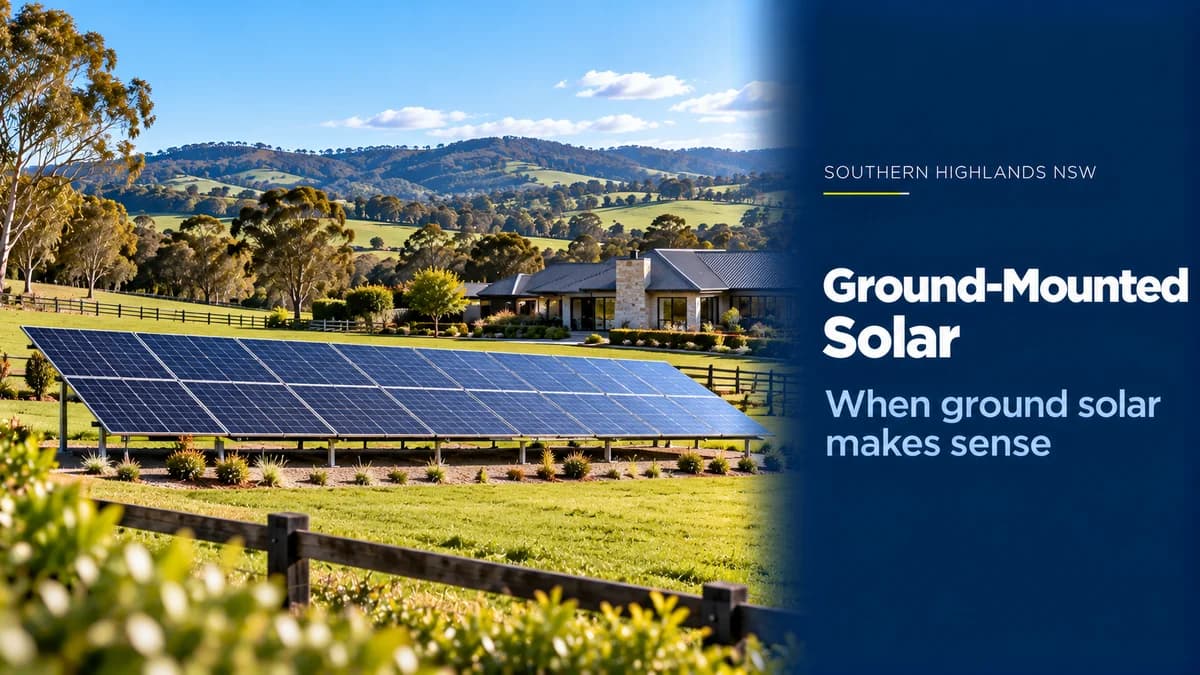
Ground-Mounted Solar Southern Highlands: 2026 Guide
Considering ground-mounted solar in the Southern Highlands? Learn about land, planning approval, orientation, cable runs, access, network connection and system sizing.
Ground-Mounted Solar in the Southern Highlands: When Does It Make Sense?
For properties across the Southern Highlands, rooftop solar is not always the only option.
See solar in the Southern Highlands for the whole region, or the local pages for Mittagong, Moss Vale and Robertson.
A home, acreage property, farm or business may have:
Limited usable roof area
Heavy roof shading
An older roof
Poor roof orientation
Large electricity consumption
Substantial unused land
Sheds located far from the main building
Future battery or EV requirements
In these situations, a ground-mounted solar system may deserve investigation.
Ground mounting allows the solar array to be positioned independently of the building, potentially improving:
Orientation
Tilt
Panel quantity
Maintenance access
Shade avoidance
Future expansion
But ground-mounted solar introduces issues that rooftop systems often do not:
planning + land use + foundations + trenching + long cable runs + property access + vegetation + network connection.
Kratos Energy's current company information confirms experience across residential and commercial solar through to ground-mounted solar farms, EPC and large-scale renewable projects, making ground-mounted work part of its broader renewable-energy capability. (kratos-energy.com)
Explore Kratos large-scale solar capabilities
Ground-Mounted Solar: Quick Assessment Checklist
What to Check | Why It Matters |
Available land | Determines practical array size |
Solar access | Trees, hills and buildings can create shade |
Orientation | Ground mount allows more design flexibility |
Planning pathway | Approval requirements depend on site and system |
Land zoning | Rural, residential and heritage constraints may differ |
Cable distance | Long runs can increase cost and electrical losses |
Main switchboard | Determines connection point |
Network approval | Controls inverter/export arrangements |
Ground conditions | Affect foundations and mounting method |
Vehicle access | Needed for installation and equipment delivery |
Vegetation | Must not shade the array over time |
Future expansion | Ground mounting can allow staged growth |
The strongest site is therefore not simply the largest empty paddock.
It is the location that balances:
sunlight + land use + electrical distance + approvals + access.
When Ground-Mounted Solar Can Make More Sense Than Rooftop Solar
1. Your Roof Is Heavily Shaded
Established trees are common across parts of the Southern Highlands.
A roof may receive substantial winter shade from:
Tall trees
Nearby buildings
Hills
Chimneys
Complex roof sections
Moving the array into an open section of land can potentially provide better year-round solar access.
This can be particularly valuable in the Southern Highlands because winter already delivers materially lower solar exposure than summer.
Kratos' existing guide to winter solar output in Mittagong explains why seasonal shade and the lower winter sun angle should be considered during solar design. (kratos-energy.com)
Read the Kratos Mittagong winter solar guide
2. The Roof Is Too Small
A home might have enough roof space for:
6.6kW
while the property electricity profile suggests that:
10kW, 13kW or more
deserves investigation.
A ground-mounted array can potentially provide the additional area needed without forcing panels onto:
Heavily shaded roof faces
Poorly oriented areas
Small roof sections
Roofs occupied by skylights or chimneys
The correct size should still be based on electricity consumption—not simply available land.
3. The Roof Needs Replacement
Solar panels can remain installed for decades.
Installing them on a roof likely to require replacement soon can create future removal and reinstallation costs.
For an acreage property where suitable land is available, ground mounting may allow the solar project to proceed independently from future roofing work.
4. You Want Better Panel Orientation
Roof-mounted solar is constrained by the direction and pitch of the existing building.
Ground mounting can provide greater control over:
Orientation
Tilt
Row spacing
Shade avoidance
That can help optimise annual generation.
However, the goal should not always be to maximise midday output.
The system orientation should still reflect:
Household usage
Morning loads
Afternoon loads
Battery charging
Export limits
Solar design should match the property's energy profile, not simply point every panel in one direction by default.
Rooftop vs Ground-Mounted Solar
Factor | Rooftop Solar | Ground-Mounted Solar |
Uses existing structure | Yes | No |
Requires free land | No | Yes |
Orientation flexibility | Limited by roof | High |
Tilt flexibility | Limited | High |
Installation foundations | Roof mounting | Ground foundations |
Cable runs | Often shorter | Can be much longer |
Planning complexity | Often simpler | Can be greater |
Maintenance access | Roof access needed | Usually easier |
Expansion | Limited by roof | Potentially easier |
Vegetation management | Usually less | More important |
Neither approach is automatically superior.
Some Southern Highlands properties may even benefit from:
roof solar + ground-mounted extension
where the electrical design and network approval support it.
Planning Approval Must Be Checked Before Installation
Ground-mounted solar is not simply:
“Put the panels somewhere in the paddock.”
NSW Planning states that solar energy systems may qualify as either exempt or complying development under the State Environmental Planning Policy (Transport and Infrastructure) 2021 when all relevant standards are met.
If a proposal does not meet the relevant exempt or complying-development requirements, another approval pathway—including development consent—may be required.
Wingecarribee Shire Council specifically advises property owners to determine:
Whether approval is required
What is permissible on the property
Which Local Environmental Plan controls apply
Which Development Control Plan applies
before development work begins.
For ground-mounted solar, check planning before finalising the installation contract.
Why Land Zoning Matters
The Southern Highlands includes a mixture of:
Residential land
Rural residential properties
Agricultural land
Environmental areas
Heritage properties
Commercial land
Tourist accommodation
Planning controls can therefore differ substantially between properties.
Wingecarribee Council maintains specific Development Control Plans for different zones and identifies separate controls for rural lands including RU1 Primary Production, RU2 Rural Landscape, C3 Environmental Management and SP3 Tourist areas.
So a system proposed on a large rural property outside Moss Vale may face a different planning context from one proposed behind a residential property in Bowral.
Do not assume that acreage automatically means unrestricted solar development.
Heritage Can Change the Assessment
The Southern Highlands contains many heritage properties and heritage conservation areas.
Wingecarribee Council notes that solar installations on heritage properties can have additional visibility and planning considerations.
For ground-mounted solar, the assessment may need to consider:
Visibility from public roads
Heritage significance
Landscape character
Existing vegetation
Location relative to heritage buildings
A visually prominent ground-mounted array may therefore require a different design from one screened within a larger rural property.
If the property is heritage-listed or within a conservation area, check the planning pathway before assuming the system is exempt.
1. Start With the Electricity Load
Before choosing land for the array, understand how much electricity the property uses.
Collect:
12 months of electricity bills
Smart-meter data where available
Daytime consumption
Evening consumption
Seasonal differences
Major equipment loads
For rural or commercial properties, major loads may include:
Pumps
Workshops
Refrigeration
Machinery
Pool equipment
Electric heating
EV charging
Accommodation facilities
Ground mounting creates space for larger systems.
That does not mean a larger system is automatically financially stronger.
Worked Example: Southern Highlands Acreage
Consider a hypothetical acreage home outside Moss Vale.
Electricity consumption
32kWh/day average
House roof
Suitable for approximately:
6.6kW
but affected by winter tree shade.
Open paddock
Good solar exposure with enough room for a larger array.
Proposed ground-mount location
Approximately:
45 metres from the main switchboard.
The homeowner is considering approximately 10kW of ground-mounted solar.
Before deciding, the installer should assess:
Planning pathway
Shade
Orientation
Ground conditions
Cable route
Trenching requirements
Voltage rise
Network connection
Future battery plans
Vehicle and machinery access
The system cannot be properly priced from the number of panels alone.
Cable Distance Can Significantly Change the Project
This is one of the biggest differences between rooftop and ground-mounted solar.
A rooftop inverter might sit only several metres from the switchboard.
A ground array could be:
30m
50m
100m
or further away.
Longer electrical runs may require:
Larger cable
Additional conduit
Trenching
Electrical protection
More installation labour
The Australian Government identifies extended cabling among the factors that can increase the cost of solar installations.
This is why the most distant sunny paddock is not automatically the most economical location.
Example: Two Ground-Mount Locations
Consider two possible array sites.
Location A
Distance from switchboard:
25m
Solar exposure:
Very good
Minor tree shade late afternoon
Location B
Distance:
110m
Solar exposure:
Excellent
No shade
At first glance, Location B appears better.
But once the project includes:
Trenching
Larger cable
Conduit
Additional labour
Location A might deliver a stronger overall result.
The design should compare:
additional solar generation vs additional electrical infrastructure cost.
Ground Conditions Matter
Unlike rooftop systems, ground-mount structures need foundations.
The appropriate mounting solution can depend on:
Soil type
Rock
Slope
Drainage
Ground stability
Wind exposure
Potential foundation approaches can include:
Driven posts
Screw piles
Concrete footings
Engineered mounting structures
The correct method depends on the site and structural engineering requirements.
This is one reason ground mounting should be professionally assessed before final pricing.
Sloping Land Needs Extra Attention
The Southern Highlands contains many properties with uneven terrain.
A steep or irregular site can affect:
Panel-row layout
Foundation design
Machinery access
Drainage
Installation labour
Maintenance access
Do not assume a large sloping paddock provides the same usable solar area as flat land.
Usable land matters more than total land area.
Vegetation Needs to Be Managed for the Life of the System
A ground-mounted array is much closer to:
Grass
Weeds
Shrubs
Growing trees
than rooftop solar.
The installation design should consider how vegetation around and beneath the array will be maintained.
Poor vegetation control can eventually create:
Shade
Restricted maintenance access
Moisture accumulation
Fire-management concerns
The aim is not to unnecessarily clear large areas.
It is to design the array in a location where long-term vegetation management is practical.
Do Not Remove Trees Solely Because You Want More Solar
Established vegetation can have:
Environmental value
Landscape value
Planning protection
Heritage relevance
Tree and vegetation work may require approval depending on the property and applicable controls.
Where possible, ground-mounted solar should first be designed around productive open land rather than assuming surrounding trees can simply be removed.
Property Access Can Affect Installation Cost
Ground-mounted arrays require materials and machinery to reach the site.
Assess:
Driveway access
Gate width
Steep terrain
Soft ground
Creek crossings
Existing fences
Machinery turning space
Distance from unloading area
A location that looks perfect on satellite imagery may be expensive or difficult to access physically.
For a large array, logistics become an important part of the site assessment.
What About Livestock?
Where ground-mounted solar is proposed on a working rural property, the owner should discuss:
Fencing
Livestock access
Panel height
Cabling protection
Maintenance routes
with the system designer.
Do not assume livestock should have unrestricted access underneath electrical equipment.
The installation and land-management plan should be designed for the actual property use.
Ground Mount and Land Productivity
For farms or rural businesses, another important question is:
What is the land currently used for?
Installing solar on a highly productive area may have a greater opportunity cost than using:
Lower-value open land
An unused paddock section
Land near existing electrical infrastructure
The financial assessment should therefore include both:
energy value + land-use value.
This becomes increasingly important as system scale increases.
Kratos and Ground-Mounted Solar
Kratos' current public information states that the company's renewable-energy experience extends from:
residential and commercial rooftops
through to:
ground-mounted solar farms and megawatt-scale infrastructure.
Kratos also lists:
Solar farm development
Engineering, Procurement and Construction
Grid-connection coordination
BESS integration
Project development
within its large-scale capability.
That means ground-mounted opportunities requiring more than a standard residential layout can be assessed within Kratos' broader engineering capability.
View Kratos large-scale solar solutions
Ground Mount Does Not Automatically Mean “Solar Farm”
This distinction matters.
A ground-mounted system could be:
Residential/Acreage
10–20kW supplying one property.
Commercial
30–100kW+ supplying a business.
Larger Project
Hundreds of kilowatts or megawatts.
The approval, electrical design and commercial structure become increasingly complex as system scale increases.
A homeowner considering a modest ground array should not assume they are entering the same development process as a multi-megawatt solar farm.
But both still require proper site assessment.
Network Connection Still Applies
Moving panels onto the ground does not bypass electricity-network rules.
The Southern Highlands is served by Endeavour Energy, including communities such as Bowral, Mittagong and Moss Vale.
The network connection still determines:
Inverter capacity
Export settings
Metering
Technical requirements
A property may have room for a very large array while the existing electricity connection supports something smaller without further network work.
The solar design therefore needs to consider:
land capacity + electrical capacity.
Should You Add a Battery?
A battery may be worth investigating where the ground-mounted array produces substantial surplus electricity during daylight hours.
For example:
Solar surplus:
12kWh/day
Evening grid imports:
10kWh/day
That could provide a reasonable basis for storage modelling.
But ground mounting alone does not make a battery necessary.
If the property consumes most of the solar directly during the day, storage may provide less additional value.
Battery sizing should follow:
solar surplus + evening consumption + backup requirements.
Explore Kratos battery storage
Ground-Mounted Solar and Winter Generation
Seasonality matters in the Southern Highlands.
Ground mounting provides an advantage because the designer has greater freedom to select panel tilt and orientation.
However, winter generation will still be lower than summer because:
Days are shorter
Solar exposure is lower
The sun sits lower
Kratos' Mittagong guide uses Bureau of Meteorology data showing significantly lower average solar exposure during June than January.
So even a well-oriented ground-mounted array should be evaluated using annual generation, not just ideal summer conditions.
What Should Be Included in a Ground-Mount Quote?
Before approving the project, ask whether the quote includes:
Solar Equipment
Panels
Inverter
Monitoring
Mounting structure
Civil Works
Ground preparation
Foundations
Posts/piles
Excavation
Electrical
Trenching
Conduit
AC/DC cable
Switchboard work
Protection equipment
Planning
Planning assessment
Required documentation
Applicable approvals
Network
Connection application
Metering
Export configuration
Site
Access requirements
Vegetation considerations
Fencing where necessary
A quote that only lists:
panels + inverter
may not represent the complete cost of a ground-mounted installation.
Ground-Mounted Solar Checklist for Southern Highlands Properties
Before committing, confirm:
Land
Is there enough usable space?
Is the location productive or important agricultural land?
Is the terrain practical?
Solar
Orientation
Tilt
Annual shade
Expected generation
Planning
Land zoning
Exempt/complying eligibility
Heritage considerations
Whether a DA is required
Electrical
Distance to switchboard
Trenching
Cable sizing
Voltage rise
Supply phase
Network
Approved inverter capacity
Export arrangement
Metering
Future
Battery
EV
Additional buildings
System expansion
A proper ground-mount proposal should answer all of these questions before installation begins.
Frequently Asked Questions
Can I install ground-mounted solar in the Southern Highlands?
Does ground-mounted solar require council approval?
Is ground-mounted solar better than rooftop solar?
Can I install panels in a paddock?
How far can solar panels be from the house?
Is ground mounting suitable for an acreage home?
Can Kratos install ground-mounted solar?
Can a battery be connected to a ground-mounted solar system?
Ground-Mounted Solar in the Southern Highlands: The Bottom Line
For a Southern Highlands property, ground-mounted solar can provide a strong alternative where rooftop solar is limited by:
shade + roof area + orientation + roof condition.
But the system needs more than open land.
A good ground-mount project follows:
Energy use → land assessment → planning → solar design → cable route → network approval → final system size.
The best array location is not necessarily the point with the most sunlight.
It is the location that delivers strong generation while remaining practical for:
Planning
Land use
Electrical connection
Installation
Maintenance
For smaller acreage systems, that may mean a carefully placed array near the home.
For larger commercial or rural projects, it may require engineering, planning and network coordination similar to a small solar-development project.
Explore Kratos large-scale and ground-mounted solar capability
View Kratos residential solar options
Read about winter solar output in Mittagong
Contact Kratos Energy for a site-specific assessment
Ground-mounted solar gives you more freedom to choose where the panels go—but that freedom only creates value when the land, approvals and electrical design all work together.
Solar System Packages
Tier 1 panels & CEC accredited installation.
- Trina 475W or Jinko panels
- 5kW power inverter
- 14 × 475W panels
- Single-phase compatible
- Trina 475W or Jinko panels
- 8–10kW power inverter
- 21 × 475W panels
- Battery & EV ready
- Trina 475W or Jinko panels
- 10kW power inverter
- 27 × 475W panels
- Three-phase compatible